Cultural facilitie
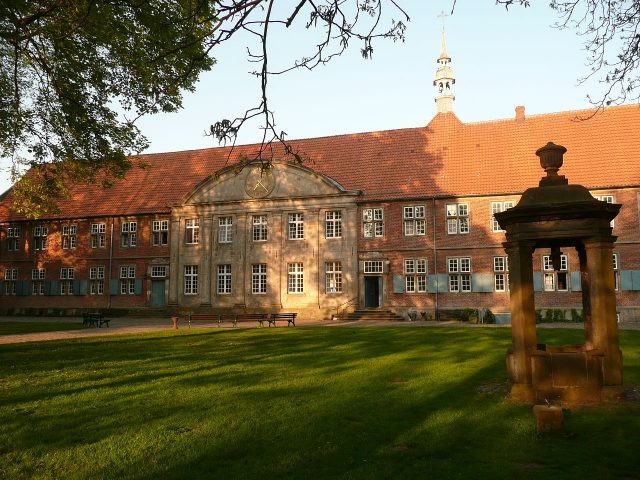
Frenswegen Abbey

Frenswegen Monastery, formerly the Augustinian Canons Regular monastery founded in 1394, is officially named Sankt Marienwolde. It is located in Frenswegen, surrounded by several old farmhouses, on the north-western edge of the Lower Saxon city of Nordhorn in the County of Bentheim.
Frenswegen was the first German monastery to join the Windesheim Congregation in 1400. In 1974, an ecumenical meeting place was established in the monastery building.
Name and Patronage+
The name Kloster Frenswegen, commonly used today after the field name, only became customary from the 16th century onwards.
The monastery was called "Monasterium nemoris beatae Maria virginis" in Latin sources and "Marienwalde" or "Marienwolde" in German sources; other names were "Vrendeswede", "Hain der Heiligen Jungfrau Maria" (Grove of the Holy Virgin Mary) or even "Paradies Westfalens" (Paradise of Westphalia). The official name is St. Marienwolde after its patroness, the Virgin Mary.
Location+
The monastery is located near the city of Nordhorn in the former farming community of Frelstrup on the grounds of the Einolding farm.
Middle Ages to the Thirty Years' War
On January 17, 1394, the physician and priest Everhard van Eze from Almelo in the Netherlands, the priest of Schüttorf, Heinrich von Marklo, known as Krull, the citizen of Schüttorf Johann Monike, and the citizen Rembert van Goer from Zwolle in the Netherlands bought the peasant inheritance Eynolding in the parish of Nordhorn and in the farming community of Frenstorpe on the Frendeswege from Count Bernhard I of Bentheim and founded a monastery according to the rules of St. Augustine.
In 1396, Count Bernhard I of Bentheim transferred two peasant inheritances to the monastery. Between 1396 and 1498, the monastery acquired a total of about 80 peasant inheritances through purchase or donations.
In 1400, by decree of Pope Boniface IX, the monastery was affiliated with the Windesheim Congregation and thus directly subordinate to the Pope.
In 1436, the foundation stone for the monastery church was laid. This church, built of sandstone and brick, was consecrated in 1445.
For the year 1451, 24 canons, three conversi (lay brothers), four clerics, ten donates, 57 lay brothers engaged in crafts and agriculture, six Frenswegen lords working externally, and 33 farm laborers working in the wider area are attested.
During the Reformation, the comital house of Bentheim converted to the Lutheran confession and subsequently caused great difficulties for the monastic convent, which remained Catholic. In 1560, the Count forbade the convent from accepting new novices.
In 1578, the monks acquired the castle in Nordhorn and moved there in 1580 due to the insecure situation during the war. Count Arnold II of Bentheim issued a new, reformed church order in 1588.
In the vacant monastery building, images were stolen and the furnishings severely damaged in 1595. Several relics were brought to Münster from the demolished altars of the monastery church.
At the beginning of the Thirty Years' War, the convent consisted of only one member.
Until Secularization
The reconstruction and renovation of the monastery buildings began in 1641, and the convent returned to the monastery building in Frenswegen in 1655 after the end of the war. In 1692, the conversion of the monastery building began.
The monastery now experienced a second flourishing period under the patronage of Prince-Bishop Christoph Bernhard von Galen. Under his influence, Count Ernst Wilhelm von Bentheim also converted to Catholicism in 1668. By 1700, the convent already consisted of seven priests, two conversi, and 19 people working externally (Expositi). The surroundings of the monastery also underwent significant structural changes. Several buildings, some of which still stand today, as well as a grain water mill, were built near the monastery. An extensive system of avenues was laid out, in particular the avenue leading to the west front of the monastery, today's Fuchsweg. In 1719, the convent settled about eleven Heuerleute (tenant farmers) on the Hovesaat Frenswegen.
The renovation work begun in 1692 ended in 1725. Two years later, in 1727, a building was already erected again on the monastery courtyard wall. In 1742, the entire complex of convent buildings was completed with the finishing of the west facade. In this form, the complex existed for about 140 years until the fire in 1878.
The convent survived the Seven Years' War from 1756 to 1763 and the French Revolutionary War from 1792 to 1802 unscathed. With the beginning of the Napoleonic War in 1803, France took possession of the County of Bentheim and the Windesheim Congregation was dissolved.
Until the First World War
On May 5, 1804, Count Ludwig zu Bentheim and Steinfurt concluded the so-called Treaty of Paris with Emperor Napoleon I. This reinstated the Count in the government of the County of Bentheim. He paid a redemption sum of 800,000 francs and took over control of Frenswegen Monastery.
Baron Droste zu Senden's application for admission to the monastery in Frenswegen failed in 1806 due to the Count's intentions to dissolve the monastery. The members of the monastery were offered pensions, free right of residence, and free use of the gardens, fishing, and hunting by the Count.
On August 4 of the same year, the Grand Duchy of Berg, under Grand Duke of Cleve and Berg, took over the County of Bentheim and the monastery and was placed under the Landdrost von Elverfeldt. Three days later, on August 7, Count Westerholt revoked the Bentheim dissolution decree of the monastery.
In 1808, the monastery comprised eleven people and a French clergyman, all of whom were priests except for one person. The convent owned 47 dependent peasant inheritances in the parishes of Schüttorf, Nordhorn, Veldhausen, Uelsen, Emlichheim, Ootmarsum (NL), Oldenzaal (NL) and in Münsterland the Stuvenburg estate, the castle in Nordhorn and the Hovesaat located near the monastery with 17 tenant dwellings.
Three years after the comital attempt at dissolution, the monastery was finally dissolved by the government of the Grand Duchy of Berg. Rumors of an impending unification of the County of Bentheim with the Kingdom of Holland aroused hopes for a reinstatement of Frenswegen by the Dutch king.
When the Napoleonic War ended, the French, before their departure, sold Frenswegen Monastery, including the church and the entire Hovesaat, to the highest bidder for 196,000 francs to a company called Männisten, whose main figures were Messrs. van Lennep and Tencaten from Almelo. The pastor of Neuenhaus and Frenswegen Canon Esseling was commissioned by Bishop Baron Spiegel zu Diesenberg to distribute the sacred objects to other churches and to receive the relics from the altars. The pastor of Nordhorn received the promise for the main altar, the organ, the Calvary, the flags, twelve benches, etc. From spring to autumn, individual peasant inheritances were sold. In November, the Hanoverian government returned to the County after the French withdrawal and declared on December 19 that all laws enacted under enemy occupation since 1804 were invalid. However, the dissolution of the monasteries of Frenswegen and Wietmarschen was not reversed. The pensions of the House of Frenswegen were set at 600 Dutch Guilders.
The last canon of the convent left the monastery in 1815 and the buildings stood empty. Eight years later, for the relinquishment of sovereign rights, the Kingdom of Hanover ceded the monastery buildings, together with an area of approximately 131 hectares around the monastery, as well as hunting and fishing rights, to the princely house of Bentheim and Steinfurt.
In the spring of 1824, Johann Hund, the long-serving foundry master at the St. Michaelis ironworks near Bocholt, approached Prince Alexis zu Bentheim and Steinfurt with a plan to establish an iron smelter in the monastery buildings. In August 1825, a preliminary contract for the construction of this ironworks was concluded. With the exception of the church, all parts of the building were to be used. The construction of a weir on the Vechte failed due to the economic utilization of the Vechte gradient.
A fire in the monastery library in 1855 destroyed irreplaceable holdings. After numerous books had disappeared from the library in previous years, the remaining stock was secured and brought to the domain chamber of the Prince zu Bentheim and Steinfurt in Burgsteinfurt. Afterwards, about 600 French prisoners of war were housed in the monastery building. The remaining stock of the library, which had been moved to the domain chamber in Burgsteinfurt, was donated to the University of Strasbourg, where it is still located today.
During the Franco-Prussian War of 1870/71, up to 450 French prisoners of war were interned in the monastery buildings. Seven prisoners died from a smallpox infection and were buried near the monastery complex, close to the former church. In the 1960s, a memorial was erected there, popularly known as the French Cemetery.
Fires in 1878 and 1881 destroyed part of the monastery building and the monastery church. In 1905, two apartments for customs officers were set up in the abandoned monastery building.
The ruin of the monastery church, damaged by lightning, was demolished in 1910–1911. A modern church building was erected on the same site from 1994 to 1996.
The Two World Wars
The poet Erika Lichte, daughter of the princely district forester Georg Carl Ernst Lichte who lived here, was born in Frenswegen in 1900 and spent her youth here until 1925. During this time, she wrote numerous poems and verses.
Temporarily, in 1915, sixty Russian prisoners of war were quartered in the building and deployed as harvest helpers in the farming communities of Frenswegen, Frensdorf, Bookholt, and Altendorf. In 1918, a customs office with officials from the Imperial Finance Administration was established in the monastery building. After the war, four customs apartments were set up. At the same time, the princely custodian and several textile workers from textile companies in Nordhorn lived in the building.
In 1936, a women's labor service camp was established in the south wing. During the National Socialist era, the Hitler Youth made use of the house and called it "Hans-Queitsch-Heim". Meanwhile, the Prince, the local history association, the city of Nordhorn, and the district administration of Grafschaft Bentheim sought possibilities for using the entire building. Suggestions for use as a museum, youth hostel, or hotel were, however, rejected.
Post-War Period to Today
After the end of the Second World War, British occupation troops were housed in the monastery building for three months. After the troops withdrew, the city of Nordhorn made a larger number of apartments in the building available to refugees and displaced persons. Furthermore, until the mid-1960s, the princely-Bentheim district forester lived in the rooms of the south wing as custodian of the monastery buildings.
Nordhorn high school graduate and current religious scholar Burkard Sauermost (* February 9, 1947) wrote a voluntary annual paper on the history of Frenswegen Monastery in February 1966 in the subject of social studies (history). In this work, accompanied by his class teacher Hermann Heddendorp, he suggested the formation of a "Foundation for Ecumenical Diakonia". On May 21, 1974, the Frenswegen Monastery Foundation was established to create an ecumenical meeting place, to which Christian Prince zu Bentheim and Steinfurt, as the previous owner, transferred the monastery building with outbuildings and the associated property. The total value of the donation was approximately 2.1 million DM. The Evangelical Reformed Church in the Synodalverband Grafschaft Bentheim contributed financially to the foundation. The district of Grafschaft Bentheim took over the renovation of the buildings. Here, the Evangelical Lutheran and Reformed congregations of Grafschaft Bentheim, the Roman Catholic congregations of Grafschaft Bentheim, the Classis Bentheim of the Evangelical Old Reformed Church in Lower Saxony, the Evangelical Free Church congregation, and the Moravian Church joined forces for common work.
After the conversion and renovation work, new life in the spirit of the foundation's project moved into the monastery on December 15, 1978 – with the handover of the buildings by the district of Grafschaft Bentheim as the developer to the foundation. The opening was celebrated festively in May 1979. The total construction costs amounted to 8.2 million DM. In 1996, the monastery's new chapel, built according to plans by architect Hans Busso von Busse, was consecrated.
Take Mobile History with you
You are reading this text for free. Premium adds what matters on the road: descriptions read aloud, sites found through your camera, whole regions taken offline.
- Every description, including the ~17,700 Premium sites
- Audio guide: have descriptions read to you on location
- AR finder: see sites through your camera, with distance and bearing
- Unlimited saved sites
14 days free, then from €2.99 a month. Cancel anytime.
Source: Wikipedia · Licence: CC BY-SA 4.0 · Image: http://commons.wikimedia.org/wiki/File:Kloster_Frenswegen_April_2009_037.jpg?uselang=de
This description draws on the facts documented in the linked Wikipedia article; Wikipedia content is licensed under CC BY-SA 4.0. Wording and editing: Mobile History.
Location: 52.4546, 7.0391