MonasteryGravenhorst

Gravenhorst Abbey

Gravenhorst Abbey

Restaurant

Cultural Events

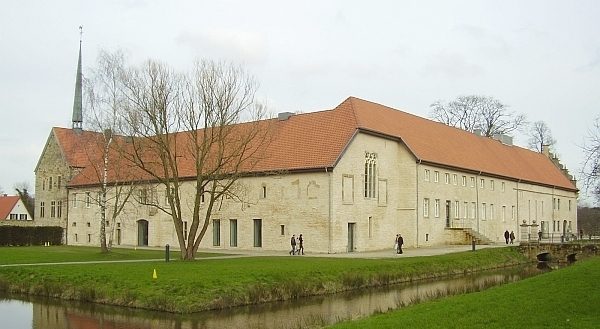
Gravenhorst Abbey is a former Cistercian nunnery in the Gravenhorst hamlet of Hörstel in the Steinfurt district (North Rhine-Westphalia).

Knight Konrad von Brochterbeck founded the monastery in 1256 together with his wife Amalgarde von Budde and endowed it with land by gifting an estate including a fish pond, as well as forests and meadows. His only daughter Oda became the first abbess, and in the following period, she managed to increase the monastery's possessions and ensure that her order, although not officially recognized, was nevertheless tolerated.

But times were turbulent. The nuns of Gravenhorst Abbey not only had to defend themselves against attacks by secular lords, but there were also constant disputes with the General Chapter of the Cistercians, who always disapproved of the great independence of the Gravenhorst nuns and their close contact with their secular environment. Nevertheless, the small community managed to maintain its independence and assert its interests against all resistance until the beginning of the 19th century.

In 1764, the nuns founded a school for daughters of higher standing from both denominations, thus reinforcing their position as a necessary institution for the well-being of the surrounding settlements. Parts of the teaching materials from that time are still preserved today in the valuable Gravenhorst monastery library, which also contains several manuscripts from the 12th and 13th centuries.

After the Reichsdeputationshauptschluss (Imperial Deputation Act) of 1803, the monastery was initially continued for another five years under secular leadership, but was finally dissolved in 1808. In 1811, the last Cistercian nuns left the abbey.

Numerous changes of ownership and different uses of the monastery buildings followed. Most recently, a mushroom farm was housed there, before the Kloster Gravenhorst e.V. association bought the complex in 1986 and subsequently handed it over to the Steinfurt district.

Today, the Förderverein Kloster Gravenhorst e.V. (Friends of Gravenhorst Abbey) association is dedicated to the preservation of the buildings and their use. Since 2004, the complex has housed, in addition to a restaurant, the Kunsthaus Kloster Gravenhorst, which is dedicated to cultural education. With this goal, exhibitions, workshops, concerts, theater performances, and readings take place there.

The Buildings+

The monastery complex was destroyed and rebuilt several times during its existence, so its exterior was often permanently altered. The appearance of today's buildings dates back to the 18th century. Nevertheless, Gravenhorst Abbey in its entirety is almost completely preserved and thus represents one of the few still completely existing monastery complexes in northern Germany.

Already in 1317, the complex was damaged by a fire. This incident was followed by numerous other destructions. Between 1618 and 1623 alone, the monastery was attacked and plundered 13 times during the Thirty Years' War.

In 1999, initial plans for the renovation and restoration of the buildings began, which took place from 2000 to 2004.

Monastery Church of St. Bernhard

The Gothic monastery church was completed in 1300 and is the oldest preserved part of the monastery. Following the strict rules of the Cistercian order, it is an unadorned house of worship without a church tower. The bells hang in a simple roof turret. Inside the church is the high altar, which was made by the Rheine sculptor Heinrich Meiering in 1641. The pulpit dates from around 1700.

Main Building

The two-winged main building adjoins the monastery church to the south. Its west wing was rebuilt in 1817 in the classical style after a fire, incorporating old building elements. Remains of an old Gothic cloister are still preserved from its predecessor building. The chapter house is the only room in the monastery complex that is still preserved in its original condition.

The south wing of the main building probably dates from the 15th century. It has a two-winged portal with a projecting open staircase and a Gothic cellar vault. After destructions in the Thirty Years' War, it was extended to the east and equipped with a stepped gable in the Renaissance style.

Outdoor Facilities

South of the east wing is the brewery and bakery, whose core substance dates back to the Middle Ages, but which also shows architectural features of the 17th century on the outside. The mill belonging to the monastery is also still preserved, while only foundations remain of the former forge building.

In 1643, the nuns also bought a heavily indebted citizen's town house in Bevergern, where they could seek refuge in dangerous situations via the so-called Nonnenpättken (Nuns' Path).

The monastery complex is surrounded by spacious gardens and forest areas, which are a popular excursion destination today.

Take Mobile History with you

You are reading this text for free. Premium adds what matters on the road: descriptions read aloud, sites found through your camera, whole regions taken offline.

  • Every description, including the ~17,700 Premium sites
  • Audio guide: have descriptions read to you on location
  • AR finder: see sites through your camera, with distance and bearing
  • Unlimited saved sites

14 days free, then from €2.99 a month. Cancel anytime.

Source: Wikipedia · Licence: CC BY-SA 4.0

This description draws on the facts documented in the linked Wikipedia article; Wikipedia content is licensed under CC BY-SA 4.0. Wording and editing: Mobile History.

Location: 52.2872, 7.6242