Restaurant
MonasterySchollbrunn
Grünau Abbey
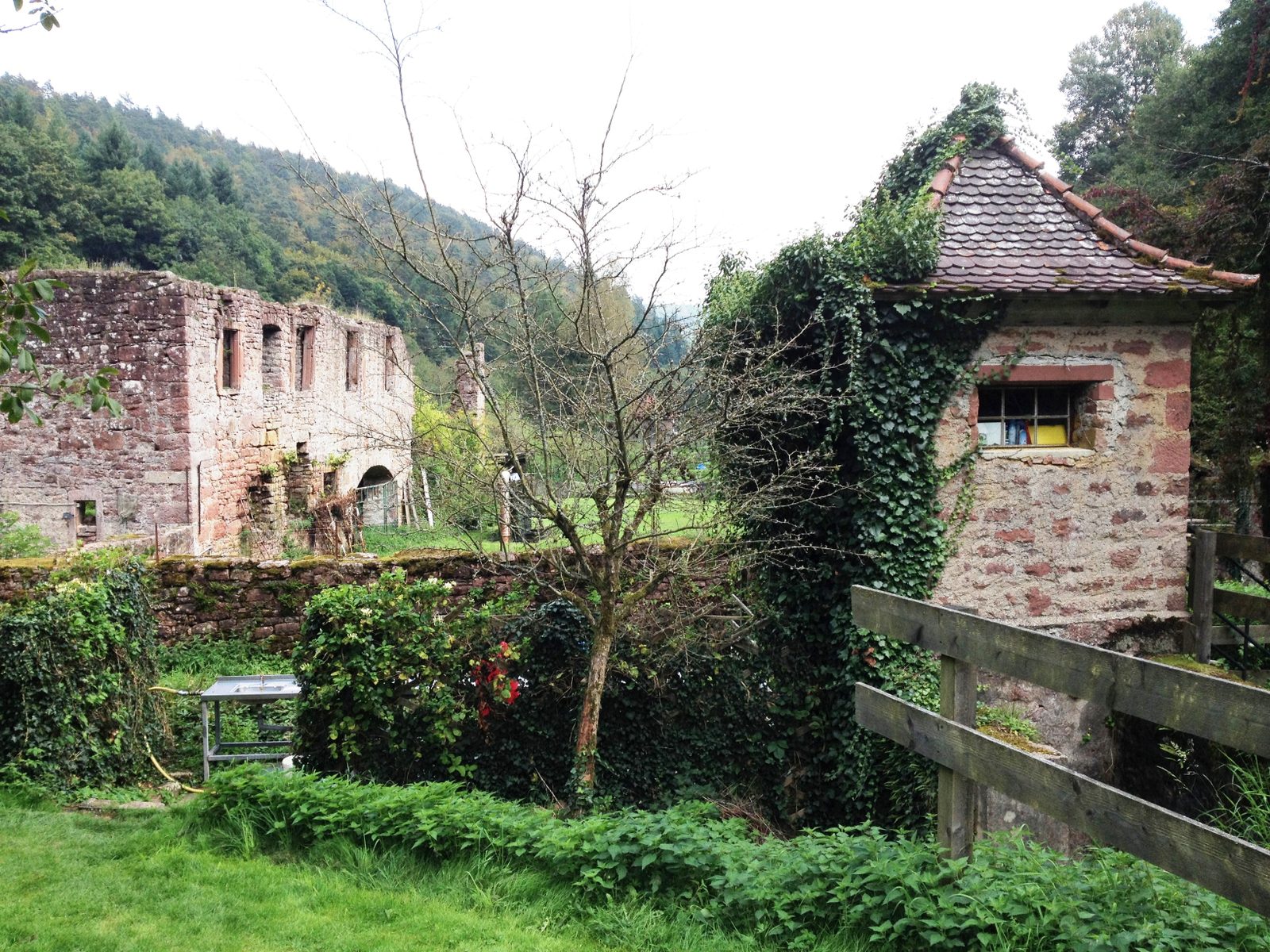
The Grünau Monastery (also Grünau Charterhouse) is a former Carthusian monastery southeast of Schollbrunn in Bavaria in the Diocese of Würzburg. It was called "Nova Cella" (also "Neuzell Charterhouse") by the monks and was the oldest charterhouse in Franconia.
History+
The monastery, dedicated to the Blessed Virgin Mary, St. Lawrence and St. Nicholas, was founded by Elisabeth von Hohenlohe, daughter of a Count of Wertheim. She probably atoned for a hunting accident she caused, in which her husband Gottfried von Hohenlohe-Röttingen had died. On March 15, 1328, the Mainz Carthusians therefore received the town of Schollbrunn to found a new monastery there. A monastery already existed at the site of the later charterhouse grounds, which was inhabited by canons from Triefenstein and was regularly a destination for pilgrimages. The monks were dismissed and left the area. The new monastery quickly developed despite a small number of monks, as several towns were subordinated to the charterhouse. Thus, the brothers received tithes from the parish of Eichel and from the chapel of Hasloch. In the years 1457–1463, Hammanus de Rudisheim was prior of the charterhouse. He was the author of several meditations. In 1525, during the Peasants' War, looting occurred by the inhabitants of the surrounding towns. The monks had fled from the destruction to the charterhouse in Ilmbach. The Reformation, in turn, brought drastic changes for the monastery. In 1545, the family of the Counts of Wertheim joined Luther's teachings and took over the administration of Grünau. After only three monks inhabited the charterhouse in 1550, the monastery was completely dissolved in 1557 and the last prior Matthias de Monte was expelled. The grounds were transferred to the Hospital of Wertheim, the other goods were received by the sister charterhouses in the surrounding area. In 1615/1616, the official unification of Grünau with the Ilmbach Charterhouse took place. The situation only changed in 1629, when Carthusian monks settled in the area again, protected from dissolution by an imperial letter of protection. Nevertheless, in 1631 they had to give up the charterhouse again, as the Swedes under Gustav Adolf conquered the country. The king handed over the monastery to the Löwenstein-Wertheim family. After the withdrawal of the Swedes, the monks regained half of their possessions. In 1635, the monastery was re-established. In 1803, it was dissolved with the secularization. The charterhouse came into the possession of the Counts of Löwenstein-Wertheim-Freudenberg, who converted it into a princely estate in 1820. The church was used until 1812. Today, the complex is used as an inn. The Bavarian State Office for Monument Preservation lists the monastery under monument number D-6-77-182-10 (see list of architectural monuments in Schollbrunn).
Source: Wikipedia · Licence: CC BY-SA 4.0 · Image: Drow69 · Wikimedia Commons · CC BY-SA 4.0
This description is a machine translation of an excerpt from the linked Wikipedia article. The source text was written by its authors, the translation is by Mobile History; like the original it is licensed under CC BY-SA 4.0.
Location: 49.8176, 9.4754