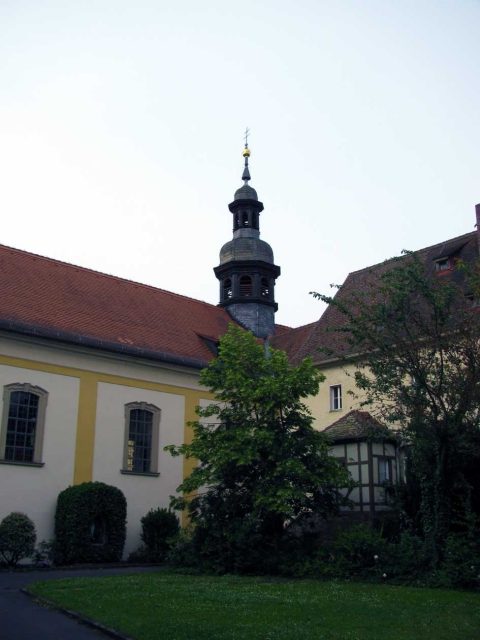
MonasteryHausen

Hausen Abbey

Hausen Abbey

Museum

Kloster Hausen is a former Premonstratensian nunnery in Hausen near Bad Kissingen.

The monastery, dedicated to the Holy Cross, was founded in 1161 by Count Heinrich von Henneberg. He had acquired the village of Hausen from Eberhard von Bamberg in exchange for the villages of Heyden and Hircendorf. After its foundation, Heinrich von Henneberg handed over the monastery to the Diocese of Würzburg under Prince-Bishop Heinrich II von Stühlingen. The property probably housed a monastic school intended to train girls to become nuns, which was initially led by a Magistra, then by a Prioress. It is possible that the monastery church was built at the same time as the monastery was founded. The first known documentary mention of the monastery church dates from 1250; the designation of the church as "ecclesia sanctae crucis" ("Church of the Holy Cross") is recorded from 1272. The monastery had the right to exercise low jurisdiction in the village of Hausen.

In 1250, a substantial donation of land was made to Kloster Hausen. It was initially a daughter monastery of Kloster Oberzell near Würzburg, but in the 13th century, it was also temporarily subject to the abbot of Kloster Veßra as part of a visitation right.

In the Peasants' Revolt of 1525, Hausen was devastated. The nuns found refuge in Kloster Oberzell; its abbot Georg von Oberzell rebuilt Kloster Hausen. Shortly thereafter, Kloster Hausen was severely affected again, on the one hand in the Second Margrave War (1552/1553) and on the other hand in the Grumbach Feud (1565). The last mention of the monastery as an independent institution dates from September 9, 1553. In 1581, under Prince-Bishop Julius Echter von Mespelbrunn, it came under the administration of the Julius-Maximilians-Universität Würzburg with the purpose of securing its economic viability.

After devastations in the Thirty Years' War (1618-1648), the monastery was re-established in 1681 under Peter Philipp von Dernbach; the monastery church was rebuilt under Prince-Bishop Julius Echter von Mespelbrunn and decorated under Prince-Bishops Johann Philipp von Greiffenclau zu Vollraths and Johann Philipp Franz von Schönborn. The extensive forest property of the monastery is still state forest today (Klauswald).

Until 1821, the complex was under the administration of the Julius-Maximilians-Universität Würzburg and then passed into state ownership. In 1837, the state sold the monastic estate (without the church) to the Jewish Baron Joel von Hirsch, who in 1847 resold the property to 28 local farmers (it is said that he was prompted to do so because a monk in a white habit appeared to him, who, according to legend, has wandered the monastery building since its earliest times). In 1860, the Kissinger district judge Count Friedrich von Luxburg bought the monastery buildings for the Kissingen district and established a "District Rescue Institution for Girls" and later a children's home there.

In the Austro-Prussian War of 1866, Bavarian soldiers found accommodation in Kloster Hausen, which was plundered by Prussian soldiers after their withdrawal.

After Maria-Stern Sisters from Augsburg took over responsibility for the monastery, a children's day-care center was established in 1894. In 1960, the children's home was dissolved and converted into a retirement home by the district of Bad Kissingen. In 1962, the state transferred ownership of the monastery church to the parish of Hausen. In 1976, the retirement home was dissolved, and its operations were moved to Münnerstadt. The monastery building has since been used as an office of the Bad Kissingen District Administration. In 1990, a plan by Vietnamese Cistercian monks to move into Kloster Hausen fell through after a short time.

Subsequently, the local pastor and Bad Kissingen dean Georg Hirschbrich created the small Cardinal-Döpfner-Museum in the monastery on the 25th anniversary of Cardinal Julius Döpfner's death (July 24, 2001) as a memorial to the well-known cardinal. In 2002, he was admitted as a knight to the Equestrian Order of the Holy Sepulchre of Jerusalem, and later became a commander.

Take Mobile History with you

You are reading this text for free. Premium adds what matters on the road: descriptions read aloud, sites found through your camera, whole regions taken offline.

  • Every description, including the ~17,700 Premium sites
  • Audio guide: have descriptions read to you on location
  • AR finder: see sites through your camera, with distance and bearing
  • Unlimited saved sites

14 days free, then from €2.99 a month. Cancel anytime.

Source: Wikipedia · Licence: CC BY-SA 4.0

This description draws on the facts documented in the linked Wikipedia article; Wikipedia content is licensed under CC BY-SA 4.0. Wording and editing: Mobile History.

Location: 50.2297, 10.0668