Monastery operation
MonasteryHeidenfeld
Heidenfeld Abbey
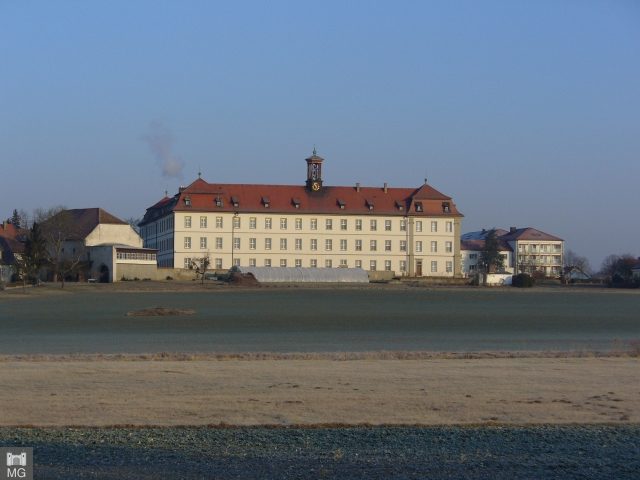
Kloster Heidenfeld, also known as Maria Hilf Monastery, is a religious site in Heidenfeld near Schweinfurt in Lower Franconia. Today, it houses the Congregation of the Daughters of the Redeemer.
History+
The monastery's foundation dates back to 1069, when Countess Alberada of Schweinfurt and her husband Count Hermann of Habsberg-Kastl endowed one of their dowries for its establishment. Bishop Adalbero of Würzburg transferred the endowment to the Augustinian Canons in 1071, who subsequently focused on pastoral care and managed over 20 parishes. In the 16th century, the monastery suffered destruction twice, first in 1525 during the Peasants' War and again in 1553/54 during the Margrave War, but was always rebuilt by the Augustinian Canons. The collegiate church received an honor in 1632 with the burial of the beatified priest Liborius Wagner. Under Provost Andreas Deichmann (1644-1673), the collegiate church experienced a flourishing period after the Thirty Years' War. Between 1723 and 1733, Balthasar Neumann provided the plans for a Baroque reconstruction of the convent building. From 1783, the collegiate church was redesigned by Joseph Ignaz Appiani and Materno Bossi.
Source: Wikipedia · Licence: CC BY-SA 4.0
This description draws on the facts documented in the linked Wikipedia article; Wikipedia content is licensed under CC BY-SA 4.0. Wording and editing: Mobile History.
Location: 49.9650, 10.2014