MonasteryHeidenheim

Heidenheim Abbey

Heidenheim Abbey

Apartments
Local Authorities


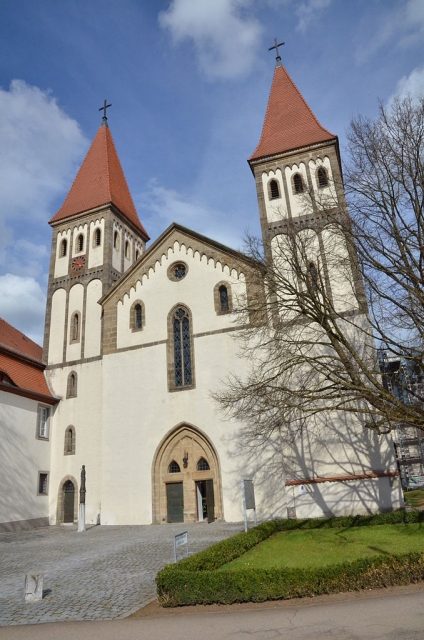
Heidenheim Monastery is a former Benedictine monastery in Heidenheim in Franconia in the Diocese of Eichstätt.

The monastery was founded in 752 by St. Wunibald, in agreement with his brother, St. Willibald, the first Bishop of Eichstätt, as a mission outpost for these Anglo-Saxons in the Sualafeld. Wunibald, who had been part of St. Boniface's retinue since 739, was also the first abbot of this new Benedictine proprietary monastery, which soon received endowments. After his death on December 18, 761, in his monastery in the presence of his brother, and his burial in the monastery church, his sister, St. Walburga, took over the leadership of the family monastery, continuing it as a Benedictine double monastery (for men and women) as abbess, following the Anglo-Saxon model. After miracles occurred at Wunibald's grave immediately after his death, on September 24, 777, his remains were exhumed and reburied in the new east choir of the new monastery church, which was under construction, by Willibald. This second church building was constructed of stone; the nature of the previous church is not known. In 778, the church dedicated to the Holy Savior was completed.

After Walburga's death on February 15, 779 or 790, the character of the monastery changed, although it is not clear whether the men's monastery was dissolved first or the double monastery immediately. The secularization is traditionally attributed to Bishop Gerhoh of Eichstätt. At an unspecified time, the monastery was replaced by a collegiate church for secular canons (secular clergy) who were not subject to the vow of poverty. How long they lived a communal life is unknown, as there is no information about the collegiate church until the 12th century. On a September 21st between 870 and 879, the remains of Walburga and Wunibald were transferred to Eichstätt, but Wunibald's remains were brought back after three days. In the 12th century, the collegiate church had become in need of reform; the spiritual life of the noble canons, if one believes the sources, was completely neglected, and the prelacies and canonries had become purchasable (simony). After the Benedictine monastery of Kastl, located in the Diocese of Eichstätt, had adopted the Hirsau Reform, Bishop Gebhard II reformed the Heidenheim collegiate church by first making it a monastery for the extinction of the canons. Pope Eugene III approved this approach and Gebhard's plan to re-establish a Benedictine monastery in Heidenheim. Gebhard's death in 1149 thwarted the plans, and his successor, Bishop Burchard, sided with the existing canons who rejected the conversion. At the instigation of Canon Ilsungus, a reform supporter, Pope Eugene III ordered the expulsion of the canons of Heidenheim and the establishment of a Benedictine monastery. The excommunication threatened to the canons did not fail to have an effect: after lengthy negotiations in Nuremberg, they agreed to the reintroduction of monastic life.

From 1155, Heidenheim was thus again a Benedictine monastery. This was dissolved in 1537 during the Reformation. Until 1805, the monastery buildings served as residences and offices. Wunibald's remains are lost.

The Church+

The first stone building was consecrated in 778. Almost 100 years later, a new building followed. A fundamental renovation followed with the Romanesque building, which was consecrated between 1182 and 1188 (clear influence of the Hirsau reform style of construction). The nave and transept of this building are still preserved. Before 1363, the choir was built in the Gothic style.

Among the numerous tombs, the following are noteworthy:

  • Walburga's tomb from the early 13th century
  • Tomb of St. Wunibald from 1484
  • Double slab of Wiricho and his wife (around 1349)

The former monastery church serves as the parish church for the Evangelical-Lutheran parish of Heidenheim.

Take Mobile History with you

You are reading this text for free. Premium adds what matters on the road: descriptions read aloud, sites found through your camera, whole regions taken offline.

  • Every description, including the ~17,700 Premium sites
  • Audio guide: have descriptions read to you on location
  • AR finder: see sites through your camera, with distance and bearing
  • Unlimited saved sites

14 days free, then from €2.99 a month. Cancel anytime.

Source: Wikipedia · Licence: CC BY-SA 4.0

This description draws on the facts documented in the linked Wikipedia article; Wikipedia content is licensed under CC BY-SA 4.0. Wording and editing: Mobile History.

Location: 49.0177, 10.7427