Museum
MonasteryHeiligkreuztal
Heiligkreuztal Abbey
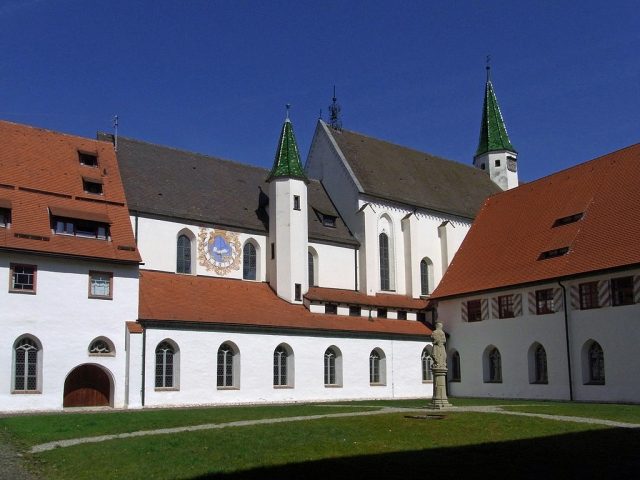
Heiligkreuztal Monastery, a former Cistercian nunnery, is situated in the eponymous district of the municipality of Altheim in Upper Swabia, Baden-Württemberg. It is renowned for its long history and the preserved architectural structures that bear witness to its former significance.
History+
The origins of Heiligkreuztal Monastery date back to 1140, when a monastic community of Beguines existed in Altheim. These "grey sisters" joined the Cistercian Order in 1204. The official founding of Heiligkreuztal Monastery occurred around 1227. Thanks to the financial support of Count Egon von Grüningen-Landau and his sister Hailwilgilde, who also became the first abbess, a representative monastic building could be erected. The name Heiligkreuztal became established around 1231, allegedly after Count Egon donated a splinter of the True Cross. King Henry (VII) placed the monastery under his special protection in 1234, and Pope Gregory IX confirmed it in 1251 with extensive privileges. Over the centuries, the monastery, which primarily admitted daughters from noble families, acquired extensive possessions. In 1383, the convent comprised 125 women. Abbess Veronika von Rietheim, from 1521, ensured strict monastic discipline and initiated extensive renovations, including the church's decoration by the Master of Meßkirch. The monastery suffered looting during the Schmalkaldic War (1552), by Swedish troops (1632), and French troops (1796). In the course of secularization, Heiligkreuztal Monastery was dissolved in 1802/1803, with the last nuns leaving by 1843.
Source: Wikipedia · Licence: CC BY-SA 4.0 · Image: https://commons.wikimedia.org/wiki/File:Heiligkreuztal-Kreuzgang17248.jpg
This description draws on the facts documented in the linked Wikipedia article; Wikipedia content is licensed under CC BY-SA 4.0. Wording and editing: Mobile History.
Location: 48.1358, 9.4033