Hotel
Museum
Hornbach Abbey

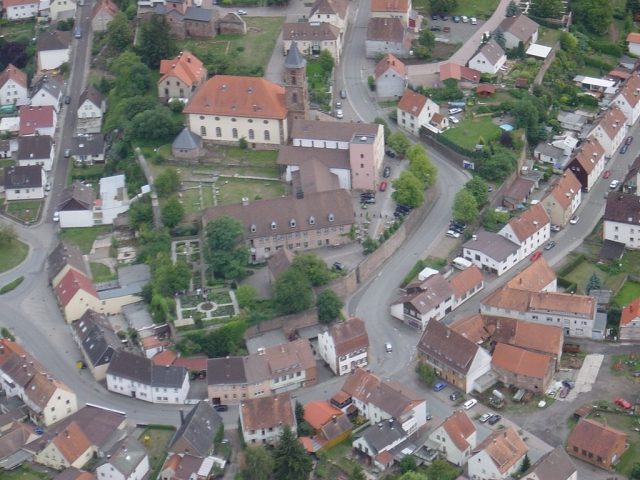
Hornbach Abbey is a former Benedictine monastery founded around 741 in the historic town of Gamundias (today Hornbach) by St. Pirminius. Today, only structural remains of the convent buildings exist, supplemented by a monastery museum, as well as a modern chapel with the historic tomb of the monastery's founder.
The site of Gamundias had Celtic and later Roman settlements, each with a mountain sanctuary on the grounds that was later built over by the monastery; predominantly Roman coin finds indicate use from 496 BC.
Hornbach in the Bliesgau belonged to the Diocese of Metz. After the founding of Murbach Abbey in 727, endowed by Count Eberhard (Etichonen), Pirmin came to Gamundias around 740/741. There, Count Warnharius from the Wido family (ancestors of the Salian dynasty) endowed the construction of a Benedictine monastery; Sigibald († 741), Bishop of Metz, signed the foundation charter and confirmed the monastery. As a proprietary monastery of the Salian dynasty, Hornbach Abbey possessed far-reaching privileges. After his death in 753, St. Pirmin was buried in the monastery. With the rise of his cult of veneration, the importance of the place grew, which is also evidenced by several renovations and extensions, as well as numerous documents mentioning tribute payments to the monastery. The saint's tomb was moved to the east apse; from 827, Pirmin – alongside Peter – was named as the patron saint of Hornbach Abbey. Around 850, it was subject to the Zell collegiate church near Worms, in whose vicinity it also owned several proprietary churches and properties. In 1087, Emperor Henry IV gifted Hornbach Abbey to Bishop Rüdiger Huzmann of Speyer. In the 11th century, a monumental pillar basilica, measuring 72 meters in length, was built, featuring five towers and a westwork in addition to the two apses. Emperor Henry V granted the monastery the right to mint coins, which was exercised until about 1230. In the 12th century, the building was renewed. The monastery provided important impulses for development in Upper Lorraine, documented by numerous village and farm foundations by the monks. When it fell under the influence of the Counts of Zweibrücken, its decline began.
In 1548, only three monks lived here, and in 1557, Hornbach Abbey was finally dissolved – in the course of the Reformation. The monastery's assets, current income, and buildings were used for the establishment of a princely state school, which was responsible for training the next generation of pastors and higher officials needed in Palatinate-Zweibrücken, or for preparing them for university studies. In 1631, the school was moved to Zweibrücken. After that, the unused building increasingly fell into disrepair. Wars also led to further destruction; for example, during the Dutch War, French troops razed the crossing tower of the basilica.
The so-called Hornbach Sacramentary, a 10th-century codex, made by the Hornbach scribe-monk Eburnant on behalf of his abbot Adalbert of Hornbach (approx. 970 to 990), is located in the Central Library of Solothurn.
Current Significance+
By the year 2000, most of the preserved monastery remains were integrated into a hotel complex, and a monastery museum "Historama Kloster Hornbach" was established in the building's basement, conveying the history of the monastery.
The relics of St. Pirminius were saved by the last abbot of Hornbach, Count Anton von Salm, in 1558 to Speyer. From there, in 1575, the former president of the Imperial Chamber Court and now governor of Tyrol, Count Schweikhard von Helfenstein, brought them to Innsbruck. Here they are today in a modern shrine in the Jesuit Church of Innsbruck. After the rediscovery of the original Hornbach tomb on the former abbey grounds in 1953, a part of the bones returned from there. They are now kept in Hornbach, Speyer, and Pirmasens. The Protestant Church of the Palatinate, which owns the former monastery district, had a chapel built over the historic tomb in 1957, and it is now once again a place of pilgrimage.
Several steps lead down to the empty tomb, ending before a profiled sandstone frame at the foot of the tomb niche. It is a window opening through which pilgrims could touch the saint's shrine. The burial site is considered the oldest known testimony of ecclesiastical architecture in the Palatinate.
Take Mobile History with you
You are reading this text for free. Premium adds what matters on the road: descriptions read aloud, sites found through your camera, whole regions taken offline.
- Every description, including the ~17,700 Premium sites
- Audio guide: have descriptions read to you on location
- AR finder: see sites through your camera, with distance and bearing
- Unlimited saved sites
14 days free, then from €2.99 a month. Cancel anytime.
Location: 49.1871, 7.3693