School
Keppel Abbey (Allenbach)

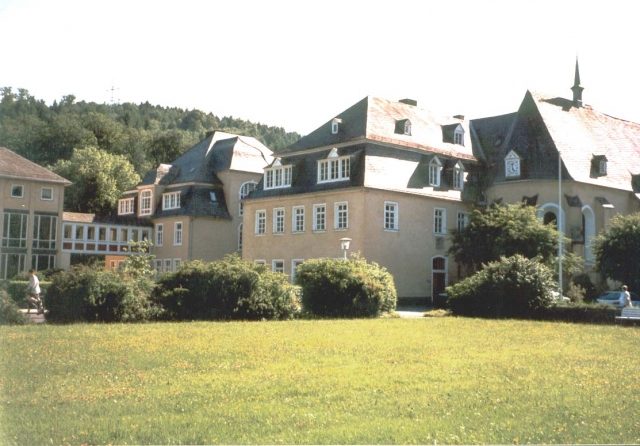
Stift Keppel is a public foundation grammar school in Hilchenbach-Allenbach. It is supported by the united foundations of Geseke-Keppel as a special asset of the state of North Rhine-Westphalia.
Since its founding before 1236 by Friedrich vom Hain, it has experienced a turbulent history: Stift Keppel was a Premonstratensian convent, a secular women's collegiate foundation, a collegiate school, a lyceum and upper lyceum, a teacher training college, and finally a co-educational grammar school. Until the 19th century, it was under the protectorate of the Counts and Princes of Nassau-Oranien, later of the Prussian royal house.
The collegiate church in its 18th-century design, with the adjoining secular buildings of the New House and the Hall Building with the convent hall, are among the most significant Baroque architectural monuments in the Siegen-Wittgenstein district.
In addition to the grammar school, there is a conference and guesthouse. A small museum showcases the lives of the canonesses and boarding school students.
Location of Stift Keppel+
The collegiate buildings are located in the Ferndorf valley between the districts of Allenbach and Dahlbruch in the town of Hilchenbach on Federal Highway 508. There is a private train station with connections to the Rothaarbahn to Siegen and Bad Berleburg. Stift Keppel also owns extensive agricultural and forestry land, including 491 hectares of forest.
The Premonstratensian Convent of Keppel
Stift Keppel was first mentioned in a document from 1239. In it, Count Heinrich II the Rich of Nassau, at the request of his vassal Friedrich vom Hain, transferred the revenues of the Netphen parish to the monastery. The document also mentions that Friedrich had built the canonesses' convent of Keppel on his property. In the necrology of the Premonstratensian Abbey of Arnstein on the Lahn, to which Keppel Convent was assigned, a Keppel convent superior was already commemorated before 1236.
The convent also served early on to provide for the unmarried daughters of the local landed gentry in a manner befitting their status. Therefore, the names of von und zu der Hees, von Selbach-Lohe, von Meschede, von Bicken, von Schnellenberg, among others, are frequently found among the conventuals. In the convent rules from 1392, Johann I, Count of Nassau, is titled as patron and founder of the convent. He chose the collegiate church as a burial place for himself and his wife Margarethe, Countess von der Mark. His mother Adelheid, née Countess von Vianden, personally managed the affairs of the foundation as "Magistra" in the last decades of her widowhood.
The Secular Women's Collegiate Foundation of Keppel and the Collegium virginum nobilium
Count Wilhelm the Rich of Nassau introduced the Reformation in his lands by 1536. In 1594, his son Johann VI, the founder of the Nassauische Hohe Schule, finally decreed the secularization of the convent into a "secular women's collegiate foundation" of Protestant character. Wilhelm the Rich had already initiated the founding of a Collegium virginum nobilium in 1549, a collegiate school where approximately 350 daughters (and also sons) of the nobility and upper bourgeoisie were educated until the Thirty Years' War. The pupils came, among others, from the houses of Nassau, Wittgenstein, Sayn, Solms, Waldeck, Isenburg, and Wied, but also daughters of commoners, lawyers, mayors, professors, and pharmacists are found in the matriculation register. Among the students from 1581 to 1596 was Christine von Dietz, the illegitimate daughter of Anna von Sachsen, wife of William of Orange, with Jan Rubens, the father of Peter Paul Rubens. During the war, Keppel briefly came into the possession of the Jesuit College in Siegen. However, in 1650, after the Peace of Westphalia, the convent superior Maria von Effern achieved the reconstitution of the women's collegiate foundation. Under the converted Catholic sovereign Count Johann the Younger, a simultaneum was established with four Reformed and four Catholic canonesses, an alternation between Catholic and Reformed abbesses, and two confessionally separate households. In the Baroque period, the interior of the collegiate church was redesigned, and the New House and the Hall Building with the convent hall were newly constructed.
The Dissolution of the Foundation in the 19th Century
The new sovereign, Grand Duke Joachim Murat of Berg, a brother-in-law of Napoleon Bonaparte and later King of Naples, imposed Isabella Marquise de Meslé as abbess on the convent in 1808. In 1812, under Napoleonic rule and after the extinction of most of the Siegerland noble families, the foundation was dissolved. After the Congress of Vienna in 1815, it fell to Prussia along with the entire Principality of Nassau-Siegen. The Prussian king continued to appoint canonesses, who, however, were not subject to residency requirements, including the poet Katharina Diez. The orphaned collegiate church was used by the Evangelical-Reformed community of Hilchenbach from 1839 to 1846, and from 1844 to 1900, the Catholic diaspora community resided there and maintained a primary school in the convent hall.
The Keppel School and Educational Institution
In 1871, the Chief Administrator Piper and the Foundation Treasurer Manger succeeded in establishing the "Keppel School and Educational Institution" for girls with an attached boarding school under the patronage of Prussian Queen Elisabeth. The opening date was September 10, 1871. Financial support came from Emperor Wilhelm I. Models were the Queen Luise Foundation (founded 1811) in Berlin-Dahlem and the "Educational and Training Institutions" in Droyssig (founded 1847).
Queen Elisabeth appointed the Droyssig teacher Nanny von Monbart as the first convent superior after an audience at Charlottenburg Palace in Berlin. Other canoness teachers were Antonie von Triebenfelde (also head of home economics), Adele von Eisenhart, Pauline von Westhofen, and Elisabeth von Burghoff. Other academic teachers were Pastor Romberg and, from the Hilchenbach teacher training college, Director Böckler and the seminar teachers Steinbruch and Wolfram. In 1874, Hugo Rönneke was then hired as foundation pastor and academic teacher. Later, the foundation hired its own senior teachers and - when this became possible - senior female teachers.
In 1872, a teacher training college was attached. External students came from Siegerland, internal students from all over Prussia, but also England, France, and Italy. Well-known former Keppel students included the Thuringian Minister for Public Education, Marie Torhorst, and the poet Helene von Monbart, a niece of the first convent superior.
In 1899, former Keppel student Anna von Ciriacy-Wantrup was appointed as the second convent superior. To accommodate the increased number of students and the new laws on higher education for girls, a new school building and two new wings of the main building were constructed. In 1910, it was recognized as a Lyceum and Oberlyceum. In 1926, women in Keppel took the Abitur for the first time as a prerequisite for university studies.
After the departure of Chief Administrator Piper, the Keppel Foundation Fund was represented by department heads in Arnsberg, including the later Chancellor Dr. Georg Michaelis and Senior Government Councillor Johannes Gisevius, until finally in 1923 Carl Freiherr von Wittgenstein was appointed Keppel Foundation Curator and held this position until 1962.
After the National Socialists came to power in 1933, Keppel was converted into a women's secondary school, and the convent superior Cornelia van Senden, who had been in office since 1927, was removed. In 1944, the foundation was to be nationalized. At the end of World War II, Keppel served as an emergency hospital.
The Public Foundation Grammar School
Already in 1946, the Foundation Curator Freiherr von Wittgenstein achieved that the nationalization of the foundation was reversed and the Foundation Fund became the owner and operator of the school. Classes resumed, albeit under the most difficult conditions. In the following decades, however, there was a strong increase in student numbers, the introduction of co-education in 1977, and a generous expansion of the school buildings. The grammar school currently has about 730 students and 40 teachers. After the closure of the Jung-Stilling-Gymnasium in 2008, Stift Keppel is the only grammar school in the area of the city of Hilchenbach.
Architecture+
The originally Romanesque collegiate church of St. Mary and St. John the Evangelist, dating from 1275, is based on an older predecessor building that had burned down in the mid-13th century. The simple rectangular choir was later extended by a Gothic choir polygon. Today, it still features the classic three-part division of Premonstratensian churches into choir, nave, and nuns' gallery. In the choir, there are, among other things, 18 grave epitaphs from the period 1464 to 1748 and late Gothic choir stalls. The altar stone and the Baroque pulpit were donated in 1677 and 1682, respectively, by Abbess Johanna Maria von und zu Holdinghausen. The multi-tiered altarpiece (1701) in the choir and the church organ (1695) in the nuns' gallery were donated by Abbess Anna Elisabeth von der Hees. According to the order's rules, the church never had a fundamental bell tower.
Patrons of the collegiate church are John the Evangelist and Elisabeth of Thuringia, who died in Marburg in 1231 and was canonized in 1235 shortly before the foundation's establishment, and who was close to both the mother foundation of Arnstein and the House of Nassau.
Epitaphs in the choir of the collegiate church: 1464: Johann v. Bruch, 1501: Philippe v.d. Hees, 1562: Anna v. Schnellenberg, 1572: Katharina v. Zweifel, 1580: Anna v.d. Hees, 1581: Elisabeth v. Selbach-Lohe, 1590: Agnes v. Selbach-Quadfasel, 1592: Agnes v. Selbach i.d. Eichen, 1612: Magdalene v.d. Hees, 1616: Anna v. Bruch, 1621: Elisabeth v.d. Hees, 1717: Anna Elisabeth v.d. Hees, 1719: Maria Marg. Elis. v. Bicken, 1719: Dietr. Ph. Ludw. Fr. v. Meschede, 1736: Maria A. Gertr. V. Neuhoff, gnt. Ley, 1741: Maria Franziska v. Riedt, gnt. Kettig v. Bassenheim, 1747: Margareta Alvera v. Winshem, 1748: Sophie Charlotte v. Bottlenberg, gnt. Kessel
The so-called New House (1733) and the adjoining Hall Building with the artfully designed convent hall (1752) were built by the abbesses Sophie Charlotte von Bottlenberg, known as Kessel, and Elisabeth von Neuhoff, known as Ley, along the cloister.
From 1903 to 1911, a new south wing was built on the area of the abbey wing, and an extended church wing was built in the area of the old dormitory, the latter by the Herborn architect Ludwig Hoffmann, who also built the senior teachers' house.
In the 1950s to 1970s, the new school buildings were constructed, including the coat of arms hall, the science classrooms, the gymnastics hall, the current auditorium, several teachers' houses, and the new boarding school building with tennis courts. More recent is the large multi-purpose sports hall (1991) at the sports field.
In addition, some houses in the Ferndorf valley and the old train station belong to the collegiate buildings.
No longer existing are the old practice school building with a small gymnasium, the foundation hospital, the old cemetery, the foundation mill, the brewery, the economy buildings, and the outdoor swimming pool.
Take Mobile History with you
You are reading this text for free. Premium adds what matters on the road: descriptions read aloud, sites found through your camera, whole regions taken offline.
- Every description, including the ~17,700 Premium sites
- Audio guide: have descriptions read to you on location
- AR finder: see sites through your camera, with distance and bearing
- Unlimited saved sites
14 days free, then from €2.99 a month. Cancel anytime.
Source: Wikipedia · Licence: CC BY-SA 4.0
This description draws on the facts documented in the linked Wikipedia article; Wikipedia content is licensed under CC BY-SA 4.0. Wording and editing: Mobile History.
Location: 50.9758, 8.0847