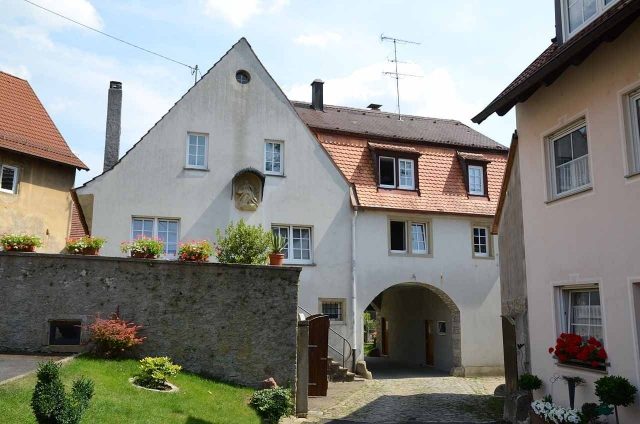
MonasteryRimpar-Maidbronn

Maidbronn Abbey

Maidbronn Abbey

Church

Maidbronn Abbey is a former Cistercian nunnery in the eponymous district of Rimpar in Bavaria, in the Diocese of Würzburg.

The Cistercian nunnery Fons Virginis Sanctae Mariae, founded in 1232, was moved to Ezelenhusen in 1235. The monastery was dissolved in 1581 (Maidbronn Abbey). Remains of the monastery have been preserved: The church serves the curacy community as a house of worship; it consists of the choir (executed as a rectangular choir, dating therefore to 1260/70), the lay church, and parts of the elevated nuns' gallery. The church and the curate's house were divided to create access to the former monastery's well, and in 1885, the remains of the nuns' church were converted into the curate's house, retaining the enclosing walls. This curate's house is opposite the church and contains the remains of the nuns' church and the associated lower church/crypt church. The enclosure of the Gothic pointed arch window has been preserved on the west gable.

The west wing of the convent building, which is used as a private residence, is attached to the former nuns' choir. It still shows traces of the former cloister. The east wing has fallen into disrepair; only remains of the outer wall are preserved, some still with the original window reveals. From the height of the windows, the former ground level can be estimated. By comparing similar Cistercian nuns' churches with partially preserved separations of the nuns' choir, such as Himmelspforten in Würzburg, one gains an idea of the church's design at that time.

The monastery was founded by Hermann I von Lobdeburg. A formal incorporation into the Cistercian Order was not yet the rule at that time; the monastery had always been subordinate to the Bishop of Würzburg. Numerous possessions and rights of Maidbronn Abbey could be proven, for example, Obereisenheim, Herlheim, Frohnlach, and Ebersdorf. In the city of Würzburg, there was a "Maidbronner Hof".

The Abbot of Ebrach, and later the Abbot of Langheim, served as advisor and visitor. The monastery Fons Virginis Sanctae Mariae had prominent advocates, including a number of popes (Gregory IX 1233, Nicholas V 1331, Innocent VI 1356, and Gregory XI 1377) and kings (Wenceslaus 1397 and Rupert of the Palatinate 1401) who confirmed the monastery's rights.

Despite this support, the monastery increasingly fell by the wayside of history over the years. In 1513, Langheim monks took over the duties of the monastery provost. A tombstone from this period still stands in the church on the right-hand side. During this time, only four nuns remained in the monastery. After the devastations of the Peasants' War in 1525, the monastery continued to operate under the Langheim provosts until 1543, fell to the knight Wilhelm von Grumbach for a few months in 1552 due to a contract in the run-up to the Grumbach Feud, and was finally dissolved in 1581 under Bishop Julius Echter. Thus ended the history of the monastery after 349 years of existence.

Riemenschneider Altar: The Lamentation in Maidbronn+

In the church, a single-nave building with a straight choir, on the high altar, in the midst of a later added baroque structure and frame, there is a large relief made of grey sandstone. It depicts a Lamentation, the mother's lament for her dead son. Max H. von Freeden wrote in 1947: "This Lamentation in the quiet church in Maidbronn is in its essence a truly final work, not only of the master Tilman Riemenschneider, but also of the era. It is imbued with an inwardness and greatness of feeling not achieved before or since."

The altar was created around 1519 to 1522. No documents regarding this are known. It is probable that the altar was not originally intended for Maidbronn, but for the Knight's Chapel in Rimpar. A payment from Maidbronn Abbey in 1526 of eleven guilders "to Meyster Dyln for a beautiful stone figure" could refer to another commission.

In the 17th century, the Maidbronn altarpiece was incorporated into a baroque stone altarpiece, and the two side figures of Peter and Paul were added.

The predella relief below the "Lamentation" hardly belongs to the altarpiece, even if it is often presented as such. The inscription draws the conclusion of the politically turbulent years of the German Peasants' War: "In the year of the Lord 1525, the peasants of East Franconia, alienated from the true faith, devastated this place... worse than enemies with robbery, murder, and fire. After they were finally defeated by force of arms and the storm was quelled, this altar was erected in honor of the most glorious Mother of God and Saints Kilian and his companions in the following year." The predella thus belongs to a monument to the victory over the peasants, but from a different context. The inscription also does not refer to a Lamentation, but to a Madonna altar with Saint Kilian and his companions - these are not depicted here at all.

After the turmoil of this period, Maidbronn and the monastery fell into a Sleeping Beauty slumber. The visitor reported on this in 1613. Diocesan Archive Würzburg, Amt Rimpar, Inventarium 1613, fol. 22r. "On the high altar, lies a portable, carved into a large stone panel, a sepultura christi unpainted. De patronis templi et altarium nihil explorare potui. On the other two altars stand old, dilapidated, unusable panels." The described condition of the Maidbronn church excludes recently made changes. The visitor in 1613 could not/was unable to research/learn anything about the church and altar patrons. This uncertainty regarding the patronage suggests a longer period of neglect, which is not surprising after the devastations of the Peasants' War in 1525 and the dissolution of the monastery in 1581.

While churches elsewhere were extensively renovated during the Renaissance, Maidbronn and its citizens, in the words of former mayor Felix Brand, "in simple modesty... held on to their meager possessions, which offered them more than just a dwelling."

Later, following the liturgical reform after the Second Vatican Council, the altar area was redesigned by the sculptor Heinrich Gerhard Bücker together with Bishop Paul-Werner. The opening to the world thus became tangible in the church space, and yet the effect of the Riemenschneider altar remained.

The Maidbronn Lamentation group is highly regarded in research as a representative of a new way of thinking about images, which is otherwise usually sought in Italy. If one associates a modern understanding of images with the Renaissance, then, according to Holger Simon, the Maidbronn altarpiece is not Riemenschneider's last purely Gothic work, but rather stands at the beginning of modern art production north of the Alps.

Take Mobile History with you

You are reading this text for free. Premium adds what matters on the road: descriptions read aloud, sites found through your camera, whole regions taken offline.

  • Every description, including the ~17,700 Premium sites
  • Audio guide: have descriptions read to you on location
  • AR finder: see sites through your camera, with distance and bearing
  • Unlimited saved sites

14 days free, then from €2.99 a month. Cancel anytime.

Source: Wikipedia · Licence: CC BY-SA 4.0 · Image: http://de.wikipedia.org/wiki/Datei:Maidbronn_Westfl%C3%BCgel_Ehem._Kloster_001.jpg

This description draws on the facts documented in the linked Wikipedia article; Wikipedia content is licensed under CC BY-SA 4.0. Wording and editing: Mobile History.

Location: 49.8478, 9.9757