Monastery operation
Mariendonk Abbey (Grefrath)

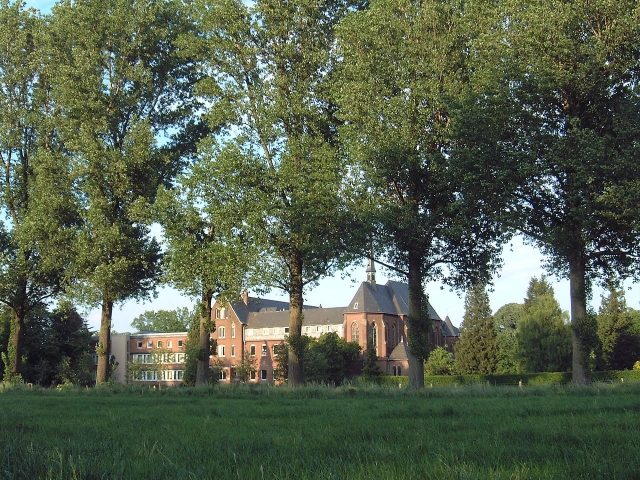
Mariendonk Abbey is a Benedictine monastery in Grefrath, Mülhausen district, near Kempen in the Diocese of Aachen.
History as a Monastery of Perpetual Adoration+
Foundation
The foundation of Mariendonk Monastery on the border of the Viersen and Kleve districts is closely linked to the general history of the late 19th century, particularly the Kulturkampf. For the monasteries, the "Law concerning the spiritual orders and order-like congregations of the Catholic Church" of 1875 was particularly decisive, as it dissolved all monasteries in Prussia, with the exception of those dedicated to nursing. Many dissolved communities therefore re-established themselves in the Netherlands. Among others, the community of the Bonn-Endenich monastery in Driebergen near Utrecht.
Nevertheless, during this time, the monastic way of life held great appeal for young women, and the community in Driebergen also grew very quickly. After the end of the Kulturkampf, the sisters soon learned that a woman near Kempen, Johanna Stieger (1848-1904), was willing to donate land and money for the construction of a monastery.
1900 - 1948
On October 23, 1900, the new prioress, Mother Ursula Kleberg, arrived with 22 sisters from Driebergen. To create a material basis and secure the community's sustenance, a small farm was soon established. The embroidery, which the sisters also practiced, only occasionally brought in income, and the host bakery slowly began in 1914.
At the end of the First World War, about 40 sisters lived in Mariendonk. The founding prioress, Mother Ursula Kleberg, continued to lead the community.
With the condition of undertaking sewing and embroidery work for the military, the monastery was not closed during the Second World War, but larger areas of the house were declared soldier and later refugee accommodations. Bomb-damaged neighboring families also found refuge here. In 1946, Sister Felicitas Berg (1909-1989) was elected prioress. At the community's request and after thorough preparation by the spiritual director P. Hermann Keller, Beuron (spiritual director from 1946-1970), she was able to complete the transformation from a monastery of Perpetual Adoration to the original monastic form of an abbey.
History of Mariendonk Abbey+
1948 - 1982
In 1948, the new constitutions were confirmed by the Vatican and the official elevation to an abbey took place. On June 24, the former prioress Felicitas Berg was consecrated as the first abbess. The abbey chose the name Mariendonk. A "Donk" is an elevated place in a marshland, here specifically the Niersaue. On October 24, 1950, the church, which had been converted and was now accessible to the public, was consecrated, and the also converted crypt was blessed.
From 1953, the sisters began to cultivate the fields belonging to the abbey themselves. Two sisters were trained as master farmers, who, together with P. Hermann Keller OSB, for whom the independence of the convent was a great concern, instructed other sisters. Only in 1993 did farming have to be discontinued, as the work could no longer be done by the sisters. Fruit and vegetable cultivation for their own needs remained.
In 1961, the construction of the urgently needed new building with a library, guest rooms, and workspaces for embroidery and the newly added weaving mill was completed. The new building now also offered more space for scientific work on the Old Latin Bible, the so-called Vetus Latina.
The full integration of the lay sisters into the convent, which was only canonically possible through the Second Vatican Council, was carried out in 1968; however, the abolition of the separation of lay and choir sisters had long been a wish of a large part of the convent.
1982 - 2005
In 1982, Sister Luitgardis Hecker was consecrated abbess after Mother Felicitas Berg's age-related resignation. Under her leadership, the guest chapel was redesigned in 1984, so that guests can now participate in the Eucharist and choir prayer together with the convent. The participation of guests in the liturgy was a great concern of the community. Therefore, it was decided very soon after the end of the Second Vatican Council to celebrate the service in German.
After the first doctorate of a Mariendonk sister in Theology / Old Testament and due to the serious illness and death of the last spiritual director P. Bonifatius Fischer OSB, Beuron, (1915-1997, spiritual director from 1973-1997), the sisters increasingly took on the task of theological knowledge transfer themselves. Since then, internal convent training has taken place.
From 1990, Mariendonk sisters began to collaborate on a bilingual edition of the Church Fathers, the Fontes Christiani, as well as intensifying pastoral care and theological training for guests in the form of lectures, Bible discussions, and retreats. In 1992, Patristics courses for religious members were established.
The spiritual director P. Bonifatius Fischer contributed greatly to this and, above all, translated the liturgical texts into German, so that the abbey could redesign its liturgy.
Since 2005
In July 2005, Sister Christiana Reemts (* 1957) was consecrated abbess, after Mother Luitgardis Hecker had resigned due to age. In 2011, the convent consisted of 34 sisters with perpetual vows, one cloistered oblate, three sisters with temporary vows, and one postulant.
Sisters of the Abbey are currently working on the following scientific projects:
- The series "Biblical Figures in the Church Fathers", affiliated with the Dölger Institute, Bonn
- Collaboration on the edition of the Vetus Latina
- Collaboration on the NTP (Novum Testamentum Patristicum)
Spirituality+
For many decades, the understanding of scripture by the Church Fathers, i.e., the theologians from the first six centuries after Christ's birth, has been a particular focus for the spirituality of the Mariendonk community. In addition to readings from the Bible, their biblical commentaries are the only texts heard together during Mass and the Liturgy of the Hours. Individual sisters have also published scholarly works on Origen and other Church Fathers.
The liturgy in Mariendonk Abbey is characterized by longer readings from the Old and New Testaments. Apart from scripture, only works of the Church Fathers are read in the liturgy.
Take Mobile History with you
You are reading this text for free. Premium adds what matters on the road: descriptions read aloud, sites found through your camera, whole regions taken offline.
- Every description, including the ~17,700 Premium sites
- Audio guide: have descriptions read to you on location
- AR finder: see sites through your camera, with distance and bearing
- Unlimited saved sites
14 days free, then from €2.99 a month. Cancel anytime.
Source: Wikipedia · Licence: CC BY-SA 4.0
This description draws on the facts documented in the linked Wikipedia article; Wikipedia content is licensed under CC BY-SA 4.0. Wording and editing: Mobile History.
Location: 51.3769, 6.3603