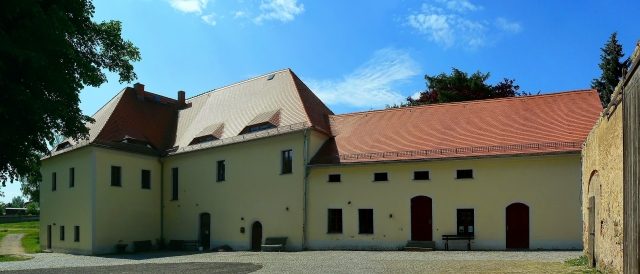
MonasterySornzig

Marienthal Abbey

Marienthal Abbey

To be privately owned

Marienthal Abbey was a Cistercian nunnery in what is now the Sornzig district of the town of Mügeln in the Nordsachsen district of Saxony.

The abbey is located on the Hasenbach, a tributary of the Döllnitz near Mügeln in the center of the Obstland (fruit region) in a hilly landscape. Sornzig is approximately halfway between Leipzig and Dresden. Larger nearby towns include Leisnig and Döbeln.

Architecture+

Preserved from the old monastery complex are the sisters' house, the monastery wall surrounding the entire grounds, the monastery garden with a fish pond, and the historic monastery mill.

Founding of the Monastery

Around 1150, Sifridus de Mogelin (Siegfried I von Mügeln) founded a noble court in Sornzig. His ancestors received the area around Festenberg as a royal gift in the 11th century, probably to act as vogts for the Bishopric of Meissen. The Marienthal Cistercian nunnery in Sornzig was founded in 1241 by Siegfried III von Mügeln. A castle chapel on Festenberg, owned by the monastery, had already existed since 1218. In 1243, Bishop Konrad of Meissen certified that Siegfried von Mügeln had subordinated the parish church of Sornzig and the castle chapel in Mügeln to the monastery. Through donations to the monastery, the surrounding villages subsequently came into the possession of the monastery, which managed them through the Sornzig Monastery Office. The Cistercian nuns introduced fruit cultivation to the monastery.

Period until the Reformation in 1539

In 1252, Margrave Henry the Illustrious (1215/16–1288) took Marienthal Abbey under his protection. He frequently appeared as a patron of the monastery. The monastery was largely destroyed by a fire in 1278. The reconstruction of the destroyed buildings was financed by various indulgences, including those from Bishop Friedrich of Merseburg.

The period from the Reformation in 1539 until the abdication of the last Bishop of Meissen in 1581

In the age of the Reformation, the strict discipline of the Cistercian nuns began to wane. The escape of the nun Katharina von Bora from the nearby Nimbschen Abbey at Easter 1523 was followed by that of six nuns from the Sornzig Abbey. Their escape helper was subsequently beheaded. In the course of the introduction of the Reformation, Marienthal Abbey was secularized around 1539/1540. The monastery was dissolved, and the assets confiscated by the state were made available to the Princely School St. Afra in Meissen. The monastery's territory was administered between 1540 and 1570 as part of the Electoral School Office of Meissen. Afterwards, it was exchanged for the Mühlberg Office and came into the possession of the Meissen Bishop Johann IX von Haugwitz.

Sornzig Abbey under the administration of the Wurzen Collegiate Chapter 1581–1818

On October 20, 1581, the last Bishop Johann IX von Haugwitz abdicated and converted to Protestantism. He lived in Mügeln until his death in 1595 and received Ruhethal Castle, built around 1150, which he named, as well as the former Marienthal Abbey in Sornzig, as a life annuity for use.

The Sornzig Monastery Office, which had been in the possession of the bishop since 1570, was placed under the administration of the Wurzen Collegiate Chapter in 1584. It was thus fully incorporated into Albertine Electoral Saxony, which had been in place since 1547, even though it was still administered as part of the Wurzen Collegiate Chapter until 1818 by a specially created "Electoral Saxon Collegiate Government" on behalf of the Dresden court.

In 1608, the Sornzig monastery estate was leased to Georg von Schleinitz for 12 years. Between 1666 and 1761, the former Sornzig monastery office was a manorial estate owned by the von Burkersroda family. The ownership of the monastery estate was distributed to the subjects of the office from 1763 onwards. Around 1797, the three new villages of Lichteneichen, Neubaderitz, and Neusornzig were founded on the relinquished Sornzig monastery land.

The former Sornzig Abbey from 1818 to modern times

After the dissolution of the Wettin collegiate government and the dissolution of the Wurzen collegiate chapter in 1818, the Mügeln office with Sornzig became a sovereign office in the Leipzig district of the Kingdom of Saxony. It existed until 1856 and was then replaced by the judicial offices of Mügeln and Oschatz.

The monastery grounds were purchased in 1892 by the Leipzig city planner Ludolf Colditz. He restored the buildings and introduced modern plantation fruit growing in Sornzig. After World War II, the Colditz family was expropriated and expelled by the communists in 1946. Fruit growing was continued as a state-owned enterprise as "Volksgut Sornzig" until the political change in 1989. Afterwards, the monastery was reacquired by the Colditz family, and the building was reconstructed internally and externally in accordance with monument preservation standards. In 1996, the "Dr. Ludolf Colditz - Kloster Marienthal" foundation was established, dedicated to the preservation and use of the complex. Since 2003, the monastery has been a European meeting and educational center. Fruit growing has been operated by the Sachsenobst company since the political change.

Take Mobile History with you

You are reading this text for free. Premium adds what matters on the road: descriptions read aloud, sites found through your camera, whole regions taken offline.

  • Every description, including the ~17,700 Premium sites
  • Audio guide: have descriptions read to you on location
  • AR finder: see sites through your camera, with distance and bearing
  • Unlimited saved sites

14 days free, then from €2.99 a month. Cancel anytime.

Source: Wikipedia · Licence: CC BY-SA 4.0 · Image: Thomas Eichler

This description draws on the facts documented in the linked Wikipedia article; Wikipedia content is licensed under CC BY-SA 4.0. Wording and editing: Mobile History.

Location: 51.2128, 13.0166