MonasterySeelbach bei Hamm - Marienthal

Marienthal Abbey
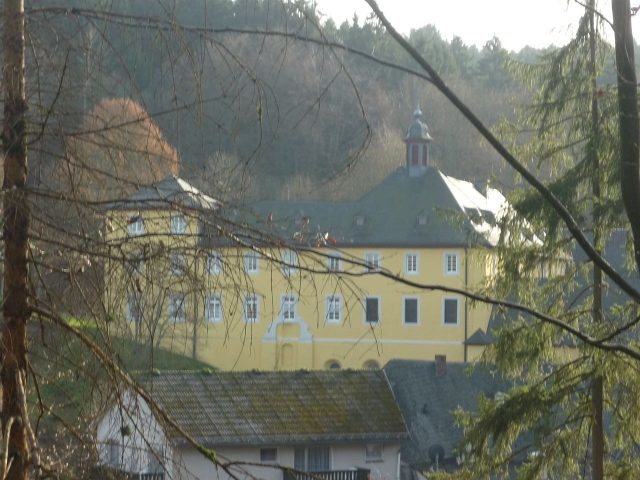
Marienthal Abbey

Education center "Haus Marienthal"

Marienthal Monastery was a Franciscan monastery in the Westerwald, in today's Altenkirchen district in Rhineland-Palatinate. Today, Marienthal is a district of Seelbach near Hamm (Sieg). On June 30, 2011, it had 55 inhabitants.

Pilgrimage Site Marienthal

The history of the monastery dates back to the first half of the 15th century. According to the founding legend, a shepherd is said to have carved an image of the Mother of God and placed it at the spot where the first chapel was built around 1460. The oldest mention of the pilgrimage site dates from 1428. The miraculous image revered today also originated around 1460. The chapel and pilgrims were cared for at that time by monks from the Cistercian monastery of Marienstatt (today Streithausen in the Westerwald district).

The chapel received the name "Marienthal" ("Mergendaell") in 1489, when the Cologne auxiliary bishop Johann Spender consecrated a new altar in the pilgrim chapel. Because the chapel became too small, a three-aisled Gothic church was built between 1494 and 1503 and placed under the patronage of the Sorrowful Mother. In 1502, the bell tower with a high spire was added, and in 1511, the church received an 1,800-pound bell, which was sold to the Florinskirche in Koblenz in 1828.

Marienthal was located in the County of Sayn. The Counts of Sayn introduced the Lutheran confession from 1561 and the Reformed confession in 1605. Pilgrimages to the church no longer took place thereafter.

Monastery Foundation

The monastery was founded in Marienthal in 1666 by Count Salentin Ernst von Manderscheid.

Salentin Ernst (1630–1705) was Catholic and had married Ernestine von Sayn-Wittgenstein (1626–1661) in 1651, the heiress of the Hachenburg part of the County of Sayn. From 1652, Salentin Ernst, together with Ernestine, took over the regency of the County of Sayn-Hachenburg. Ernestine died in 1661, and Salentin Ernst married the Protestant Christina Elisabeth von Erbach (1641–1692) in 1662. He received a dispensation due to the mixed marriage. Out of gratitude, Salentin Ernst founded Marienthal Monastery in 1666. Already before, on Palm Sunday in 1664, the first Catholic service was celebrated in the pilgrimage church, which was cared for by Franciscans from Hachenburg Monastery.

The construction of the monastery was delayed, which was also due to the special location of the church and the monastery. In the 17th century, Marienthal was located directly on the border between the two counties of Sayn-Hachenburg and Sayn-Altenkirchen, but still belonged to the parish of Hamm in the County of Sayn-Hachenburg. In both counties, Lutheran and Reformed parishes coexisted. In Sayn-Hachenburg, the Catholic faith was now permitted again, but not in Sayn-Altenkirchen.

An altar consecration was reported from 1688. In 1701, the Archbishop of Cologne confirmed the monastery's foundation. Already in 1703, the first monastery building began to be expanded or replaced by a new, three-story half-timbered building, and in 1704, the monastery was occupied by the Franciscans. Due to dilapidation, the half-timbered building was replaced by a quarry stone building in 1756. The construction was carried out by the Franciscan brother Cornelius Schmitt from Wessobrunn, and the stucco work was done by Wessobrunn stucco artists.

19th Century

Due to the Reichsdeputationshauptschluss (Imperial Recess), the monastery was secularized in 1803. Under the Nassau government, the monastery was evacuated in 1813, and in 1815, it came into Prussian possession. The monastery buildings were auctioned off in 1836 for 1,315 thalers, and the Prussian King Frederick William III donated the monastery church to the Catholics of Marienthal in 1838. Baron Everhard von Geyr-Schweppenburg had the church and monastery renovated and transferred the monastery to the Archbishopric of Cologne in 1853. The church was partially demolished in 1839 and rebuilt as a Baroque church, smaller and without a tower.

From 1853 to 1864, Lazarists were active in Marienthal, and from 1864 to 1872, Spiritans. In a travel guide from 1865, the "former Franciscan monastery Marienthal" is described as follows:

"Of the old church, only the choir in pointed arch style remains, which, like the monastery building, has now been restored. The church and monastery belong to the Archdiocese of Cologne, which, supported by the government, has purchased the domain and uses it as a place of punishment for clergy, a demotion asylum (Demeritenhaus), under the direction of Lazarists. Since the choir of the half-destroyed church has been restored to divine service, it is, as before, a much-visited pilgrimage site."

The Franciscans took over the monastery again in 1892, and they remained until 1974.

20th Century

The miraculous image from the 15th century was restored and consecrated in 1911. Since 1969, it has been in a side chapel.

The church was rebuilt and renovated in 1969. During this process, old frescoes and an old vault were discovered. In 1978, an extension was added to the monastery building.

The first Franciscans left the monastery in 1971, but the care of pilgrims by the Franciscans continued until 1974. From 1979 to 2007, a priest from the "Order of Saint Michael" from Poland was active in pastoral care. Since 2008, priests from the Archdiocese of Cologne have taken over the pilgrimage pastoral care.

Miracle Books+

Between 1487 and 1492, a monk from Marienstatt described the Marienthaler Wunderbüchlein, also known as the Marienthaler Mirakelbuch, which lists 81 miraculous healings.

A miracle book is also preserved from Hilgenroth, only two kilometers away, which was also a popular Marian pilgrimage site from the 15th to the mid-16th century. The Hilgenrother Mirakelbuch was written between 1427 and 1430 and describes more than a hundred miraculous healings.

Marienthal Today+

Former Monastery

When the Franciscans left Marienthal in 1974, the Archdiocese of Cologne initially established a branch of its rural adult education center in Rhöndorf in the monastery premises. Since 1982, the house has been operated by the Archdiocese as an educational center "Haus Marienthal". Conferences and courses are held there. Since 1997, the office of the "Bildungswerk der Erzdiözese Köln in der Region Rheinland-Pfalz" (Educational Institute of the Archdiocese of Cologne in the Rhineland-Palatinate Region) has also been located here.

Monastery and Pilgrimage Church

The current pilgrimage church was built in 1839; only the eastern part of the original church, built around 1500, is preserved in its original form. The two western bays were reconstructed in a Baroque style around 1970. The high single-nave church interior is adorned with lunette vaults and rocaille ornamentation. The two church bells date from 1880 and 1950.

The Baroque high altar was only installed here in 1968; it comes from Windorf on the Danube. The high altar painting "Maria Immaculata" was painted in 1841 by Clementine von Geyr-Schweppenburg. A Baroque organ stands at the back of the church interior.

The 105 cm tall miraculous image of the "Sorrowful Mother" dates from the 15th century. It is attributed to an artist of the "Cologne School". The miraculous image stands in a side chapel on the right side of the pilgrimage church.

Pilgrimage Site

Marienthal remains a pilgrimage site. The main pilgrimage seasons are from May to the first half of October. The high feast with a candlelit procession takes place on the first Saturday after September 15, the day of the Commemoration of the Sorrows of Mary.

Surroundings

In the monastery area, there are two half-timbered houses from the 18th and 19th centuries, which, like the church, are designated as cultural monuments.

To the left of the Marienthaler Bach, on a hill, lies the Marienthaler Way of the Cross. It was built between 1853 and 1869.

The village of Marienthal is located on Kreisstraße 51, which connects Hilgenroth and Breitscheidt. Marienthal can be reached by train via the "Kloster Marienthal" train stop, a 10-minute walk from the town center, on the Oberwesterwald line (Au (Sieg) - Altenkirchen (Westerwald) - Hachenburg - Westerburg - Limburg (Lahn)).

Take Mobile History with you

You are reading this text for free. Premium adds what matters on the road: descriptions read aloud, sites found through your camera, whole regions taken offline.

  • Every description, including the ~17,700 Premium sites
  • Audio guide: have descriptions read to you on location
  • AR finder: see sites through your camera, with distance and bearing
  • Unlimited saved sites

14 days free, then from €2.99 a month. Cancel anytime.

Source: Wikipedia · Licence: CC BY-SA 4.0 · Image: http://commons.wikimedia.org/wiki/File:Marienthal_kloster_bei_Hilgenroth_2009.jpg?uselang=de

This description draws on the facts documented in the linked Wikipedia article; Wikipedia content is licensed under CC BY-SA 4.0. Wording and editing: Mobile History.

Location: 50.7364, 7.6713