MonasteryHannover-Marienwerder

Marienwerder Abbey
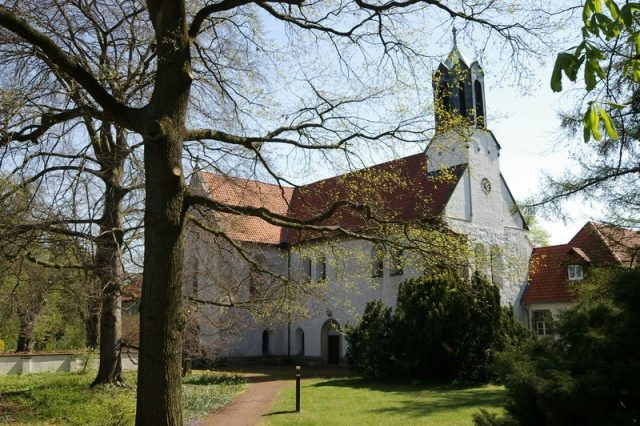
Marienwerder Abbey

Monastery operation

The Marienwerder Monastery is an Augustinian convent in the Marienwerder district in the northwest of Hanover. It is one of the five Calenberg monasteries. The monastery church, built around 1200 in the Romanesque style as a basilica, is the oldest church in Hanover.

The monastery complex is located in the natural transition area from the geest to the loess zone of the Calenberg Land. It is situated in the terrace and floodplain landscape of the Leine, not far from the river. The monastery area includes larger sand dunes, which were blown up on the north bank of the Leine after the last ice age and are now forested.

Foundation

The monastery was founded in 1196 as Monasterium Sanktae Mariae in Werdere by Count Konrad I of Roden. The founding site was on a no longer existing river island in the Leine. According to a legend, a wooden statue of Mary was miraculously washed ashore there, which is said to have led to the founding of the monastery. A similar apparition is said to have led to the founding of Mariensee Monastery about 25 km downstream in 1215. In 1200, the consecration of Marienwerder Monastery took place by Bishop Themar of Minden. For the first few years, the monastery was an Augustinian canonry. At this time, the monastery church adjacent to the monastery was also built. In 1216, the monastery underwent its second consecration and was subsequently inhabited by Augustinian nuns from the Obernkirchen Abbey. In February 1250, Bishop Johann of Minden merged the parish of Garbsen with Marienwerder, so that the monastery church was now also used as a parish church. Over time, the monastery was endowed with possessions. This included the estate of the Counts of Roden, on which it was built, and who were temporarily the city lords of Hanover. In addition, there were lands as well as fishing and mill rights. In the 13th century, the monastery's possessions included the villages of Garbsen, Linden, and Limmer.

Building History

The three-aisled monastery church was built around 1200 in the Romanesque style from quarry stones. The northern side aisle was destroyed by a fire in 1135 and was not rebuilt. Over the course of the Middle Ages, the building underwent various alterations.

In 1335, a fire destroyed almost the entire monastery complex, but the church remained largely intact. In the following years, the monastery was rebuilt with the help of donations and re-consecrated in 1339. In another major fire at the monastery in 1687, the church was again largely spared. In 1688, residential buildings were built as the west and south wings of the monastery church. In 1704, a two-story east wing was erected. Around 1860, there was a church renovation by Conrad Wilhelm Hase. Around 1885, the chancel was painted by Oscar Wichtendahl. In 1997, on the occasion of its 800th anniversary, the church received a remarkable bronze entrance door with biblical motifs.

Reformation

In 1542, the monastery finally became Protestant due to the Calenberg Church Order issued by Elisabeth of Brandenburg and Anton Corvinus. Both thus introduced the Lutheran Reformation in the Calenberg Land. A counter-reformation in 1546 by Elisabeth's husband Erich II failed. Elisabeth subsequently confiscated the monastery's possessions, but did not transfer them to the state treasury, but instead established a fund. This led to the "General Hanoverian Monastery Fund," which continues to exist today as the Klosterkammer Hannover. In 1603, the common kitchen and economy typical of monastic life were dissolved, and the conventuals now received their livelihood individually. During the Thirty Years' War (1618-1648), the monastery suffered from plundering mercenary hordes, so that the four remaining nuns temporarily fled to a town house belonging to the monastery in Hanover. In 1663, Duke Georg Wilhelm of Calenberg issued a new monastery order and demanded that the nuns confess to the Augsburg Confession. In 1687, the second major fire at the monastery occurred. In the following year, the south and west wings were rebuilt, and the monastery church received a bronze bell.

Redesign+

Hinüber Garden

In the 18th century, construction measures took place on the east wing of the monastery. In 1727, the monastery was leased to Carl Anton von Hinüber. From 1760, Jobst Anton von Hinüber was the bailiff of the monastery. He transformed it into a model agricultural estate based on the English model.

In 1774, Jobst Anton von Hinüber had an approximately 40-hectare area laid out as a garden in the style of a Jardin anglo-chinois, which was called the Hinüber Garden. The complex contained various follies, such as a "Witch's Tower" (artificial tower ruin), a "Chinese Pavilion," and a grotto on the bank of the large pond, on which Venetian gondolas floated and in which a flower island was laid out. Von Hinüber also intended the harmonious unity of designed landscape and agricultural use in the sense of a so-called ornamented farm. A visit to his garden is said to have been a mandatory program for educated guests of the Electorate of Hanover.

Redesign 19th and 20th Century

In the mid-19th century, the monastery church was in a very poor condition. Only after a visit by the king did extensive renovation work begin in 1858: The galleries were rebuilt, and the church received new interior furnishings in the form of pews, a pulpit, a lectern, and a high altar. In addition, a parish cemetery was laid out in 1862. In 1924, the monastery and cemetery chapel received new bells, after the old ones had been melted down in the First World War. In 1927, the city of Hanover acquired the monastery estate. In 1962, a nursing home for members of monasteries and abbeys was built. From 1976 to 1978, a final renovation took place on the east wing of the monastery to create space for new apartments.

Current Situation+

The assets and buildings of the monastery are managed by the Klosterkammer Hannover. The convent of the monastery currently (January 2014) consists of four ladies and an abbess. Two monastery wings house a nursing home for canonesses of the Calenberg and Lüneburg monasteries.

The monastery church is also used by the Marienwerder parish, which comprises about 720 members. The parish maintains partnerships with communities in Leipzig and Tanzania.

Take Mobile History with you

You are reading this text for free. Premium adds what matters on the road: descriptions read aloud, sites found through your camera, whole regions taken offline.

  • Every description, including the ~17,700 Premium sites
  • Audio guide: have descriptions read to you on location
  • AR finder: see sites through your camera, with distance and bearing
  • Unlimited saved sites

14 days free, then from €2.99 a month. Cancel anytime.

Source: Wikipedia · Licence: CC BY-SA 4.0 · Image: http://de.wikipedia.org/wiki/Kloster_Marienwerder#mediaviewer/Datei:1171_-_Hannover_-_Marienwerder_-_Kloster_-_20050420.JPG

This description draws on the facts documented in the linked Wikipedia article; Wikipedia content is licensed under CC BY-SA 4.0. Wording and editing: Mobile History.

Location: 52.4061, 9.6281