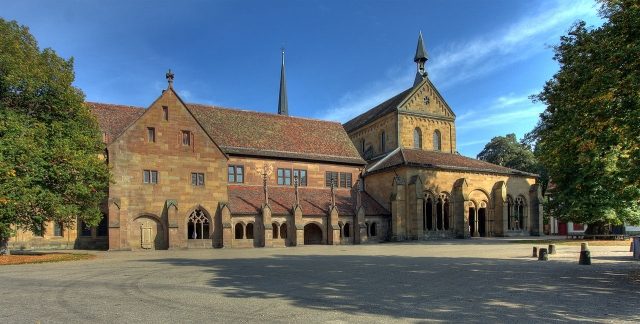
The Monastery can be visited
Maulbronn Monastery

Maulbronn Monastery (German: Kloster Maulbronn) is the best-preserved medieval Cistercian monastery complex in Europe. It is situated on the outskirts of Maulbronn, Baden-Württemberg, Germany and is separated from the town by fortifications. Since 1993 the monastery is part of the Unesco World Heritage.
The monastery was founded in 1147 under the auspices of the first Cistercian pope, Eugenius III. The main church, built in a style transitional from Romanesque to Gothic, was consecrated in 1178 by Arnold, Bishop of Speyer. A number of other buildings — infirmary, refectory, cellar, auditorium, porch, south cloister, hall, another refectory, forge, inn, cooperage, mill, and chapel — followed in the course of the 13th century. The west, east and north cloisters date back to the 14th century, as do most fortifications and the fountain house or lavatorium.
After the Reformation broke out, Ulrich, Duke of Württemberg, seized the monastery in 1504,[dubious – discuss] later building his hunting lodge and stables there. The monastery was pillaged repeatedly: first by the knights under Franz von Sickingen in 1519, then again during the German Peasants' War six years later. In 1534, Duke Ulrich secularised the monastery, but the Cistercians regained control — and Imperial recognition — under Charles V's Augsburg Interim. In 1556, Christoph, Duke of Württemberg, built a Protestant seminary, with Valentin Vannius becoming the first abbot two years later; Johannes Kepler studied there 1586–89.
In 1630, the abbey was returned to the Cistercians by force of arms, with Christoph Schaller von Sennheim becoming abbot. This restoration was short-lived, however, as Gustavus Adolphus of Sweden forced the monks to leave again two years later, with a Protestant abbot returning in 1633; the seminary reopened the following year, however the Cistercians under Schaller also returned in 1634. Under the Peace of Westphalia, in 1648, the confession of the monastery was settled in favour of Protestantism; with abbot Buchinger withdrawing in process. A Protestant abbacy was re-established in 1651, with the seminary reopening five years later. In 1692, the seminarians were removed to safety when Ezéchiel du Mas, Comte de Mélac, torched the school, which remained closed for a decade.
The abbey was secularised by Frederick I, King of Württemberg, in the course of the German Mediatisation in 1807, forever removing its political quasi-independence; the seminary merged with that of Bebenhausen the following year, now known as the Evangelical Seminaries of Maulbronn and Blaubeuren.
The monastery, which features prominently in Hermann Hesse's novel Beneath the Wheel, was inscribed on the World Heritage List in 1993. The justification for the inscription was as follows: "The Maulbronn complex is the most complete survival of a Cistercian monastic establishment in Europe, in particular because of the survival of its extensive water-management system of reservoirs and channels". Hesse himself attended the monastery before fleeing in 1891 after a suicide attempt, and a failed attempt to save Hesse from his personal religious crisis by a well-known theologian and faith healer.
An image of Maulbronn Abbey is set to appear representing Baden-Württemberg on the reverse of the 2013 €2 commemorative coin for Germany.
Take Mobile History with you
You are reading this text for free. Premium adds what matters on the road: descriptions read aloud, sites found through your camera, whole regions taken offline.
- Every description, including the ~17,700 Premium sites
- Audio guide: have descriptions read to you on location
- AR finder: see sites through your camera, with distance and bearing
- Unlimited saved sites
14 days free, then from €2.99 a month. Cancel anytime.
Source: Wikipedia · Licence: CC BY-SA 4.0 · Image: http://commons.wikimedia.org/wiki/File:Kloster_Maulbronn_2009.jpg
This description draws on the facts documented in the linked Wikipedia article; Wikipedia content is licensed under CC BY-SA 4.0. Wording and editing: Mobile History.
Location: 49.0012, 8.8128