Church Academy
School
MonasteryObermarchtal
Obermarchtal Abbey
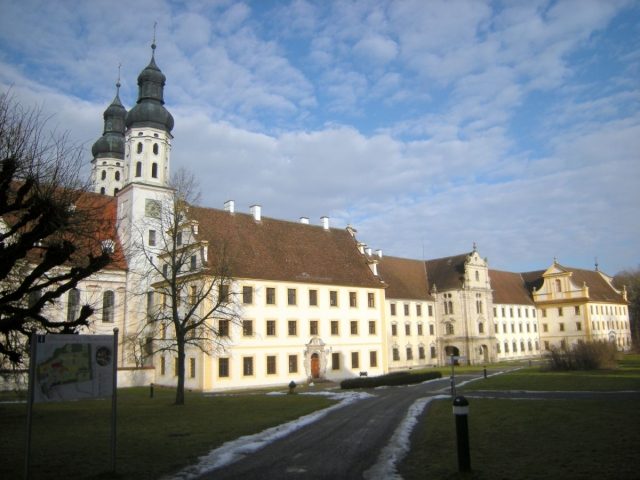
Marchtal Abbey (German: Kloster Marchtal or Reichsstift Marchtal) is a former Premonstratensian monastery in Obermarchtal in the Alb-Donau-Kreis, Baden-Württemberg, Germany. The minster church of Saints Peter and Paul, the former abbey church, located on a prominent elevation, still dominates the landscape for miles around.
History+
First foundation+
In 776 the noble clan of the Ahalolfinger made a gift of the monastery founded by their ancestor Halaholf and his wife to St Gall's Abbey. By 993 the monastery had become a collegiate foundation of canons dedicated by Herman II, Duke of Swabia, and his wife Gerberga to the apostles Peter and Paul. During the 12th century the monastery passed through the possession of a series of Swabian nobles, including the Staufen and particularly Frederick I, Holy Roman Emperor. These constant changes of proprietor caused a severe decline in the monastery.
Second foundation+
In 1171 the monastery was refounded by Pfalzgraf Hugo II of Tübingen as a Premonstratensian double abbey for men and women and given an adequate endowment. The canons were brought from Mönchsrot Abbey in Rot an der Rot. The existing premises were extensive and large-scale construction was not immediately necessary. The first prior of the new foundation was Eberhard von Wolfegg from Mönchsrot Abbey. Between 1204-1208 Prior Meinhardt had the walls rebuilt. Prior Walther II had the old church extended to a three-aisled basilica, which was dedicated on 2 May 1239 by Henry I, Bishop of Constance. In 1273 Prior Konrad (1226–75) forbade any more admissions to women, and the double monastery soon became one for men only. Under Prior Heinrich Mörstetter (1436–61) Marchtal was raised to the status of an abbey, in 1440. In 1500 it was made an Imperial abbey, with a place and vote in the Reichstag. In 1609 the abbot received the right to bear the pontificalia (mitre, ring and pectoral cross). At this period more than 20 places and estates belonged to the territory of the abbey, besides houses in the towns of Reutlingen, Ehingen, Munderkingen and Riedlingen. The Thirty Years' War caused much distress in the southwest of Germany. In 1632 the canons had to flee from the Swedes. The buildings survived the war, but in a very dilapidated state.
Source: Wikipedia · Licence: CC BY-SA 4.0 · Image: http://schloesserrundschau.de/bawue/schloesser/albdonau17.html
This description is an excerpt from the linked Wikipedia article and was written by its authors. Like the original it is licensed under CC BY-SA 4.0 and may be reused under the same terms.
Location: 48.2365, 9.5710