Monastery operations
MonasteryZell am Main
Oberzell Abbey
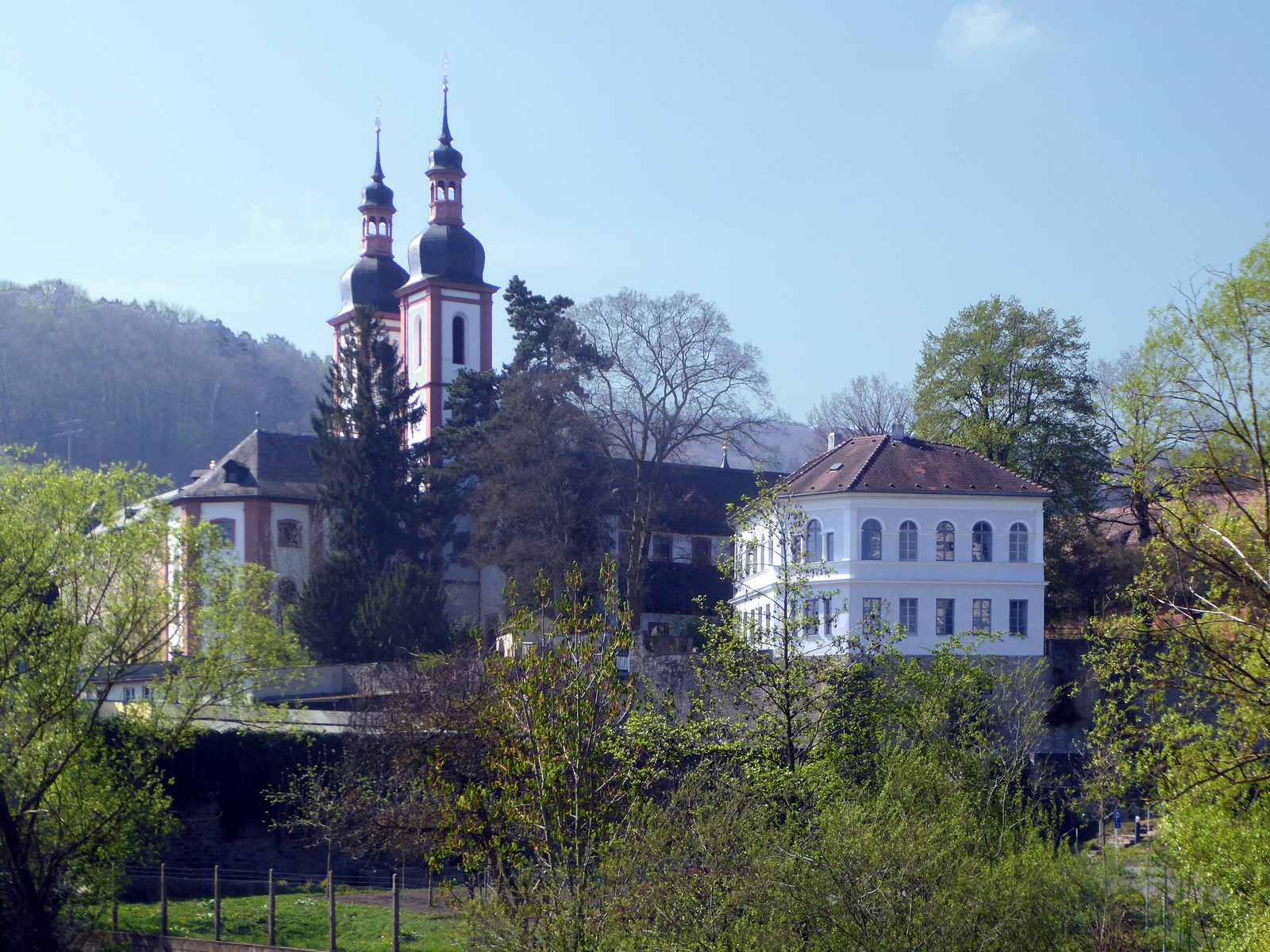
Oberzell Abbey is a monastery in Zell am Main, Bavaria, in the Diocese of Würzburg. The monastery is located on the left bank of the Main River, about six kilometers from Würzburg, partly within its territory.
The Premonstratensian monastery, dedicated to the Archangel Michael, was founded in 1128 as a double monastery by Johannes, a cathedral canon, and his brother Heinrich, at the instigation of the order's founder, Norbert of Xanten, revered as a saint since 1582. Around 1230, Hermann I von Lobdeburg, Bishop of Würzburg, founded Unterzell Abbey by relocating the women's convent affiliated with Oberzell Abbey. In 1525, rebellious, serf-bound peasants plundered Unterzell Abbey during the German Peasants' War. In 1562, under Prince-Bishop Friedrich von Wirsberg, it came under the administration of the Prince-Bishops of the Prince-Bishopric of Würzburg. After a checkered history, Oberzell Abbey experienced its heyday under Abbot Oswald Loschert (1747 to 1785). Balthasar Neumann, the famous architect of the Würzburg Residence, created the new Baroque building. After Neumann's death, the staircase was completed in 1760 under the direction of his sons, but the abbey building remained without a wing towards the church.
Until the secularization in Bavaria in 1803, it was the only Premonstratensian monastery in Franconia with the rank of an abbey. The abbey was dissolved in 1803 as part of the secularization, and the last abbot, Christoph Kroh, was compensated with a pension. The church was desecrated, and the library was given to the University of Würzburg. All monastic property was expropriated: 90 acres of vineyard, 637 acres of meadows, 22 acres of garden, 8180 acres of forest, the farms and houses in Waldbrunn, Moos, Estenfeld, and Würzburg. Most of Onghers' paintings from the art gallery are lost, the furniture was scattered to the winds, and even some of the documents and manuscripts were lost.
Secularization 1803 to 1900+
In 1812/13, the so-called "Schlösschen" (small castle) with its rare architecture was built, enthroned on the monastery wall above the Main. It belongs to the era of Classicism, a subform of revolutionary architecture. The Schlösschen was designed by architect Peter Speeth. The builder was Joel Jakob Hirsch (1789 to 1876). The Jewish banker had the Schlösschen built as a summer residence. In 1817, Friedrich Koenig and Andreas Friedrich Bauer established a printing press factory in the monastery building, which, as Koenig & Bauer, enjoys world renown today.
Source: Wikipedia · Licence: CC BY-SA 4.0 · Image: Renardo la vulpo · Wikimedia Commons · CC0
This description is a machine translation of an excerpt from the linked Wikipedia article. The source text was written by its authors, the translation is by Mobile History; like the original it is licensed under CC BY-SA 4.0.
Location: 49.8009, 9.8780