MonasteryArnsberg

Oelinghausen Abbey (Arnsberg)
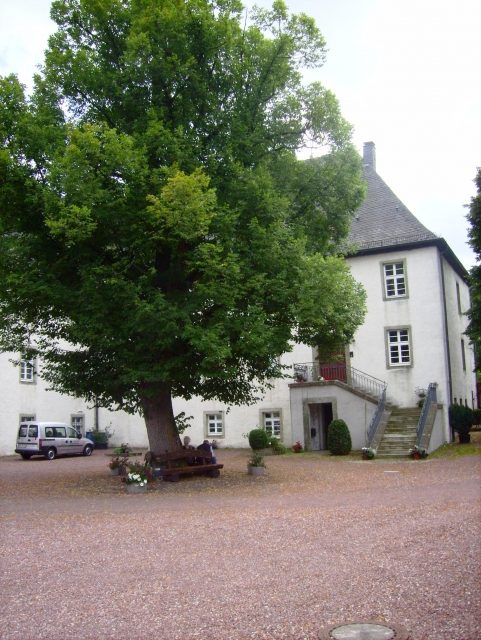
Oelinghausen Abbey (Arnsberg)

Museum

Monastery operation

The Oelinghausen Monastery in the Arnsberg district of Holzen was founded in 1174, initially as a double monastery, before developing into a pure Premonstratensian nunnery. In the 17th century, it was converted into a secular women's collegiate foundation, before returning to the Premonstratensian order after a few decades. The monastery was dissolved in 1804 during the secularization.

The monastery church, dedicated to Saint Peter and Saint Mary, has since been a parish church. The largely Gothic church dates essentially from the 14th century. The interior was uniformly redesigned in the Baroque style in the 18th century. Notable furnishings include the so-called "Cologne Madonna" from the first decades of the 13th century and the organ, parts of which still date from the 16th century.

Since 1992, the restored monastery building has been inhabited by sisters of Saint Mary Magdalene Postel. A monastery garden museum has existed for several years. The monastery and the associated manor are located in a predominantly agricultural and forestry area, significantly distant from the nearest closed settlements of Herdringen and Holzen.

Historical Development+

Founding Period

The monastery was founded in 1174 by Siegenand von Basthusen, a ministerialis in the service of the Archbishop of Cologne, and his wife Hathewigis. The founders transferred estates in Oelinghausen and Bachum to the monastery. A few years later, the founder again endowed the monastery and transferred the Vogtship of the monastery to a Count Reiner von Freusburg. After his death, the founder was buried in the monastery church.

In its development phase, the complex was a double monastery, i.e., canons and canonesses lived spatially separated in one building complex. Recent research provides a more precise picture. According to historian Edeltraud Klueting, Oelinghausen was initially an institution for women, for whom Scheda Monastery near Wickede provided pastoral care. Only after a certain consolidation phase is there evidence in the sources for a double convent. This way of life was not unusual for early monastic history until the General Chapter of the Premonstratensian Order decided in 1188 to separate male and female convents. However, it is unclear when the character as a double monastery ended in Oelinghausen and other monasteries. In Oelinghausen, it did not end before the early 13th century. It is still verifiable for 1194, but even in 1238, there is still talk of "fratrum et sororum".

Oelinghausen was not independent but was initially subordinate to the abbot of Scheda Monastery and from 1228 to the paternity of Wedinghausen Monastery near Arnsberg. In contrast to Rumbeck Monastery, it was able to retain the free election of the provost. Klueting suspects that the change of paternity coincided with the end of the double monastery character. But instead of a clear break, there was probably a transitional period that lasted until the fourth decade of the 13th century.

Gaining Significance and Prosperity

The monastery was promoted by the Archbishops of Cologne. Philipp von Heinsberg confirmed the foundation in 1174, freed it from belonging to the Hüsten parish in 1179, and gave it a tithe. Adolf I von Altena freed it from archidiaconal jurisdiction after 1194. He also gave the monastery a forest and confirmed its existing rights and possessions. Bruno IV von Sayn freed it from the Vogtship by noble families in 1208. Engelbert von Berg donated the miraculous image of the enthroned Madonna. He also probably arranged for the monastery to receive the confirmation of its foundation by Pope Honorius III in 1225. It states that he "takes the prior and convent of Oelinghausen, or the place and the people dedicated to divine service there, with all their goods, under the protection of St. Peter and Paul and himself." He also confirmed all freedoms already granted by the Archbishop of Cologne.

Following the example of the archbishops, numerous nobles and ministeriales also endowed the monastery. Among them was Simon von Tecklenburg as early as 1184. After the turn of the 13th century, Adolf I von Dassel and Hermann II von Ravensberg followed.

However, the Counts of Arnsberg were the foremost patrons until the end of their rule. Gottfried II was the first from the comital house to appear in 1204. He also settled conflicts between the monastery and the commoners from Herdringen. Numerous other founders followed the example of the high nobility. For example, Conradus von Allagen and his heirs donated their own property near Allagen to the monastery in 1194 for their salvation. Lambert, cathedral provost in Paderborn, transferred his estates near Neheim to the monastery in 1207/1212. Despite being freed from the Vogtship, the Counts of Arnsberg exerted considerable influence on the internal life of the monastery. They succeeded in deposing an unpopular provost. As main benefactors, the counts expected good conduct. Over time, they attained a position similar to that of a Vogt.

The first provost known by name, Radolf, succeeded in 1232 in combining the income from the parish in Altenrüthen with the provostship in Oelinghausen, which led to a dispute with Grafschaft Monastery for decades. In the 15th century, the rights reverted to Grafschaft. During Provost Radolf's time, Gottfried II von Arnsberg also transferred the patronage rights of the chapel in Hachen to Oelinghausen Monastery.

In the 14th century, prayer fraternities were formed with numerous other monasteries and collegiate foundations. These demonstrably existed with the monasteries of Varlar, Siegburg, St. Alban in Trier, and Altenberg.

In addition to choral prayer, the monastery fulfilled other tasks. For example, there was an almshouse and a hospital, which received their own income around the 13th century. The hospital still existed at the end of the 15th century.

Crisis in the Late Middle Ages and Early Modern Period

As late as 1391, the Archbishop of Cologne praised the monastery for observing divine services more diligently than others. At the same time, however, significant material problems also became apparent. The Archbishop exempted Oelinghausen from the apparently burdensome raising of hunting dogs. At the same time, he complained that more and more dependent peasants were moving to the cities and free territories. This "theft" of people would cause great damage to the monastery. The Archbishop and sovereign of the Duchy of Westphalia forbade the cities in his sphere of influence from accepting these refugees. He declared the granting of citizenship inadmissible and ordered that those affected should pay a high fine and be returned to the monastery in chains.

Further disintegrating factors were added. There were clear tendencies towards the formation of separate assets and the loosening of enclosure. The monastery was severely affected at the beginning of the 15th century by the plague, which killed a large part of the choir nuns. Archbishop Dietrich II von Moers used the necessity of clothing numerous still young nuns to tighten the enclosure regulations. "The young girls who have taken the habit in Oelinghausen Monastery to serve God shall not be distracted by frequent and useless interaction with secular persons. The Archbishop strictly enjoins everyone to observe the enclosure of the monastery so conscientiously" and not to admit anyone to the interior of the enclosure. Ultimately, however, this remained in vain. From the 15th century, there is even a report of an inn run by a conventual from Wedinghausen.

The Soest Feud in the years 1444 to 1449 brought considerable economic burdens. Provost Heinrich von Rhemen, during his term of office from 1483 to 1505, introduced the usual habit of the Premonstratensian nuns instead of the previously differing clothing. However, it was not possible to prevent the formation of individual households. In order not to completely cut off external donations, the situation was covered by the General Abbot in 1491. Contrary to the order's statutes, he allowed families to transfer secular goods to the nuns for their own needs. In this way, a further loosening of the way of life could not be prevented. Furthermore, there was a lack of clergy to support the provost in his liturgical duties. Even the General Chapter of the abbots urged the recruitment of more chaplains or canons. Provost Gottfried von Ulfte resigned his office in 1539 against this background, which then remained vacant for a decade. Even later, an orderly divine service could not be guaranteed. In 1548, Archbishop Adolf III von Schaumburg visited Oelinghausen Monastery. The prioress, sister of the Landdrost Henning von Böckenförde gen. Schüngel, admitted that the rule was only partially observed and that the main problem was living in individual houses. There were no followers of the Lutheran doctrine, however. Despite some minor measures to re-enforce the monastic rules, the individual dwellings were not fundamentally questioned. Life in Oelinghausen increasingly resembled that in a secular women's collegiate foundation.

In 1583, troops of the Protestant Archbishop of Cologne, Gebhard Truchsess, occupied the monastery. He had a secular administrator appointed, and Lutheran preachers tried in vain to persuade the nuns to change their confession. Most of the women left the monastery and fled to their families. After Gebhard's defeat, the women returned. The monastery had been plundered during the occupation, which exacerbated the already existing economic difficulties. Under the leadership of Kaspar von Fürstenberg, a group of related nobles had drawn up a new order for the monastery. According to this, the office of provost was to be abolished and the sole leadership was to lie in the hands of the prioress. Fürstenberg also pushed through the election of his sister Ottilia von Fürstenberg (1585–1621).

Revival and Conversion into a Women's Collegiate Foundation

Even in the preceding period, Oelinghausen Monastery had become the preferred residence of Ottilia von Fürstenberg's mother and, contrary to the monastic rule, something of a family center. The brothers Kaspar von Fürstenberg and Bishop Dietrich von Fürstenberg contributed greatly to Oelinghausen's economic recovery. Dietrich alone donated 4334 thalers to Oelinghausen in memory of his mother in the form of a memorial and sacrament foundation. In total, he donated 10,000 thalers. Consequently, the abbey building could be rebuilt and the provostry restored. Ottilia succeeded in settling disputes over property and regaining lost estates. Debts of 20,000 thalers were paid off, and a surplus of 13,000 thalers could even be set aside. The prosperity is evidenced by the fact that the monastery, as stated in a visitation protocol, simultaneously hosted the Archbishop of Cologne and the Bishop of Paderborn. However, this period also saw raids by mercenaries from the Netherlands, which forced the convent to flee temporarily. In addition, there were two waves of plague.

Ottilia von Fürstenberg's goal, who was also abbess of Heerse Abbey, was the conversion of Oelinghausen into a women's collegiate foundation. This policy was favored by the internal weakness of Wedinghausen. Only after the election of Abbot Gottfried Reichmann did an open conflict arise from 1613 onwards. The latter aimed to reintegrate Oelinghausen firmly into the Premonstratensian Order. A large part of the nobility of the Duchy of Westphalia, with the Fürstenbergs at the forefront, however, sided with Ottilia von Fürstenberg. Dietrich von Fürstenberg therefore applied to Pope Paul V in 1616 for the conversion into a women's collegiate foundation. An investigation revealed that there could no longer be any talk of monastic life anyway. According to this, there was no monastic observance ("nulla regularis vigeat observantia"). The virgins lived without enclosure, without taking vows, and had laid aside the monastic habit. Thereupon, the Pope dissolved Oelinghausen from the Premonstratensian Order in 1617. A year later, it was converted into a women's collegiate foundation. A new order delimited abbey and chapter assets and stipulated that, in addition to the abbess, as the head was now called, twenty ladies should live there. Even after the death of Ottilia von Fürstenberg, her successors continued the chosen course.

Return to the Premonstratensian Order

During the Thirty Years' War, the ladies repeatedly had to leave Oelinghausen. The Premonstratensians, who did not recognize Oelinghausen's separation from the order, moreover did everything to get the former monastery back. Wedinghausen had temporarily handed over responsibility for Oelinghausen to Knechtsteden Monastery. Its abbot conducted a thirteen-year lawsuit through three instances. Ultimately, the nuncio Fabio Chigi, later Pope Alexander VII, decided against the canonesses. These, however, were not willing to submit to him. Therefore, the Wedinghausen abbot Reichmann attacked the collegiate foundation in 1641 and occupied it. Thereupon, the canonesses had to leave Oelinghausen against compensation.

The monastery was initially re-occupied with choir nuns from Rumbeck Monastery. A provost was again elected, who from then on always came from Wedinghausen. The new beginning was hampered by war damage. Only at the end of the 17th century was the financial situation somewhat consolidated again, so that a new provost's building could be erected under Provost Nikolaus Engel. Under Provost Theodor Sauter (he served from 1704 to 1732), a new convent building was erected, the church interior was splendidly furnished, and an extension and renovation of the organ were carried out. The provost left behind a monastery chronicle. With regard to monastic discipline, the visitors expressed satisfaction.

End and Subsequent Use

However, in the last decades of the 18th century, the advance of the Catholic Enlightenment in the Duchy of Westphalia and the Archdiocese of Cologne endangered the existence of the monastery. The rationalistically oriented Wedinghausen conventual Friedrich Georg Pape had prompted some choir nuns to complain about the provost's authoritarian leadership and to request a visitation. The investigation was entrusted to the ecclesiastical councilor Maria Balduin Neesen, who was committed to the Enlightenment and critical of monastic life. He noted a "monastic despotism" and harshly criticized individual members of the community and the clergy. Both the prioress and the cellarer had to resign their offices. The provost was removed from office in 1789. Neesen argued in vain for the conversion of the monastery into a welfare institution for bourgeois and noble women. But the community remained internally divided. Especially younger choir nuns, influenced by the ideas of freedom and equality, refused obedience to the prioress.

In 1804, in the course of secularization after the Duchy of Westphalia passed to Hesse-Darmstadt, the monastery was dissolved. The monastic estate was initially leased and in 1828 bought by Baron von Fürstenberg from Herdringen. As early as 1806, a curacy benefice was established on the basis of Fürstenberg foundations from the early modern period. Its first incumbent and vicar was the last monastic cleric Johann von Nagel. In 1904, the independent parish of St. Petri Oelinghausen was established. Today, the parish, together with St. Antonius and St. Vitus Herdringen and Heilig Geist Hüsten, belongs to the Pastoralverbund Kloster Oelinghausen.

From 1956 onwards, Mariannhill missionaries lived in Oelinghausen for some time. Since 1992, the restored monastery building has been inhabited by sisters of Saint Mary Magdalene Postel. In the old stable building, a monastery garden museum, operated by the Freundeskreis Kloster Oelinghausen e.V., has existed since 2005. The association also organizes guided tours of the church and the monastery complex. For more than forty years, concerts in the "musica sacra" series have regularly taken place in the monastery church.

Structures+

Possessions

After its foundation, the monastery became increasingly wealthy and was able to buy tithes and farms as early as the 13th century. Bruno, Abbot of Deutz, transferred the villications of the main farms Linne (Kirchlinde) and Ruggingshausen to Oelinghausen Monastery in 1220 and set the dues to be paid. There were repeated disputes over these in the following centuries. Overall, income from villications played only a minor role. By 1300 at the latest, leasing dominated. However, the community also separated from uneconomical possessions, such as shares in vineyards near Remagen, probably due to high transport costs. In 1245, the monastery still received 5000–6000 liters of wine per year. It consumed only a part itself, the rest was sold. According to records from 1280, Oelinghausen owned possessions and income in the parishes of Enkhausen, Hüsten, Menden, in the parishes of Balve, Schönholthausen and Voßwinkel, in the town and district of Werl, in the court of Körbecke, and in the town and surroundings of Soest. In addition, there were possessions on the Hellweg as far as Altenrüthen. To the east, the possessions extended to Horn and Mellrich. For the administration of the possessions, there were several Vogtships of the monastery, for example one on the main farm in Kirchlinde, which was mentioned in 1223, and others in Dreisborn and Sümmern. There were town Vogtships in Werl and Soest, perhaps also in Menden. Later, the officials responsible for collecting dues were called receptors. Such existed at the dissolution of the monastery in 1804 in Werl, Neheim, Menden, Soest and Oestereiden. In addition to tithes and other rights, Oelinghausen still had 130 peasant estates at that time.

Own Economy

Around the monastery itself, it succeeded in transferring all farms into its ownership. This resulted in a significant self-sufficient economy. This was initially organized in the form of the grange or curia system. The Schultenhöfe in Stiepel, Mimberge, and Holzen were managed from the monastery farm. In addition to agriculture and forestry, this included workshops operated by conversi. Their professions included weavers, furriers, shoemakers, construction workers, and blacksmiths. In the 14th century, the number of conversi decreased. This led to the abandonment of the grange economy. With the exception of the actual monastic estate, all possessions were leased. In the 18th century, this included 650 Morgen (slightly more than 160 ha) of agriculturally usable land and another 3000 Morgen of forest with a total of thirty secular employees. The buildings consisted of a church, monastery building, chapel, and dwellings for two clerics. In addition, there were servants' and maids' quarters, a brewery and bakery, stables, garden houses, a barn, a gristmill and sawmill, and an ash and a brick kiln. In Oestereiden, a barn and granary were added, in Soest a receipt house, and in Hachen and Kirchlinde the chapels.

At the time of its dissolution, the self-sufficient economy also included 17 Morgen of vegetable and fruit gardens and 11 Morgen of fish ponds. In total, Oelinghausen owned 24 fish ponds, where mainly carp were bred. In addition to grain and other arable crops, hops were also cultivated. The monastery owned 97 head of cattle, 78 pigs, and 260 sheep. The monastery had to give up a large goat herd in 1726 by electoral order. Oelinghausen tried to increase the yield of its self-sufficient economy by employing charcoal burners, establishing a brickworks, a distillery, and similar ventures.

Among the oldest commercial enterprises in the monastery area are mills. There was probably a mill already at the time of its foundation. The donation of a mill near Werl in 1203 by Gottfried II is documented. The monastery built a ban mill on the Bieberbach. They were initially operated by conversi. From the middle of the 15th century, the mill was leased. In addition to the gristmill, the monastery operated a sawmill and an oil mill.

Only recently has it been proven that there was probably mining and smelting activity in the Middle Ages and early modern period. This is indicated by pits and prospecting sites, as well as an archaeologically proven smelting plant in the form of a bloomery furnace. Ceramic remains dating from the 13th to 15th centuries were found in the immediate vicinity of the furnace.

The monastery took over the farm in Soest from St. Walburgis Abbey after the Soest Feud. For Oelinghausen Monastery, the stone house, which had its own chapel, was not only the center for the administration of the monastery's property around Soest, but also benefited from its connection to the urban market. From there, the goods necessary for the monastery could be acquired and the produced goods sold. The house served as an interim storage facility.

Overall, revenues are estimated at over 18,000 thalers per year. In addition, there was active capital of 16,000 thalers. This made Oelinghausen the wealthiest women's monastery in the Duchy of Westphalia.

Convent

The convent was considered more distinguished than that in Rumbeck. The choir nuns therefore came from important noble families in the first centuries. Among them were the sister of Archbishop Engelbert von Berg and Irmgard von Arnsberg, the sister of Gottfried III. A whole series of female members of the family of the Counts of Arnsberg were choir nuns in Oelinghausen until the 14th century. Members from the high noble houses of Tecklenburg, Waldeck, Dassel, zur Lippe or Limburg are also said to have belonged to the convent.

With the end of the Arnsberg comital house in the 14th century, Oelinghausen lost its distinguished reputation. High noble ladies were replaced by members of the lower nobility, such as from the families Plettenberg, Böckenförde called Schüngel, Fürstenberg, Vogt von Elspe, Hanxleden, Schade or Wrede. Several choir nuns also came from the patriciate of the city of Soest. The influx was apparently still considerable at the beginning of the 16th century. Visitors of the order noted in 1517 that Oelinghausen had accepted so many novices that they could hardly be provided for by the monastery's income.

For at least the last three hundred years of its existence, the community also included non-noble lay sisters, who were responsible for manual labor. In addition, there were male conversi. These, under a cellarer, were responsible, among other things, for the administration of the extensive property. Manual labor was also performed by conversi at times. Since the 16th century, prebendaries, mostly from peasant families, who primarily performed manual labor, have also been attested.

A characteristic of the Premonstratensian nunneries was that at the head of the convent there was not an abbess as an unlimited leader, but from the time as a double monastery, the provost played a central role. He was responsible for both spiritual supervision and the administration of the estates. Only for contracts concerning the substance of the property did he have to obtain the consent of the convent. According to their noble character, the provosts were primarily chosen from noble Premonstratensian monasteries such as Scheda or Cappenberg Monastery. Since the 15th century, when more non-noble canons lived in Wedinghausen, none of the provosts came from there anymore.

The prioress, who stood at the head of the convent, was only responsible for the internal affairs of the women's community. Other higher monastic offices were subprioress and cellarer. In addition, there were monastic offices such as sacristan and armorer. The prioress was elected by the choir nuns under the direction of the provost and later confirmed by the Wedinghausen abbot. Initially, the prioress lived with the other sisters, later she had her own dwelling. The subprioress mediated between the convent and the prioress. The number of choir nuns in the 13th and 14th centuries was around 60, at the beginning of the 16th century it is even said to have been 80. This number decreased to 40 by the middle of the century and to 30 in the 17th century.

At the end of the early modern period, the character of the convent changed significantly. In the 18th century, Oelinghausen counted 34 "religious". Two-thirds of these were choir ladies and one-third lay sisters. Instead of noble choir nuns, with the exception of members of some salt-boiler families, mainly women from wealthy bourgeois or peasant families took their place. These came from the Duchy of Westphalia as well as from the Archdiocese of Cologne and from the prince-bishoprics of Paderborn, Münster, and the Archdiocese of Mainz. The lay sisters came exclusively from peasant families in the region.

Archive and Library

After its dissolution in 1804, the monastery's archive initially went to the archive depot in Arnsberg. During this time, the records were intensively used to clarify disputed property and legal relationships. Later, the documents and files went to the Provincial Archive in Münster (today the State Archive of North Rhine-Westphalia, Westphalia Department). The archivist Peter von Hatzfeldt created a first finding aid from 1850 to 1860. Compared to other, sometimes widely scattered monastic archives in the Sauerland, the Oelinghausen document collection is, in the opinion of historian Manfred Wolf, "uncommonly rich."

The library holdings of women's monasteries and collegiate foundations in the Duchy of Westphalia are only inadequately preserved. Some of them, including Oelinghausen and Rumbeck, probably never possessed a significant collection of books. During the renewed conversion of the women's collegiate foundation into a monastery in 1641, the ladies burned books. However, these were probably mainly breviaries and choir books for personal use.

Buildings and Furnishings+

Church Building

The building history of the monastery church is not entirely clear due to a lack of written sources. Archaeological excavations revealed remains beneath the church that belong to a non-ecclesiastical building. It is presumed that these are residential or economic buildings of the founding family. Regarding the building history of the church itself, A. Dünnebacke claimed in 1907, a view that Wilfried Michel also adopted a few years ago in the Westfälisches Klosterbuch, that the present sacristy is identical to the older church building. This is now considered refuted.

There was at least a Romanesque predecessor building to the present Gothic church. This was narrower and shorter than the nave of the existing church. A capital from this has been preserved, which today serves as the base for the Paschal candlestick. The crypt beneath the nuns' gallery also dates from the Romanesque period around 1200. This room is single-nave, three-bayed, and has a groin vault. Since the 1960s, the crypt has served as a chapel of grace and is the location of the so-called "Cologne Madonna." An antechamber adjoins the crypt, opening into the nave through three pointed-arch arcades. This three-aisled and single-bayed room is dated to the first half of the 14th century. The sacristy, which was built in three construction phases, is also partly older than the actual church. The oldest parts are early Gothic, a renovation took place in the second half of the 14th century with the new church building, and further changes date from the Baroque period.

The present Gothic church as a whole dates from the 14th century. It is a single-nave, nine-bay hall church with a 5/8 choir. The main nave was built in three construction phases. The choir and the nave are uniformly vaulted with ribbed vaults and keystones at the apex.

From the fourth bay onwards, an elevated nuns' gallery is inserted in the main nave, which is reached via two staircases. It spans about half of the church. Two chapels are located on the south side. Of these, the western one ("Cross Chapel") is three-bayed, the eastern one (the already mentioned sacristy) is two-bayed with a wall apse. In the north, a former, now walled-up entrance serves as a small Marian chapel. The church windows are pointed-arch, two-part with tracery. In the sacristy, the windows are single-part. The church is covered with a slate roof. On the south side, it continues downwards without interruption over the sacristy and the Cross Chapel. The church only received a small bell tower in the 16th century.

Furnishings

In the interior of the church, Gothic wall and ceiling paintings from the last quarter of the 15th century have been visible again since a general restoration between 1957 and 1960. Even older are the white-grey surface tones with painted reddish ashlar and tendril ornaments around the keystone. The plant-like vault decoration, two angels, and other elements date from 1499. The large depiction of Saint Christopher, rediscovered in 1933, dates from the beginning of the 16th century.

From 1704 to 1732, Provost Theodor Sauter had the church furnished in Baroque style. The sculptor Wilhelm Spliethoven, known as Pater from Volbringen, created a comprehensive interior with a high altar, life-size apostle figures, and organ case. Only in Oelinghausen has the work of this artist, who created several church interiors in Westphalia, been completely preserved to this day. The illumination (painting) of the Baroque interior by Alexander La Ruell (Münster) has also only been preserved in Oelinghausen.

The Madonna in the crypt is referred to as "Our Lady of Cologne," "Queen of the Sauerland," or "Cologne Madonna." It dates from the first decades of the 13th century. The Virgin sits on a throne and is dressed in a long robe; her face and body are turned frontally towards the viewer. The Infant Jesus was added in the Middle Ages. He holds a book in his left hand, and his right hand is raised in blessing. Together with the throne, the Madonna is 57 cm high. The hands, the Infant Jesus, and the crown were newly created after losses. Based on recent art historical investigations, the image received its current color scheme, approximating the original, in 1976. A comparable, though somewhat younger, depiction in the region can be found in the Merklinghausen Chapel.

The 10 m high main altar with numerous statues is Baroque and was created in 1712 by Wilhelm Spliethoven – possibly according to the specifications of Provost Sauter – based on Italian models. The paintings are by Alexander La Ruell.

The twelve apostle figures in the main nave are also by Spliethoven and La Ruell.

In the Cross Chapel, there are several tombstones of former provosts. Dominant, however, is the epitaph for Ottilia von Fürstenberg, which today serves as an altar retable. The tomb was probably created by Gerhard Gröninger or an Italian artist. In the vault of the Cross Chapel, there is a late Gothic crescent moon Madonna from around 1530.

The Marian Chapel contains a Gothic panel painting depicting the Bethlehem Nativity scene. In addition, there is a Baroque painting here showing the murder of Archbishop Engelbert I of Cologne. According to monastic tradition, which, however, does not correspond to actual historical events, the bishop is said to have spent the night before his murder in Oelinghausen.

On the nuns' gallery, to the right and left of the wall, is the choir stall with 46 seats, the back rows of which date from the 18th century. In the front rows, the late Gothic end pieces from around 1380 were reused. On the gallery, there is also a triumphal cross from the second half of the 12th century. Under the vault is a two-meter-high Baroque double Madonna from around 1730. The back wall of the organ is covered by a large St. John's altar, next to which stand the so-called Apostle Towers. The figures placed there are late Gothic and possibly come from a lost carved altar; some of the younger ones are attributed to Gertrud Gröninger. Sculptures from the period between the 14th and 17th centuries are also found on the choir stalls of the gallery.

Organ

An organ, probably in the form of a swallow's nest organ, was first mentioned in Oelinghausen in a memorial foundation by Provost Wilhelm Freseken. However, the source does not state that it was donated by Freseken, as has sometimes been claimed. The organ work was expanded in 1499. At this time, there was probably already a larger second organ. In 1585, a spring chest organ with two manuals was registered. On February 2 of the following year, Dutch troops of Martin Schenk von Nideggen attacked the monastery and destroyed the organ in the process. After the destruction of the older instrument, the Paderborn Prince-Bishop Theodor von Fürstenberg donated two new organs to his sister and prioress Ottilia in 1599. The new organ was built by Marten de Mare at the location where it still stands today, using the material from the predecessor organs that was available to him and not destroyed in 1586. Johann Berenhard Klausing from Herford began renovation and expansion work on the organ in 1713. Klausing's work was completed in 1717. The organ case was created by Spliethoven and La Ruell. The special feature of the organ in Oelinghausen is that most of the pipes have remained unchanged since 1599 or 1717. The stops from 1599 are particularly noteworthy because they are hardly found in this form in Germany and neighboring countries. The panel paintings on the organ's back wall date back to De Mare's original wing doors. From 2000 to 2002, the instrument was extensively restored and reconstructed by the Swiss company Orgelbau Kuhn with financial support from the Freundeskreis Oelinghausen e. V. (founded in 1983), with the condition of 1717 being decisive.

Notes

Further Buildings

Apart from the church, few of the former monastery buildings remain. The actual monastery building was attached to the church on the west side. The last building had three wings. However, only the eastern and southern wings are preserved. The northern wing was demolished after secularization. The monastery building was erected at the beginning of the 18th century. However, it rests on the foundations of earlier buildings. For example, two fireplaces are preserved in the cellar. One of them bears the coat of arms and life data of Ottilia von Fürstenberg. A farm building was erected at the beginning of the 20th century on the site of the former north wing. This is a listed building and today houses the monastery garden museum. To the southwest of the church and convent building stands a half-timbered house. Some refer to it as the shepherd's house, others see it as one of the individual residential houses from the time of the women's collegiate foundation. Immediately to the right in front of the so-called shepherd's house is the former "Oberförsterscheune" (head forester's barn), a building with foundations from the 16th century. Extensively restored, it now houses an occupational therapy practice run by one of the sisters living in Oelinghausen. The monastery area is surrounded by a 400-meter-long listed wall. This was formerly about eight meters high and even had towers. The monastery wall is a habitat for various plants and animals. East of the monastery church lies the reconstructed monastery garden.

Although located on former monastery grounds, the Oelinghausen estate, which is owned by the von Fürstenberg family, no longer belongs to the actual monastery area today. Parts of the estate are also listed buildings. These include gate entrances and an administrator's house, which was built during the Wilhelminian era with Art Nouveau influences. Also noteworthy is the large dovecote in the farmyard, which, although built only in the 19th century, connects to the monastery's old self-sufficient economy.

Take Mobile History with you

You are reading this text for free. Premium adds what matters on the road: descriptions read aloud, sites found through your camera, whole regions taken offline.

  • Every description, including the ~17,700 Premium sites
  • Audio guide: have descriptions read to you on location
  • AR finder: see sites through your camera, with distance and bearing
  • Unlimited saved sites

14 days free, then from €2.99 a month. Cancel anytime.

Source: Wikipedia · Licence: CC BY-SA 4.0

This description draws on the facts documented in the linked Wikipedia article; Wikipedia content is licensed under CC BY-SA 4.0. Wording and editing: Mobile History.

Location: 51.4126, 7.9442