Abbey
MonasteryOttobeuren
Benedictine Abbey Ottobeuren
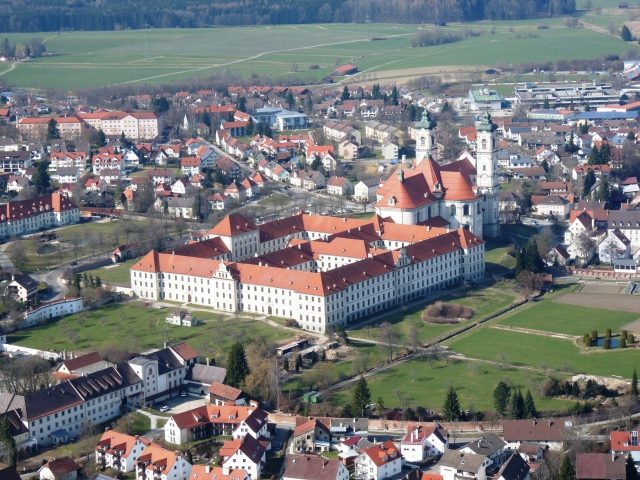
A Benedictine monastery in Bavarian Upper Swabia, Ottobeuren Abbey, stands as an example of Baroque monastic architecture. Often referred to as the “Swabian Escorial,” the complex with its appearance and furnishings.
History+
Ottobeuren Abbey was founded in 764 by the Alemannic nobleman Silach. As early as 972, it was elevated to an Imperial Abbey under Emperor Otto I. After a period of subordination to the Bishop of Augsburg, the monastery experienced a golden age during the era of church reform. The Hirsau-Georgener reform, introduced by Abbot Rupert I, shaped monastic life and influenced other monasteries such as Ellwangen and Marienberg. In the 13th century, Ottobeuren solidified its status as an Imperial Abbey, confirmed by the Imperial Chamber Court in 1624. The monastery possessed an extensive dominion with 27 surrounding villages. Despite internal difficulties in the late Middle Ages and its subordination to Augsburg, it survived the Reformation. The current Baroque complex, built between 1737 and 1766, to the abbey's economic power. In 1802, the monastery was dissolved during secularization, but it was re-established as a priory in 1835 and again elevated to an independent abbey in 1918.
Source: Wikipedia · Licence: CC BY-SA 4.0
This description draws on the facts documented in the linked Wikipedia article; Wikipedia content is licensed under CC BY-SA 4.0. Wording and editing: Mobile History.
Location: 47.9414, 10.2981