Restaurant
Museum
MonasteryKönigsee-Rottenbach-Paulinzella
Paulinzella Abbey
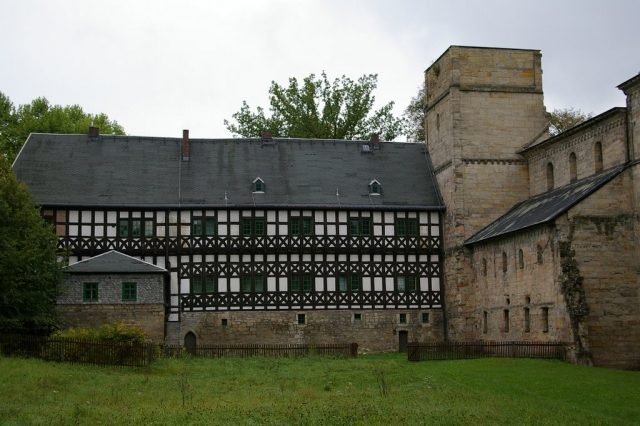
Paulinzella Monastery is a former Benedictine monastery in Paulinzella in the Rottenbach Valley in Thuringia. The ruins of the monastery church are among the most important Romanesque buildings in Germany.
The origin of Paulinzella lies in a hermitage, which was founded between 1102 and 1105 by the Saxon noblewoman Paulina. Paulina was the daughter of the seneschal Moricho (Moritz) from the court of King Henry IV. The king had given Moricho 24 royal hides in Gebstedt in 1068/69. Moricho, who, according to another document, was a brother of Bishop Werner von Wolkenburg of Merseburg, left these estates to his daughter Paulina before entering Hirsau Monastery. Paulina had previously resided in Gatterstädt (near Querfurt). Paulina also acquired the outworks of Hengelbach, Liebringen, and Nahewindten near the estates. The actual founding of the monastery, originally called Marienzelle, in the early Frankish settlement period, is attributed by legend to a travel accident of Paulina in the previously uninhabited forest valley.
In 1106, work began on the monastery complex. In 1107, the monastery joined the Hirsau Reform. In 1124, the monastery church, which had been built on the model of the monastery church in Hirsau, was consecrated. The monastery quickly acquired rich possessions. 19 villages were owned by the monastery, and in 52 other places, the monastery owned further estates; the monastery held rights in over 100 places in total. The economic center of the monastery and its villages was the now deserted outwork of Neusis between Gösselborn and Hengelbach.
As early as 1195, the third abbot in office received the mitre from the Archbishop of Mainz. Until the middle of the 14th century, Paulinzella was a double monastery, then only a monastery for monks. 27 named abbots served in the monastery. The patrons were the Counts of Schwarzburg. From 1133 to 1153, Sizzo III was mentioned. The monastery also owned serfs. Several noble and wealthy families near the monastery were in feudal relationships. The abbots exercised patronage rights over 24 churches or chapels. The monastery existed for over 400 years.
Then, during the Peasants' War, the Schwarzburg farmer exchanged the plough for weapons to achieve his independence. This, with the introduction of the Reformation in 1533 by the Counts of Schwarzburg, marked the beginning of its decline. Johann V. Schidt, from the neighboring village of Milbitz, was the last abbot from 1528 until its dissolution in 1541/42. In 1542, after fruitless resistance, it passed into secular jurisdiction. The estates were leased or administered by officials. Heinrich von Schwarzburg-Leutenberg seized the church treasury and confiscated all the monastery's possessions.
During the Peasants' Wars, the monastery was plundered and dissolved in 1542 during the Reformation. The former monastic property came into the possession of the Counts of Schwarzburg-Rudolstadt in 1547. They established the Paulinzella district, consisting of seven localities, which was enlarged in 1803 by the Ehrenstein district but incorporated into the Stadtilm district in 1851.
After the dissolution of the monastery, a gradual decay of the entire monastic complex began, which was also used as a quarry for sandstone for construction purposes. After 1600, the entire complex burned down and completely fell into ruin. In 1680, parts of the monastery complex were renovated.
Source: Wikipedia · Licence: CC BY-SA 4.0 · Image: Google Hupf
This description draws on the facts documented in the linked Wikipedia article; Wikipedia content is licensed under CC BY-SA 4.0. Wording and editing: Mobile History.
Location: 50.7025, 11.1038