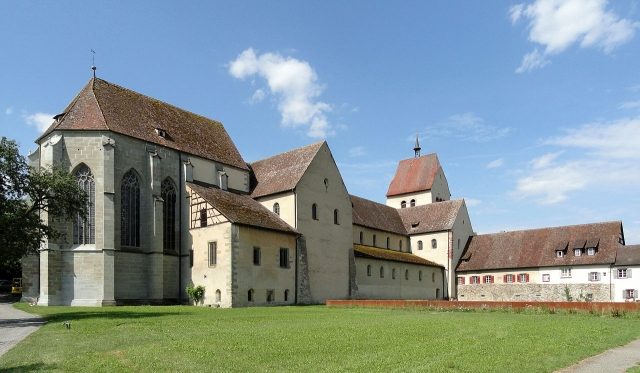
MonasteryReichenau

Reichenau Abbey

Reichenau Abbey

Municipal offices

Reichenau Abbey was a Benedictine monastery on Reichenau Island in Lake Constance. It was founded in 724 by Pirminius and became a priory of the Bishop of Constance in 1540. Alongside St. Gallen and Fulda, it is considered one of the most important monasteries of the Carolingian era. In 1803, the monastery was dissolved; today, the building houses the town hall of the municipality of Reichenau.

The monastery's illuminated manuscripts were inscribed in the UNESCO Memory of the World Register in 2003. Since 2001, after 250 years, a small community of Benedictine monks has once again lived on the island.

Foundation Legend

Reichenau Island was within the sphere of influence of an Alemannic nobleman named Sintlas, who resided at the nearby Sandeck Castle, in the present-day municipality of Salenstein on the opposite Swiss shore. Therefore, the island was formerly also known as Sintlas-Au or Sindleozesauua. When Saint Pirminius arrived at Lake Untersee in 724, Sintlas asked him to build a chapel in the area. Pirminius chose Reichenau Island as the location. It was covered with an inhospitable primeval forest and full of snakes, toads, and insects. Where Pirminius first set foot on the island, a spring emerged. The vermin, however, fled the island for three days and swam across the lake. Pirminius and his companions then cleared the area, made the island habitable for people, and founded a monastery.

Middle Ages

The Benedictine monastery was founded in 724 by the missionary bishop Pirminius in what was then largely pagan Alamannia. Subsequently, under Abbot Waldo, it became a Carolingian abbey and enjoyed the support of the Frankish mayors of the palace and kings. Thus, a first flourishing period for the monastic community, important for the Christianization of Alamannia, fell in the late 8th and 9th centuries. Abbot Waldo (786–806) was the founder of the Reichenau School of Scholars. He granted Egino of Verona permission to found the Cella St. Peter and Paul at the western tip of the island. Abbot Haito (806–823) was the builder of the Minster of St. Mary in Mittelzell. Emperor Charles the Fat was buried in the church's choir in 888. The Reichenau confraternity book and the St. Gall Plan, developed on Reichenau, date from the 9th century, at the end of which the politically very influential Abbot and Archbishop of Mainz Hatto III (888–913) had St. George's Church in Oberzell built.

Through privileges such as immunity, customs exemption, electoral rights, and donations from Kings Henry I, Otto I, and Otto II, and their visits, Reichenau achieved its second cultural golden age around the turn of the millennium during the time of the Ottonian kings. This is represented by the "golden" Abbot Witigowo (985–997) and the reform abbots Immo (1006–1008) and Berno (1008–1048). The famous Reichenau scriptorium belongs here, as do the wall paintings in St. George's Church in Oberzell and the historical writings of Hermann of Reichenau († 1054) and Berthold of Reichenau. A kind of afterglow of the island monastery can be observed during the reign of Abbot Diethelm of Krenkingen (1169–1206). After that, the spiritual and material decline of the monastic community began in a rapidly changing social and economic environment of the late High Middle Ages. Reform attempts repeatedly failed. In the second half of the 14th century, the entire monastic property was at times pledged. Abbot Eberhard of Brandis finally sold all the goods and rights of his monastery to his relatives in 1367. In 1402, besides the abbot, there were only two high-ranking conventuals as "monks."

At the end of the Middle Ages, the Benedictine monastic ideal regained its footing, the Minster in Mittelzell was extended with the late Gothic choir, and the Radolfzell chronicler Gallus Öhem wrote a monastery history. In 1540, Abbot Markus von Knöringen renounced the leadership of the monastery, which he ceded to the Bishop of Constance. Subsequently, Reichenau, as a priory with twelve monks, was merely an administrative office of the Diocese of Constance (Obervogteiamt). The fortunes of Reichenau Abbey were also described in Heinrich Murer's short but lavishly illustrated chronicle, created around 1627.

Dissolution of the Monastery

Attempts by the spiritual community on Reichenau to regain independence ended with the dissolution of the monastery in 1757. In 1803, the monastery was dissolved as part of the secularization following the Reichsdeputationshauptschluss.

Cella St. Benedict (from 2001)

250 years after the last Benedictines had to leave Reichenau Island, through the mediation of Bishop Reinhard Lettmann of Münster and Archbishop Oskar Saier of Freiburg, on September 1, 2001, Father Nikolaus Egender OSB, former abbot of Dormition Abbey in Jerusalem, and Father Stephan Vorwerk OSB, former prior of the Benedictine Priory of Tabgha, settled on the island. On June 13, 2004, the Cella St. Benedict was officially founded. The Cella is based in the rectory of St. Peter and Paul in Niederzell and is managed as a "dependent house" of the Archabbey of St. Martin in Beuron and supported by the Archdiocese of Freiburg. Since 2010, Stephan Vorwerk OSB and Hugo Eymann OSB have belonged to the Cella. The main task of the convent is local parish pastoral care on Reichenau.

Culture+

Personalities

The monastery was one of the important cultural and scientific centers of the Carolingian and Ottonian empires in the Early Middle Ages. Among others, Reichenau was also the place of activity of Abbot Walahfrid Strabo, who wrote the Visio Wettini there in 824 and around 840 the early botanical work Liber de cultura hortorum (On the Cultivation of Gardens).

Probably the most significant abbot of Reichenau from 888 to 913 was Hatto III, Archbishop of Mainz (891–913), Archchancellor of the Holy Roman Empire. In the retinue of Arnulf of Carinthia, who had himself crowned emperor by the Pope, Hatto I went to Rome in 895 and received the St. George relic from Pope Formosus there. In all probability, this was the occasion for the construction of St. George. After Arnulf's death in 899, Hatto I was guardian of the six-year-old heir to the throne Louis IV. In 911, he crowned Conrad I King of the East Frankish Empire.

Illuminated Manuscripts

Especially through the manuscripts from the 10th and 11th centuries, which outstandingly represent Ottonian book illumination in Germany, the monastery achieved widespread renown. The Reichenau scriptorium produced, among others, the Gospel Book of Otto III (Munich) and the Gospel Book from Bamberg Cathedral, highlights of book illumination. An Evangeliary can still be seen in the Minster treasury.

In the course of secularization, the entire surviving collection of manuscripts passed into the Karlsruhe Court Library and later the Baden State Library in 1805. This includes 267 parchment manuscripts, 162 paper manuscripts, 212 fragments, and a selection of incunabula.

The ancient illuminated manuscripts of the Lake Constance monastery of Reichenau were inscribed in the UNESCO Memory of the World Register in 2003. Reichenau Island in Lake Constance had already been declared a World Heritage Site by UNESCO in 2000.

From the beginning of the 9th century until about 1100, the collection of the monastery library in Reichenau was considered one of the largest in the world. See the graphic on the development of the most important library collections worldwide from 300 to 1900.

Goldsmiths

The abbot's crozier from 1351 of Reichenau Abbey, a brilliant achievement and the oldest dated object of Konstanz goldsmithing, is located in the Victoria and Albert Museum in London. In the treasury of the Minster are the shrines of the island saints: the Shrine of John and Paul, the Shrine of Fortunatus, and the Shrine of Mark, masterpieces of medieval goldsmith work.

Apart from four gold discs, including the two-meter-wide Majestas Domini disc of Konstanz Minster, nothing from the Carolingian or Ottonian period has survived, but sources mention works that could have originated here, such as the Petershausen Altar. The description handed down by Bishop Gebhard, the founder of Petershausen Monastery (983), in his chronicle, suggests the Basel Antependium, which may have originated on Reichenau. Henry II, who made the donation to Basel Minster, certainly had interests in the Duchy of Swabia.

The predecessor building of Basel Minster, a Carolingian church, the so-called Haito Minster, was built in the first half of the 9th century (805–823) by the Bishop of Basel Haito, Abbot of Reichenau Abbey. During the time of Charlemagne, the Diocese of Basel experienced its first flourishing under Bishop Haito. Haito, like Walaus, was simultaneously Abbot of Reichenau Abbey and also a confidant and advisor to the Emperor, for whom he traveled to Constantinople as an envoy in 811.

The first goldsmith to be named is the St. Gallen monk Tuotilo. After a long pause, in the Middle Ages, the craft shifted to the cities, where demand increased significantly. In Konstanz, for example, five goldsmiths are known by name between 1222 and 1296, fifteen between 1300 and 1400, 36 are mentioned in the first half of the 15th century, and another 40 goldsmiths until 1525.

List of Works from Reichenau Abbey

  • The Imperial Crown in the Vienna Treasury was possibly made by the goldsmiths of Reichenau Abbey.
  • Gospel Book of Otto III (Munich) in the Bavarian State Library
  • Gospel Book from Bamberg Cathedral in the Bavarian State Library
  • Pericopes Book of Henry II in the Bavarian State Library
  • Hildesheim Orationale in the Hildesheim Cathedral Library
  • Bamberg Apocalypse in the Bamberg State Library
  • Liuthar Gospels in the Cathedral Treasury of Aachen Cathedral
  • Codex Egberti in the Trier City Library
  • Reichenau Evangeliary as a permanent loan in the Leipzig University Library
  • Gero Codex in the University and State Library Darmstadt
  • Petershausen Sacramentary in the Heidelberg University Library, a Sacramentary
  • Epistolary in Cambridge in the Fitzwilliam Museum
  • Missal Fragment in Paris in the Bibliothèque nationale de France
  • Sacramentary of St. Paul in Lavanttal in St. Paul's Abbey in Lavanttal
  • Hillinus Codex in the Archbishop's Diocesan and Cathedral Library Cologne
  • Confraternity Book of Reichenau Abbey in the Central Library Zurich
  • Gesta Witigowonis named after Abbot Witigowo in the Baden State Library
  • Reichenau Pericopes Book in the Herzog August Library in Wolfenbüttel
  • Confraternity Book of Reichenau Abbey
Personalities+
  • Pirminius (c. 670–753), Saint and founder of the monastery
  • Hatto III was Abbot of Reichenau Abbey from 888 to 913, as Hatto I Archbishop of Mainz (891–913) and Archchancellor.
  • Meinrad of Einsiedeln (797–861)

Take Mobile History with you

You are reading this text for free. Premium adds what matters on the road: descriptions read aloud, sites found through your camera, whole regions taken offline.

  • Every description, including the ~17,700 Premium sites
  • Audio guide: have descriptions read to you on location
  • AR finder: see sites through your camera, with distance and bearing
  • Unlimited saved sites

14 days free, then from €2.99 a month. Cancel anytime.

Source: Wikipedia · Licence: CC BY-SA 4.0 · Image: http://de.wikipedia.org/wiki/Datei:Kloster_Reichenau_%28Foto_Hilarmont%29.jpg

This description draws on the facts documented in the linked Wikipedia article; Wikipedia content is licensed under CC BY-SA 4.0. Wording and editing: Mobile History.

Location: 47.6988, 9.0622