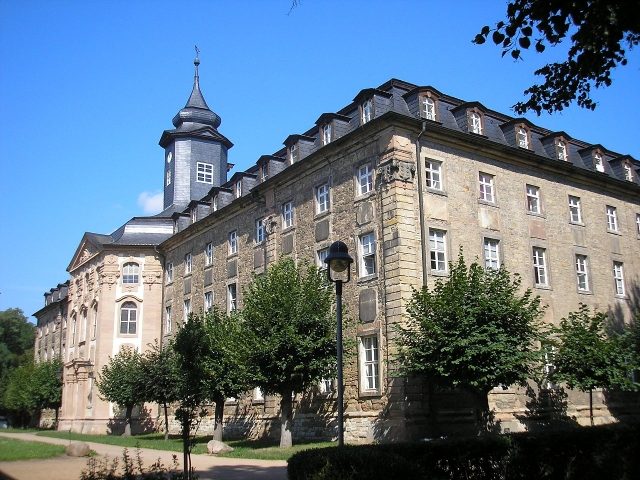
MonasteryRoßleben

Roßleben Abbey

Roßleben Abbey

Foundation

Klosterschule Roßleben is a state-recognized, privately run grammar school with a boarding school in Roßleben, Thuringia. The school was founded in 1554 by Heinrich von Witzleben.

From Monastery to Monastery School

Around 1140, Count Ludwig von Wippra founded an Augustinian monastery on the banks of the Unstrut near the settlement of Rostenleba. On April 27, 1142, the monastery received its confirmation charter from Pope Innocent II, and on February 21, 1174, a letter of protection from Emperor Frederick Barbarossa. These two documents are still in the possession of the Klosterschule Roßleben Foundation and are kept in their original form in the Foundation's archive.

In the middle of the 13th century, the Augustinian monastery was converted into a Cistercian nunnery. When the landgrave's court judge Christian von Witzleben received Wendelstein Castle as a hereditary fief after the Thuringian Counts' War, he also became one of the two secular patrons of the monastery.

The monastery was dissolved as a result of the Reformation in the mid-16th century.

In 1554, the school was founded on behalf of the last Vogt, the knight and doctor of both laws, Heinrich von Witzleben. Initial plans had already been made in 1547. Georg Fabricius, a student of Melanchthon, was commissioned with the school's founding. He had been rector of the Princely School of St. Afra in Meißen since 1546. As Ephorus of Klosterschule Roßleben, Fabricius wrote its first school law, the Leges ludi Vicelebiani.

Since the school's foundation in 1554, a male member of the von Witzleben family from among the agnates has presided over the Klosterschule Roßleben Foundation as hereditary administrator.

16th Century

From April 1554, the first teacher of Klosterschule Roßleben, Salomo Rhode, taught 18 students two hours daily. By September, the number of students had increased to 56, and Isaak Faust from Wittenberg was appointed as the first rector. From 1556, three teachers taught about 60 students in three classes. Early subjects included ancient languages, philosophy, religion, rhetoric, logic, and music.

17th Century

By 1639, 1435 students had already attended the school. As a result of the Thirty Years' War, the school had to be closed and could only be reopened in 1675 by Wolf Dietrich the Elder von Witzleben.

On Good Friday 1686, a large fire destroyed almost the entire village of Roßleben, including the monastery building. Only the rectory remained unharmed. By luck and chance, 85 old charters and documents were saved from the library. Among them were the originals of the papal and imperial charters.

18th Century

In 1727, the reconstruction of the school building began, which was solemnly inaugurated on January 2, 1742. The plan was designed by the electoral building inspector J.H. Lobenstein, who also supervised the construction.

The foundation stone for the new church was laid on October 4, 1751 – the master builder was Johann Georg Häuser. Unfortunately, construction progressed slowly. In 1755, the lock on the nearby Unstrut also had to be built. After the outbreak of the Seven Years' War in 1756, the construction, which had already reached the roof, completely stagnated and subsequently fell into disrepair in the following years.

19th Century

After the Battle of Jena and Auerstedt in 1806, Klosterschule Roßleben was used as a hospital by Prussian troops during their retreat.

As a result of the Congress of Vienna in 1815, where previously Saxon territories were ceded to Prussia, political disagreements arose at the school between pro-Saxon and pro-Prussian students, but these were overcome by hereditary administrator Georg Hartmann von Witzleben and Rector Benedikt Wilhelm.

In 1875, the Lion Monument was erected in honor of the monastery students who fell in the wars of 1866 and 1870/71.

Around 1880, there were already seven classes with over 100 students and 13 teachers. In addition, structural changes brought the school up to the latest standards of the time. By 1910, the gymnasium, central heating, sanitary facilities, three sports fields, the bathing establishment and boathouse, residential houses for the rector and teachers, an infirmary, and the residential house for the monastery tenant were built.

20th Century

After two years of construction, the new monastery church in the north wing was finally consecrated in 1913. Particularly noteworthy is the installation of the organ, unique for central Germany, built by the organ building workshop Dalstein & Haerpfer from Lorraine.

In 1921, the "Verein Alter Roßleber e.V." was founded by former students. In 1999, the "Verein der Absolventen der ehemaligen Goethe-Oberschule und des Staatlichen Gymnasiums Klosterschule Roßleben e.V." was also founded, but it decided to dissolve in 2010, as the statutory purpose of the association had ceased due to privatization. In 2005, the "Verein Alter Roßleben e.V." merged with the "Förderverein Klosterschule Roßleben e.V." to form the "Verein Klosterschule Roßleben - Ehemalige und Förderer e.V.".

Resistance against the Nazi Regime

After the National Socialists came to power in 1933, the then hereditary administrator Wolf-Dietrich von Witzleben endeavored to preserve the unique character of Klosterschule Roßleben against the power claims of the Nazi state and to maintain the foundation's sponsorship, despite the prescribed new curricula. His consistent resistance against all nationalization intentions significantly contributed to preventing the conversion of Klosterschule into a National Political Education Institute. He was supported by Senior Study Director Kurt Sachse as rector. The guiding principles "deo, patriae, litteris" – "to God, to the fatherland, to science" – were to continue to shape education.

Numerous former monastery students joined the resistance against the Nazi regime. Four graduates of the Klosterschule, Peter Graf Yorck von Wartenburg, Ulrich Wilhelm Graf Schwerin von Schwanenfeld, Egbert Hayessen, and Heinrich Graf von Lehndorff-Steinort, as well as the member of the founding family, Field Marshal Erwin von Witzleben, were executed in Plötzensee for their involvement in the assassination attempt on Adolf Hitler on July 20, 1944.

Nationalization

After World War II, the Klosterschule Roßleben Foundation was expropriated in the Soviet Occupation Zone. 17 students, five teachers, and the caretaker of the Klosterschule were denounced as alleged werewolves and arrested by the Soviet military police. The caretaker and two teachers were executed immediately after their arrest; 15 of the students and the remaining three teachers were interned in the Buchenwald and Sachsenhausen special camps. During their imprisonment, two of the teachers and three of the students died from the consequences of their detention. Some of the imprisoned students were deported to labor camps in the Soviet Union, the last of these students only returned home in 1955. In 1995, the Prosecutor General's Office of the Russian Federation fully rehabilitated all those convicted.

During GDR times, the school continued as an Extended Secondary School (EOS) with a language focus (Russian lessons since 1952) from August 28, 1949, under the name Goetheschule. Even during this period, the teachers and educators, especially under the long-standing leadership of headmaster Ernst Bösemüller, tried to preserve the traditional moral values of this school. This was reflected primarily in artistic, creative, and sporting offerings. The obligatory productive work of the students took place in the Roßleben potash plant and later also in other companies, such as the Kyffhäuserhütte Artern.

Reunification

After reunification, the school complex, which was in great need of renovation, was expensively renovated under the direction of Friedrich-Karl von Witzleben. For example, a stained-glass window (Melanchthon) destroyed during GDR times in the chapel, which had been converted into the "Karl Marx Festival Hall," was reconstructed. The Klosterschule Roßleben Foundation, which had regained the school grounds and parts of the former monastery estate, but not the former 286 hectares of agricultural land, concluded a usage agreement with the district of Artern until 2017 as the owner of the now eight-hectare school campus. This was later continued by the Kyffhäuserkreis district. As the school's sponsor, the Kyffhäuserkreis operated the State Grammar School "Klosterschule" Roßleben under the direction of Erich Hofereiter on the foundation's properties.

21st Century

Private Sponsorship

On December 18, 2008, the usage agreement between the Kyffhäuserkreis and the Klosterschule Roßleben Foundation was prematurely terminated by mutual agreement. The Klosterschule Roßleben Foundation thus resumed sponsorship of the school, under the management of Christian von Witzleben. By decision of the Thuringian Ministry of Education on June 25, 2009, the dissolved State Grammar School "Klosterschule" Roßleben was succeeded by Klosterschule Roßleben as a privately run grammar school.

In the 2009/10 school year, about 400 students attend Klosterschule Roßleben. The boarding school has 110 places. The school fees for local students from the Kyffhäuserkreis are temporarily covered by the district.

Take Mobile History with you

You are reading this text for free. Premium adds what matters on the road: descriptions read aloud, sites found through your camera, whole regions taken offline.

  • Every description, including the ~17,700 Premium sites
  • Audio guide: have descriptions read to you on location
  • AR finder: see sites through your camera, with distance and bearing
  • Unlimited saved sites

14 days free, then from €2.99 a month. Cancel anytime.

Source: Wikipedia · Licence: CC BY-SA 4.0

This description draws on the facts documented in the linked Wikipedia article; Wikipedia content is licensed under CC BY-SA 4.0. Wording and editing: Mobile History.

Location: 51.2952, 11.4280