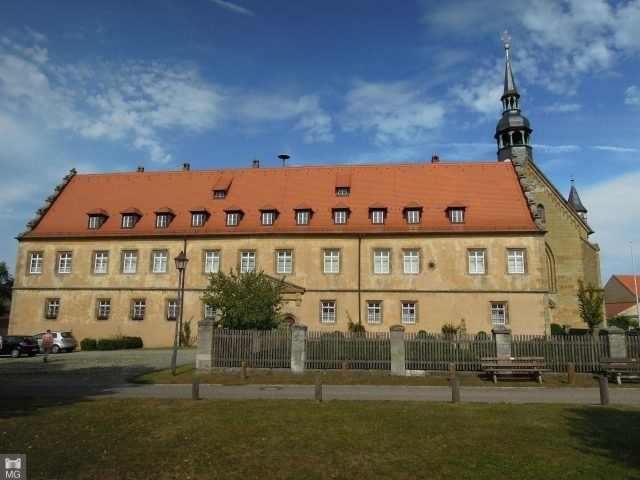
Church
Schlüsselau Abbey

Kloster Schlüsselau was a Cistercian nunnery founded in Schlüsselau in the 13th century, located in the Archdiocese of Bamberg. The Prince-Bishop of Bamberg, Johann Philipp von Gebsattel, erected a representative building next to the church, and the church, after its reconstruction, became a pilgrimage church.
Founding of the Monastery
Eberhard IV von Schlüsselberg († 1283) and his son Konrad I founded a noble Cistercian nunnery as a proprietary monastery in the village of Seppendorf, today Schlüsselau, around 1280. Gottfried von Schlüsselberg, who further supplemented the foundation, also belonged to the founding circle. A foundation charter no longer exists, but the monastery received its confirmation in 1290 from Bishop Arnold von Solms of Bamberg.
Several common reasons contributed to the founding of the monastery. The Schlüsselbergers, as an influential family, created their proprietary monastery here with their own burial site. This was done as an expression of piety and concern for their own salvation. In addition, the monastery offered an economic basis for unmarried daughters of their own family as well as other noble families from the surrounding area. The number of nuns was around 20, and from the 14th century onwards, some commoners also belonged to them.
In 1295, the abbey was incorporated into the Cistercian order. The abbot of Ebrach was quickly replaced as visitor by the abbot of Langheim, from where chaplains, confessors, and converses were also sent. The first nuns probably came from the Mariaburghausen monastery, to which the first Schlüsselau abbess, Gisela von Schlüsselberg, daughter of the founder, also belonged. Gottfried von Schlüsselberg († 1307), whose high tomb is in the church, is considered the builder. By 1350, the church was completed to its present size and consecrated to the Sorrowful Trinity.
Further Development
Anna von Schlüsselberg (1339-1379) is considered the most important abbess, who helped the monastery achieve a sustainable economic foundation. Nevertheless, the monastery was equipped with only modest means. Over time, the number of converses or lay sisters who performed agricultural work decreased. Private property among the nuns became common. Lease revenues sometimes failed to materialize during times of crisis.
The extinction of the Schlüsselbergers, with Konrad II von Schlüsselberg, to whom a tomb in the church is to commemorate, necessitated a first imperial letter of protection. This happened in 1356 under Anna von Schlüsselberg. Emperor Charles IV confirmed the rights of the monastery. The bishops of Bamberg and Würzburg were significantly involved in the decline of the Schlüsselbergers. The rather secluded and modest monastery was spared further complications. It outlasted the founding family with extensive land ownership and had its own high jurisdiction.
In the early 16th century, the pilgrimage to the Sorrowful Most Holy Trinity began, which continues to this day.
Decline of the Monastery
During the Peasants' War, the monastery was repeatedly attacked and destroyed by fire in 1525. The penultimate abbess Ursula von Truppach and the nuns had fled to the Schlüsselau Hof on Kaulberg in Bamberg. The abbess died in exile in Bamberg, and the nuns did not return until 1528. The monastery was rebuilt according to historical models. In the Second Margrave War, the monastery was again destroyed by Margrave Albrecht Alcibiades. A revival did not take place; instead, the monastery was handed over by the last superior, Brigitta von Stiebar, to the Prince-Bishopric of Bamberg in exchange for a life annuity. The Prince-Bishopric administration confiscated the properties and established the Schlüsselau office.
In the 20th century, an attempt was made to reoccupy the monastery buildings with an order. In 1949, seven Carmelite nuns (OCarm) from Holland moved into the historic buildings, but due to the inadequacies they found, they left Schlüsselau in 1968 and re-established themselves in Erlangen-Büchenbach.
Monastery Church+
Only under Prince-Bishop Johann Philipp von Gebsattel, who was also dedicated to the expansion of Giechburg, was the church restored in the Renaissance style from 1603 onwards. The nun's choir, typical for Cistercian nuns, and the elevated nave were omitted during the reconstruction. The rebuilt convent building received an ornate facade with a Renaissance-style gate and a representative forecourt.
The church's furnishings date from around 1730, with Martin Walther from Bamberg involved. Further construction measures took place between 1753 and 1765, and the west side was rebuilt in 1895.
However, several furnishings from the monastery period also returned to the church. In the choir, formerly standing in the middle of the presbytery, is the cenotaph of the church's builder, Gottfried von Schlüsselberg, with a large, magnificent coat of arms of the Schlüsselberg family. The altarpiece on the high altar was adopted, but it was extended in height and repainted; the secondary figures on the high altar are by Franz Anton Schlott. The Sorrowful Trinity, also known as the Throne of Grace, from the high altar of 1603, is located on the southern inner outer wall. An oversized crucifix from the 14th century features the evangelist symbols at the ends of the cross. A Vesper group is dated to around 1420; it is a Nuremberg work made of fired clay. Twelve Passion reliefs from the 16th century were probably originally parts of an altar. A painting depicting the Holy Kinship is in the tradition of Dürer's successors from the 16th century.
Take Mobile History with you
You are reading this text for free. Premium adds what matters on the road: descriptions read aloud, sites found through your camera, whole regions taken offline.
- Every description, including the ~17,700 Premium sites
- Audio guide: have descriptions read to you on location
- AR finder: see sites through your camera, with distance and bearing
- Unlimited saved sites
14 days free, then from €2.99 a month. Cancel anytime.
Source: Wikipedia · Licence: CC BY-SA 4.0 · Image: Mobile Geschichte
This description draws on the facts documented in the linked Wikipedia article; Wikipedia content is licensed under CC BY-SA 4.0. Wording and editing: Mobile History.
Location: 49.7911, 10.9103