Church
MonasterySt. Märgen
St. Märgen Abbey
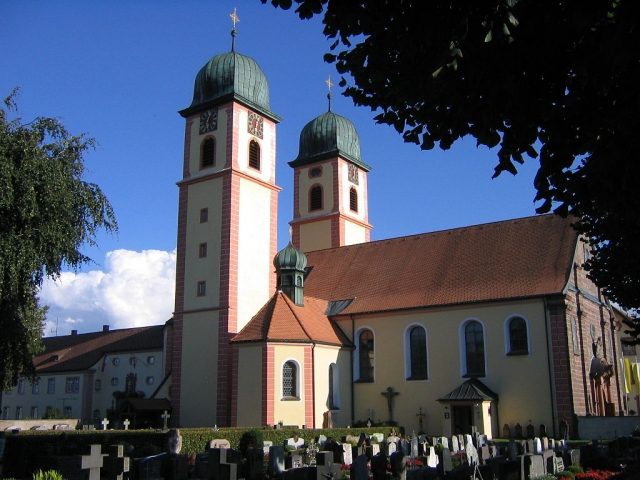
The St. Märgen Monastery is a former Augustinian Canons Regular monastery in St. Märgen in the Black Forest, founded in 1118 under the name Cella Sanctae Mariae. The German form of the name, "Maria-Zell auf dem Schwarzwald" (Mary's Cell in the Black Forest), evolved over the centuries through Mergenzell, Sankt Maria, St. Marien, St. Märijen, and St. Mergen to today's monastery and town name St. Märgen.
The regulated Augustinian Canons Regular monastery of St. Märgen, founded around 1115/1118 by Bruno von Hohenberg, Strasbourg canon, later Bishop of Strasbourg and Chancellor to Emperor Henry V, under the names Cella Sanctae Mariae or Monasterium sanctae Mariae, was a political foundation of the Counts of Hohenberg against the Dukes of Zähringen. The latter were the bailiffs of the St. Gallen estates in the Dreisam Valley and had built Wiesneck Castle for their protection. In 1093, they had moved their house monastery Weilheim unter Teck to St. Peter to secure the road connection through the Glotter Valley to Villingen, thereby bypassing the Hohenbergian possessions around Wiesneck Castle. The dispute between the two monasteries led to the destruction of the Hohenbergian Wiesneck Castle by the Zähringer, which caused a severe loss of Hohenbergian power in the Dreisam Valley.
Bruno von Hohenberg settled the monastery with Augustinians, presumably from St. Leo in Toul, who were soon replaced by German Augustinians. According to tradition, the Lorraine canons brought with them a miraculous image, around which a pilgrimage soon developed and which is still venerated in the pilgrimage and monastery church today. It represents the oldest known miraculous image in the Archdiocese of Freiburg today.
The monastery's possessions primarily included cleared land in the immediate vicinity. Here, a demarcation from the monasteries of St. Peter and St. Gallen soon became necessary. The monastery filled the parish positions in St. Märgen, Wyhl, Scherzingen, and Haslach. Haslach, however, was lost during the Reformation but was replaced by the donation of the Zähringen parish in 1615. In addition, the monastery had citizenship rights in Endingen, Villingen, and Freiburg.
The papal assurance of free Vogt (bailiff) election remained theoretical. From the Counts of Hohenberg, the Vogtship over the monastery passed to the Freiburg knight Burkart Turner in 1293, to the Schnewlin at the beginning of the 14th century, to the Blumeneck in 1370, and back to the Schnewlin in 1450. The constant dispute with the Vogts severely affected the monastery throughout the 14th and 15th centuries; 3 abbots suffered a violent death, among them Abbot Konrad, whom a knight of Schnewlin had murdered near Ebnet in 1355. Abbot Johannes II. Schlegerle was also murdered by the – Blumenecker – Vogts in 1401, while Abbot Berthold was murdered by his own conventuals in 1385.
A fire destroyed the facilities in 1430. The dispute with the Vogts led, on the one hand, to the church only being consecrated again in 1493, and on the other hand, to the monastery selling all its possessions to the city of Freiburg in 1461 and moving the following year to the Augustinian Canons Regular monastery of Allerheiligen in Freiburg, founded around 1300, with which it had already merged in 1370.
In 1546, the abbacy was declared extinct; from then on, the head of the convent held only the title of administrator, and from 1583, a provost of Allerheiligen.
Only after the destruction of the Allerheiligen monastery in Freiburg in 1678 did the canons return to St. Märgen. After the church and monastery were again destroyed in 1704 during the War of the Spanish Succession, they were rebuilt under Provost Andreas Dilger: the church from 1716 to 1725, and the monastery buildings from 1726 to 1729. In 1725, the monastery joined the Lateran Augustinian Congregation in Rome. In 1738, Dilger's successors for St. Märgen again received the abbacy, and in 1771, admission to the Breisgau Prelacy.
Source: Wikipedia · Licence: CC BY-SA 4.0 · Image: http://commons.wikimedia.org/wiki/File:St._Maergen_T%C3%BCrme_8523.jpg
This description draws on the facts documented in the linked Wikipedia article; Wikipedia content is licensed under CC BY-SA 4.0. Wording and editing: Mobile History.
Location: 48.0062, 8.0922