Museum
St. Pauli Abbey

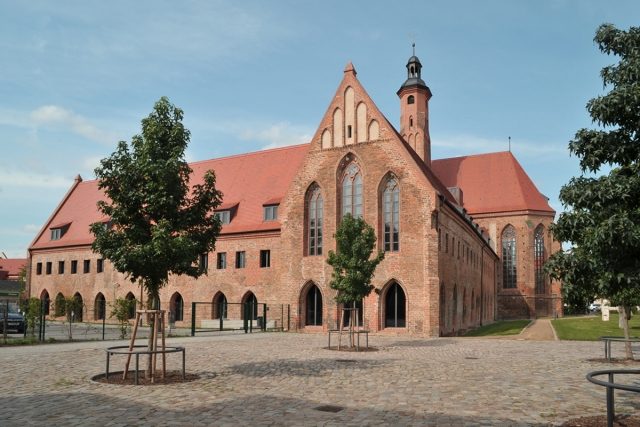
The Paulikloster is a former Dominican monastery in Brandenburg an der Havel in the Neustadt area.
Origin+
After the Margraves of Brandenburg left the old Slavic fortress of Brandenburg, the Ascanians chose an area on the southwestern edge of Neustadt Brandenburg as the seat of their residence. Neustadt had been systematically founded and laid out by the Margraves of Brandenburg before 1196.
In 1267, Margrave Otto III died at the margravial court, surrounded by Dominican monks. His son Otto V (the Long) gifted the margravial residence to the Dominican Order in 1286. Construction of the monastery complex began in the same year. The choir represents the oldest part of the building. Only about 100 years later were the hall church, reserved for laypeople, and the adjacent cloister buildings completed.
In 1286, Bishop Gebhard of Brandenburg consecrated the church to St. Andrew and St. Mary Magdalene. Almost a hundred years later, after the completion of the monastery-church complex, Bishop Dietrich III von der Schulenburg reconsecrated the church in 1384 and dedicated it to the Three Holy Kings and St. Paul.
Following a tradition widespread in the Middle Ages, this mendicant order monastery is also found in a medieval suburban location. To the south, the city wall, still largely intact, borders the monastery area. This creates a commonality with the former Franciscan monastery of St. Johannis in the old town of Brandenburg on the opposite bank of the Havel.
A more secluded, marginal location, away from the hustle and bustle of the city, favored the monks in their contemplative endeavors, without hindering them too much in their spiritual obligations to the city's population.
Construction and Style+
The church is a simple three-aisled Gothic hall building without an ambulatory. The entire complex was built using Märkisch brick technique. At its southeast corner, before the transition to the east wing of the monastery complex, the nave is accompanied by a fragile-looking, narrow tower.
South of the nave, the monastery complex, surrounding a cloister garden, adjoins.
With the advent of the Reformation in the Margraviate of Brandenburg, the Catholic era of the monastery ended. The monks were allowed to remain in the monastery for life, but new appointments were forbidden. In 1560, Elector Joachim II gifted the monastery complex to Neustadt Brandenburg. The church itself was reconsecrated as Protestant, and the monastery buildings were put to charitable use as a Neustadt hospital and an old people's home.
In the last days of World War II, during the fighting on April 26 and 27, 1945, the tower of the Paulikloster was misused as an observation and sniper post as the Red Army approached. As a result, the entire area came under heavy artillery fire, and both the adjacent residential areas and the monastery itself suffered severe damage.
In the 1960s, the GDR planned to rebuild the ruin and use it as a museum. Financial bottlenecks caused the project to fail. However, the ruin could at least be secured, parts of the monastery buildings were re-roofed and thus protected from further decay.
Usage+
In 2002, the decision was made for the complete reconstruction of the monastery. After the completion of the restoration work, the State Archaeological Museum was opened on September 24, 2008. In addition, the nave is frequently used for other cultural events.
The monastery and church of St. Pauli are a particularly successful example of a careful and expert renovation of a medieval building complex that was completely destroyed by war. Without massive intervention in the building structure, modern technical requirements were harmonized with the original monastery concept. For the repair of the damaged sections, bricks specially made in the region in the so-called "monastery format" were used.
Choir Apex Window+
The choir apex window of the bell church of St. Pauli was returned to the monastery complex after sixty-five years of storage and was to be restored and reinstalled in its original place by Easter 2008 with funds from the State of Brandenburg, the Ostdeutsche Sparkassenstiftung, and donations from the public.
Due to the war, it was removed before the destruction of the Paulikloster during the fighting around Brandenburg an der Havel in April 1945 and was initially kept by the parish of St. Gotthardt, and about 30 years later by the parish of St. Katharinen. In 1975, the parish installed the window in the choir apex window of St. Katharinen, where, due to its smaller size and the altar in front of it, it was hardly noticeable. After the restoration of the monastery complex was completed, the decision was made to return the window to its original place.
Parts of the choir apex window are about 30 years older than the windows of St. Marienkirche in Frankfurt (Oder). It is one of the oldest and most beautiful medieval church windows in Brandenburg and is the tenth oldest stained glass window in Germany. In the Margraviate of Brandenburg, only a single stained glass window panel from the village church of Lindena (mid-13th century) is dated older.
The choir apex window of St. Pauli consists of 12 rows and 3 columns, a total of 36 panels, accompanied by applied tracery, of which 22 panels show motifs of Christian typology of the Middle Ages according to traditional arrangement. The meaning and purpose of the typological representation of Old and New Testament scenes was the intention to prove that Old Testament quotes refer to events of the New Testament and thus underpin a legitimate succession of Christianity in the covenant God made with the Jews.
The rest of the fields, with the exception of the tracery fields above, are filled with ornamental representations.
Typically, typological windows, which usually occupied the most exposed position, i.e., the choir apex window, were designed according to fixed rules. Thus, in three-column windows, the sequence of scenes from the Nativity of Christ to the Ascension of Christ was depicted from bottom to top in the central column. These images, assigned to the New Testament, were then flanked on the left and right by pictorial quotes from the Old Testament, which could be interpreted as a reference to the Son of God and his work.
In the middle of the nineteenth century, the choir apex window underwent a thorough restoration by a hitherto unknown workshop. Art historically expertly, lost fields were supplemented, among other things, by consulting typological templates from the medieval Biblia Pauperum (Poor Man's Bible). However, the harder, more angular and expressive style of Gothic representation was altered in favor of the taste of the 19th century. The figures were given more pleasing, softer, "sweeter" contours and features.
In the choir apex window of St. Pauli, original and restored or supplemented glass panels can be distinguished very well by looking at the backs, as the old window surfaces show a significantly higher degree of corrosion.
Also noteworthy is the fact that the medieval glass painter only used black for direct painting. This color was applied to differently colored glass surfaces, which were then mosaically connected with each other by lead strands.
Special Features+
In an angle between the church and the monastery, a Romanesque window, which had been built over for centuries, was discovered and is now considered one of the oldest window openings in the Margraviate of Brandenburg.
Take Mobile History with you
You are reading this text for free. Premium adds what matters on the road: descriptions read aloud, sites found through your camera, whole regions taken offline.
- Every description, including the ~17,700 Premium sites
- Audio guide: have descriptions read to you on location
- AR finder: see sites through your camera, with distance and bearing
- Unlimited saved sites
14 days free, then from €2.99 a month. Cancel anytime.
Source: Wikipedia · Licence: CC BY-SA 4.0
This description draws on the facts documented in the linked Wikipedia article; Wikipedia content is licensed under CC BY-SA 4.0. Wording and editing: Mobile History.
Location: 52.4063, 12.5630