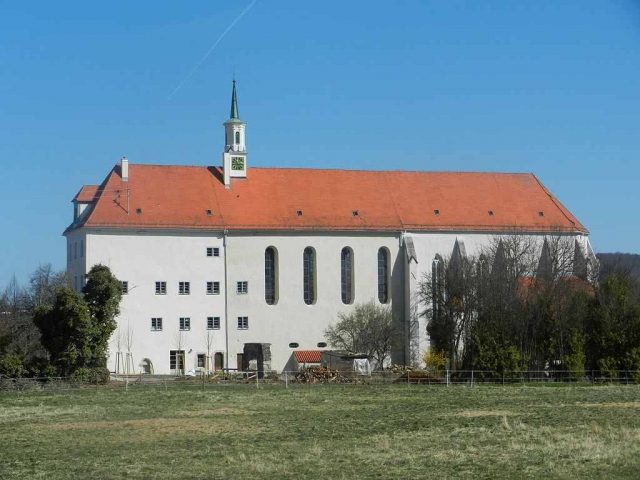
Church
Stetten Abbey
The former Stetten Monastery in Gnadental is located in Stetten, a district of Hechingen in the Zollernalbkreis (Baden-Württemberg). It was founded as an Augustinian convent, but was placed under the Dominicans as early as 1278. In the Middle Ages, it was the hereditary burial place of the Counts of Zollern.
The monastery, built on the Reichenbach, was first mentioned in a document dated April 1, 1261, in which Pope Alexander IV confirmed the privileges previously granted to the resident Augustinian nuns. In 1267, Count Friedrich the Illustrious of Zollern elevated the monastery to the hereditary burial place of the Zollerns. In 1278, it was placed under the Dominican Order, which built the monastery church of St. John the Baptist around 1280 as an early Gothic structure.
Wherever the mendicant order built, the churches and monasteries had to be simple yet impressive. The monastery church is an early Gothic building. The monastery flourished in the 14th century after it had gained prosperity through many donations. It served as a burial place for the Counts of Zollern from the 13th century to the 15th century. In 1802, the monastery was dissolved during the secularization and assigned to the Princes of Hohenzollern-Hechingen. The nuns were granted the right to remain until their death. Gundi Salva Utz, the last Dominican in Stetten, stayed alone within the monastery walls for another 65 years. She grew herbs in the monastery garden and produced herbal schnapps to secure her livelihood. She died in 1867 at the age of 90. The convent buildings were then temporarily used as barracks for the Light Hohenzollern Home Battalion. From 1869, the Franciscans took possession of the monastery for six years. Subsequently, it was used as a shoe factory until the building fell victim to a major fire in 1898. Only a few wall remnants of the east wing remain, while the north wing of the monastery with the church was spared from the flames.
Monastery Church+
Design
The single-nave church is concluded with a polygonal choir. It has slender tracery windows, and a cross-rib vault with three bays spans above it. The choir occupies more than half of the church's floor plan. Since its creation around 1290, it has remained unchanged externally and internally. It is a typical example of early Gothic mendicant order architecture because decorative additions were largely omitted.
The nave with the nuns' gallery was rebuilt in the Baroque style in the 18th century. To the south, the John's Chapel adjoins the choir, which is now used as a sacristy. It was built in the middle of the 13th century. The rich stucco decorations inside the small chapel in the Renaissance style from around 1600 are reminiscent of the St. Luzen monastery church in Hechingen.
Furnishings
On the north wall of the choir is a nine-meter-high tabernacle. It is richly decorated and dates from the end of the 15th century. Sculptures include Saint George on the front corner pillar, Christopher and John the Baptist on the second floor, and Saint Sebastian between two warriors on the third floor.
The Baroque pulpit from 1738 bears the inscription: "Beati, qui audiunt verbum Dei et custodiunt illud" (Blessed are those who hear the word of God and keep it). The congregational pews with strapwork and shell motifs were artfully carved around 1750.
The Stetten image of grace is a high-quality work by the Hechingen woodcarver Zachäus Taubenschmid from around 1610 and shows Mary and the infant Jesus in a mandorla of rays; the rosary was added later. Also noteworthy are a Pietà on the north wall and a late Gothic Madonna on a crescent moon, both sculptures probably created at the end of the 15th century.
Three stained glass windows from the late 13th century depicted scenes from the Old and New Testaments. They were removed in the 19th century and installed in the Michael's Chapel at Hohenzollern Castle.
The organ has 13 registers. The facade dates from the early 18th century.
Take Mobile History with you
You are reading this text for free. Premium adds what matters on the road: descriptions read aloud, sites found through your camera, whole regions taken offline.
- Every description, including the ~17,700 Premium sites
- Audio guide: have descriptions read to you on location
- AR finder: see sites through your camera, with distance and bearing
- Unlimited saved sites
14 days free, then from €2.99 a month. Cancel anytime.
Source: Wikipedia · Licence: CC BY-SA 4.0
This description draws on the facts documented in the linked Wikipedia article; Wikipedia content is licensed under CC BY-SA 4.0. Wording and editing: Mobile History.
Location: 48.3450, 8.9785