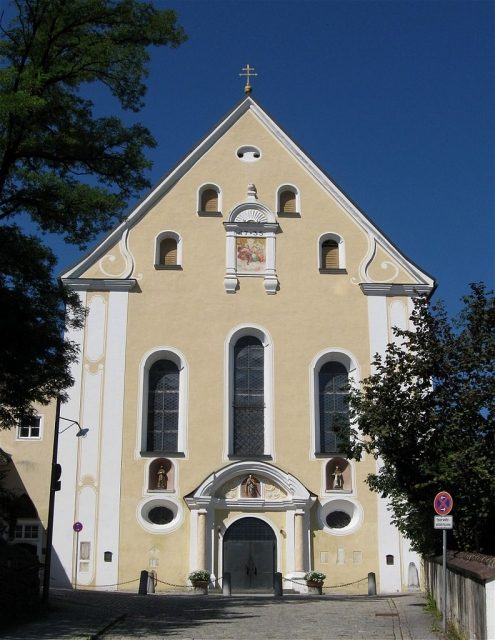
MonasteryBad Tölz

Tölz Abbey

Tölz Abbey

To be privately owned

Kloster Tölz is a former monastery of the Franciscan Reformists in Bad Tölz, Bavaria, in the Archdiocese of Munich and Freising.

The Foundation and its Motives

The monastery, dedicated to the Holy Trinity, was founded in 1624. The foundation took place as part of Duke Maximilian I's efforts to reform the Bavarian Franciscan monasteries, to consolidate them into a Bavarian Reformist province, and thereby gain greater influence over the order and its monasteries. For this purpose, he campaigned for years from 1614 with Pope Paul V through his ambassador Giovanni Battista Cesare Crivelli, cousin of the then Tölz administrator Giulio Cesare Crivelli. Pope Urban VIII approved Maximilian's plans, including the monastery's foundation in Tölz, and thus the Bavarian Reformist province of the Franciscans was established on March 1, 1625. The monastery was staffed with reformed monks from Northern Italy. A plaque in the monastery entrance to the left of the church commemorates them. The convent also operated a hospice.

Expansion Measures

As the original monastery church received strong patronage, it became too small after a few years and was therefore expanded in 1660/61. In 1660, Tölz mayor Kaspar Reiffenstuel had an Antonius Chapel built, which was stuccoed in 1684 by "Nikolaus Bertho", probably Giovanni Niccolò Perti. When the church and monasteries had to be enlarged again, the Antonius Chapel was demolished in 1733.

From Secularization to Abandonment

The monastery was dissolved on January 25, 1802, during the secularization under King Max I Joseph. In 1804, the church was handed over to the magistrate, and the library, stocked with 7000 volumes, was unfortunately almost completely lost. On August 15, 1827, the subsequent King Ludwig I decided to allow the Franciscans back into Tölz and other cities. On December 1, 1828, the monastery was re-established. In 2008, the Franciscans finally abandoned the monastery.

Organ+

The organ of the monastery church was built by the organ building company Vleugels. The slider chest instrument has 35 stops (1912 pipes) on two manuals and pedal. The key actions are mechanical, the stop actions are electric.

Take Mobile History with you

You are reading this text for free. Premium adds what matters on the road: descriptions read aloud, sites found through your camera, whole regions taken offline.

  • Every description, including the ~17,700 Premium sites
  • Audio guide: have descriptions read to you on location
  • AR finder: see sites through your camera, with distance and bearing
  • Unlimited saved sites

14 days free, then from €2.99 a month. Cancel anytime.

Source: Wikipedia · Licence: CC BY-SA 4.0

This description draws on the facts documented in the linked Wikipedia article; Wikipedia content is licensed under CC BY-SA 4.0. Wording and editing: Mobile History.

Location: 47.7598, 11.5544