Monastery Operations
MonasteryTriefenstein
Triefenstein Abbey
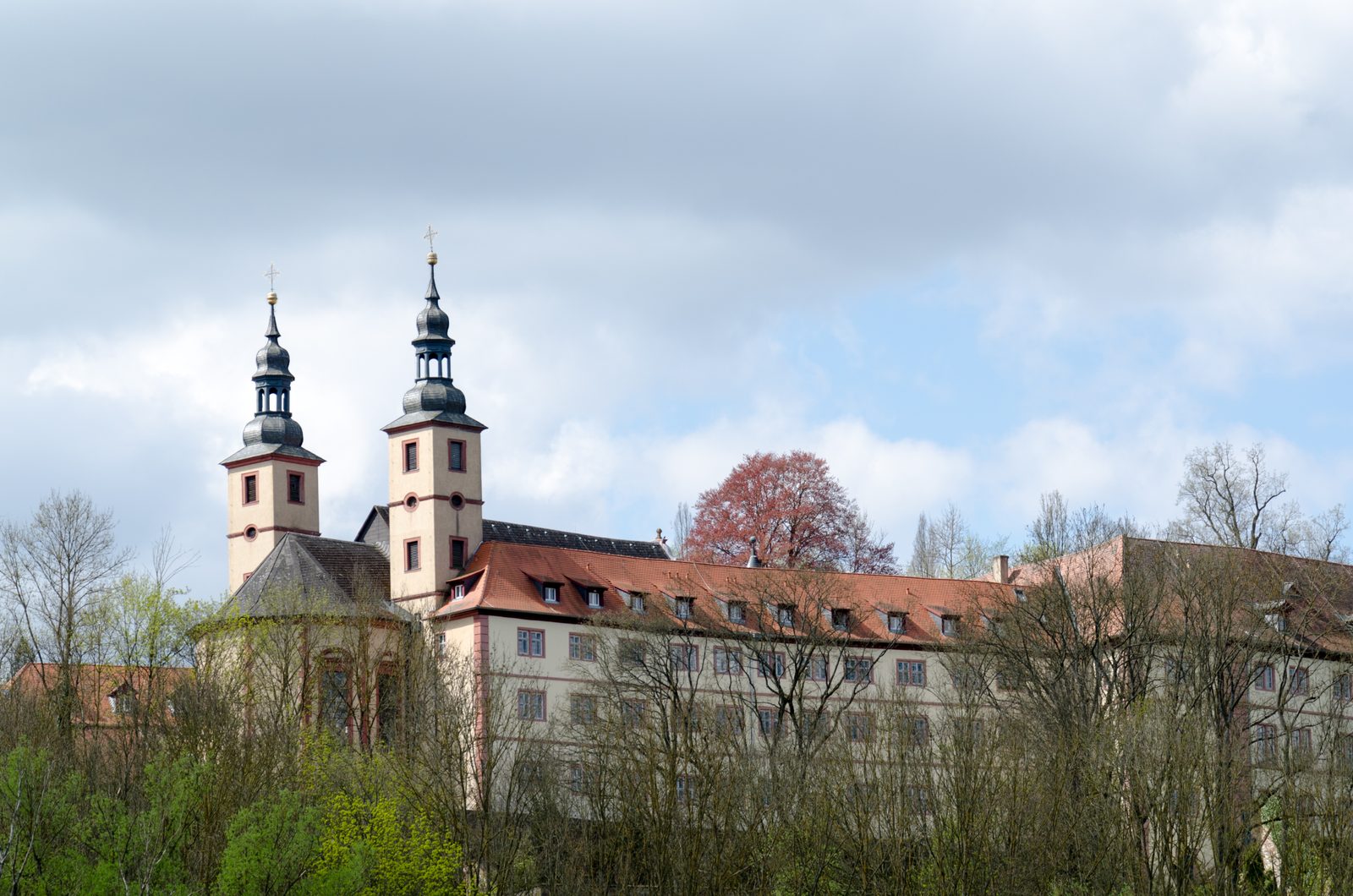
Triefenstein Monastery is a former Augustinian Canons' collegiate church and today the main seat of the order-like Protestant Christusträger Brotherhood, located in the market town of Triefenstein in the Lower Franconian district of Main-Spessart. Its name is derived from the "triefenden Stein" (dripping stone), a spring that rises directly next to the monastery under a prominent stone.
Location+
The complex, consisting of several buildings, is listed in official statistics as a locality or officially designated part of the municipality of Triefenstein and is located in the Trennfeld district, west of the Main, directly above an old river crossing. Opposite lies the village of Lengfurt, all districts of the present-day market town of Triefenstein at the southern end of the Main-Spessart district in the Mainviereck. Barely one kilometer northwest, sparse remains of the Neuenburg, a Romanesque castle complex from the 12th/13th century, are preserved.
History+
Monastic settlement probably began during the Investiture Controversy by the collegiate canon Gerung, the former dean of Neumünster Collegiate Church in Würzburg, who is said to have settled here near a chapel in 1088. The official founding of the Augustinian Canons' collegiate church dedicated to St. Peter and Paul by the Würzburg Bishop Emehard (Eginhard) von Comburg dates to 1102, and was confirmed by Pope Calixtus II in 1123. Several reasons speak for the location of the monastery: at the foot of the mountain lay a ford, or a ferry across the Main, for the Frankfurt-Würzburg-Nuremberg trade route; the proximity to the Neuenburg; the exposed location on the mountain as well as abundant springs in the immediate vicinity. The building ground was probably provided by the Benedictine abbey of Neustadt am Main, alongside which, right at the beginning, the Prince-Bishopric of Würzburg, whose bishop Emehard, as well as Bishop Konrad of Salzburg, appeared as important benefactors. The patron saints prove the Triefenstein canonry as a reform monastery, and indeed, from 1459 to 1461, Triefenstein religious were involved in the founding of the Franconian collegiate church of Birklingen. Triefenstein gained Vogt-freedom and was directly subordinate to the Prince-Bishopric of Würzburg. Soon, through further endowments, great prosperity set in. Thus, in 1421, it had income from 49 localities. But already in the same century, the Counts of Wertheim gradually managed to seize both monastic subjects and income, which was later further intensified by the Peasants' War around 1525. Thus, in 1683, Triefenstein only had income from 27 places. During the Thirty Years' War, the monastic property even temporarily fell entirely into the hands of the Wertheimers, whereby the buildings remained standing, but almost the entire interior was lost. When in 1634, Provost Johannes Molitor (reg. 1617–1619 and 1623–1637), who had temporarily fled from the Swedish troops, returned with his collegiate canons, the church was even found to have been used as a stable. After 1648, however, a continuous economic consolidation succeeded, and so Provost Adam Dorbert (reg. 1686–1694) began extensive construction work in the year of his consecration in 1687, which gave the canonry its baroque appearance that still characterizes it today. Continued by his equally construction-loving successors Valentin Benkard (Benkert) (reg. 1694–1706) and Peter Brotsch (reg. 1707–1737?), a new church and new convent buildings were thus built by 1715. As master builder, Provost Dorbert initially managed to win over the stonemason Valentino Pezzani, established in Würzburg. Under Provost Benkard, from about 1698, the later Prince-Bishopric of Würzburg's city and country master builder Joseph Greissing joined, who in Triefenstein, at least in the early years, was probably mainly active as a carpentry contractor. From 1687 to 1694, the collegiate church of St. Peter and Paul was built in several sections as a relatively simple, but massively vaulted building, presumably according to Pezzani's plans. Two core Romanesque choir flank towers were taken over from the predecessor building, which were raised and provided with baroque Welsch domes including lanterns. In addition, the dormitory was built on the Main side in 1690. In a second construction phase from 1696/97 to 1715, new convent buildings were added. In the course of the 18th century, the externally rather simply designed buildings received a partly extremely valuable interior decoration. The artistic highlight is the church, completely reshaped internally under the last Provost Melchior Zösch (reg. 1783–1803). Especially in the years 1785 and 1786, the Würzburg court artists Materno Bossi and Johann Peter Wagner, initially supported by the Mainz court painter Giuseppe Ignazio Appiani, later by the Trier court painter Januarius Zick, introduced an exceedingly precious early classical interior into the house of God. This consists of noble stucco marble altars, a matching elegant pulpit, finely carved choir stalls and harmoniously composed ceiling frescoes, all framed by exquisite Louis Seize stucco work.
Source: Wikipedia · Licence: CC BY-SA 4.0 · Image: Tilman2007 · Wikimedia Commons · CC BY-SA 3.0
This description is a machine translation of an excerpt from the linked Wikipedia article. The source text was written by its authors, the translation is by Mobile History; like the original it is licensed under CC BY-SA 4.0.
Location: 49.8077, 9.5984