Museum
Tückelhausen Abbey

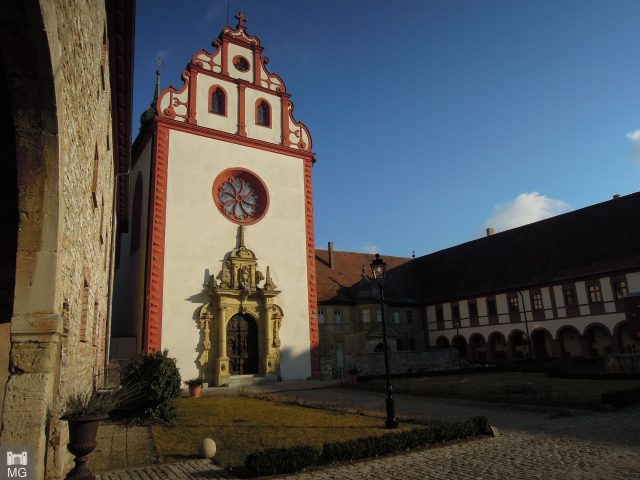
The Tückelhausen Monastery is a former Carthusian monastery. Tückelhausen is an incorporated district of Ochsenfurt in Bavaria. Since the secularization, the majority of the property has been privately used. The Carthusian monastery complex is almost completely preserved. The Carthusian Museum provides insight into the history of the Franconian Carthusian monasteries and the daily life of the monks.
High Middle Ages
A Liège chronicle mentions a pilgrimage to the mountain of St. Lambert in Tückelhausen around 1050. Remains of the Lambertus Chapel with a Romanesque portal are preserved in the courtyard of a farm, which adjoins the staircase leading from the village into the Thierbach Valley.
Premonstratensians
Unknown nobles founded a Premonstratensian monastery in the years before 1139 with the support of Bishop Otto of Bamberg. The nuns were already moved in 1144 to Lochgarten near Bad Mergentheim, 20 km away. Due to insufficient material resources, the monastery frequently struggled with economic problems. However, the noble convent members defended their independence against Oberzell Monastery. In 1305, nuns, this time from Michelfeld Abbey near Kitzingen, were again admitted. In 1307, the canons were transferred to Oberzell to maintain discipline, and until its dissolution in 1349, the monastery of the "Sisters of St. Lambert's Mountain" was inhabited solely by nuns.
Carthusians
In 1349, Tückelhausen was sold to the Würzburg Cathedral Dean Eberhard von Riedern, who wanted to found a Carthusian monastery. But only after his death in 1351 was Tückelhausen handed over to the Carthusians for use as a "cella salutatis". Their life was characterized by silent work and numerous daily prayers. In the second half of the 14th century, significant reconstruction work was carried out so that each monk could be assigned his own small house with a garden plot. The Carthusians lived in a mixed observance that combined hermitic life with elements of communal life. The cells consisted of a long row in the form of small houses. The cloister provided access to the monk's cell, which had a living and study room as well as a small house chapel. A pass-through to the cloister served to supply the monks with food. For Vigils, Matins, Morning Mass, and Vespers, the monks gathered in the church, which had been specially rebuilt for their purposes: the northern and southern transepts had been separated from the single-nave longhouse of the church. In the former transepts, the Carthusians housed an oratory, the chapter house, the archive, and the library. During the rest of the day, they cultivated their hermitic life and prayed alone in their cell. The monks dedicated themselves particularly to the study of the Holy Scriptures and the copying of books.
War Devastation
In the German Peasants' War in 1525 and the Margrave War in 1552, there was significant devastation and looting. In 1561, the Carthusian monastery was fortified with a ring wall. In the course of the Reformation, many Carthusians left the community. At the beginning of the 17th century, the Carthusian monastery was able to consolidate again. From 1613 to 1616, the church was redesigned in the Mannerist style.
During the Thirty Years' War, further damage was caused by the Swedes. In the campaign of 1673, the French then plundered Tückelhausen.
18th Century
In 1694, extensive construction measures began, which extended over several decades. First, the economic wing and later a new priory building as well as a guest wing were erected. A large wine cellar was also added. The wine was cultivated in the Thierbach Valley. In 1720, the remarkable Baroque pulpit was installed in the monastery church, and in the middle of the 18th century, the Rococo high altar and the carved choir stalls were added. The high altar comes from the Würzburg workshop of the court sculptor Wolfgang van der Auwera.
Secularization
In the course of secularization, the Carthusian monastery was dissolved in 1803. The monastery church became a parish church. Since then, the majority of the property has been privately used.
Carthusian Museum+
Pastor Robert Rakowitz opened a Carthusian Museum in 1991. Since 1997, the Diocese of Würzburg has been the patron of the museum. The museum provides insight into the history of the Franconian Carthusian monasteries and shows the daily life of the monks. Visitors can see the reconstructed house of a Carthusian with its associated small garden, the cloister, and the chapter house. Contemporary artworks are exhibited in the former library.
Take Mobile History with you
You are reading this text for free. Premium adds what matters on the road: descriptions read aloud, sites found through your camera, whole regions taken offline.
- Every description, including the ~17,700 Premium sites
- Audio guide: have descriptions read to you on location
- AR finder: see sites through your camera, with distance and bearing
- Unlimited saved sites
14 days free, then from €2.99 a month. Cancel anytime.
Source: Wikipedia · Licence: CC BY-SA 4.0 · Image: Mobile Geschichte
This description draws on the facts documented in the linked Wikipedia article; Wikipedia content is licensed under CC BY-SA 4.0. Wording and editing: Mobile History.
Location: 49.6526, 10.0236