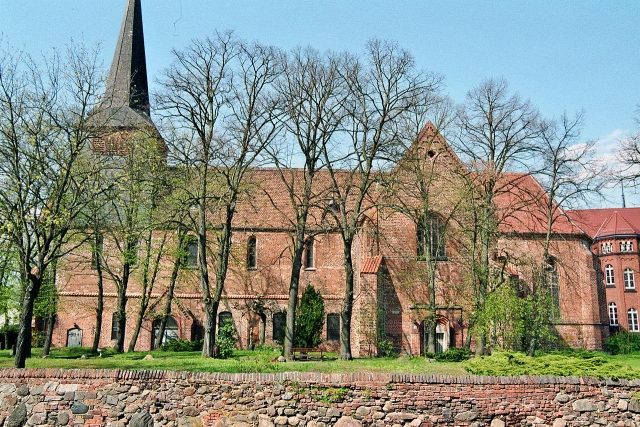
Church
Unser lieben Frauen Abbey

The Liebfrauenkirche (Church of Our Lady) in Jüterbog was built in 1161 on behalf of Archbishop Wichmann of Seeburg from Magdeburg and is the second oldest preserved church in the state of Brandenburg. For 275 years, it was also a place of life and learning for Cistercian nuns, as it was incorporated into their monastery.
After Archbishop Wichmann of Magdeburg had conquered the Jüterbog region in 1157, he had the church built as a three-aisled brick basilica starting in 1161 (first documented mention). He brought Premonstratensian canons from the collegiate monastery of Gottes Gnade near Calbe (on the Saale) to Jüterbog to serve as chaplains for the colonists brought into the region from the Lower Rhine (Flemings from present-day Netherlands and Belgium). The canons were also missionaries for the Slavs living around Jüterbog. The Premonstratensians were also granted the church patronage.
On the day Jüterbog was granted town rights, April 29, 1174, the Liebfrauenkirche (also called Marienkirche) was consecrated, according to the document as the main church (ecclesia principalis) of the Jüterbog region. It was placed under the patronage of the Gottesgnade monastery.
After its (presumed) destruction in the Wendish Uprising of 1179, the church was re-consecrated in 1183. In 1225, it was expanded by the addition of a transept with apses for two altars.
From 1282, the Cistercians built the nunnery "Zum Heiligen Kreuz" (Of the Holy Cross), into which the Liebfrauenkirche was incorporated. The church itself remained the parish church for the suburb of Damm. Around 1480, the Gothic choir was added. The now cruciform church received a crossing flèche in the style of Cistercian churches. After the dissolution of the monastery in 1557, it became an evangelical church. The flèche was removed in 1571 due to dilapidation. Instead, a wooden bell house was erected next to the church. Around 1575, bailiff Leopold von Klitzing (the Younger) had the sacristy added.
It was not until 1722 that the church received a Baroque half-timbered tower, which was removed in 1845 due to dilapidation, leaving only a stump with a tent roof. The current pointed slate tower was only built in 1891. During a comprehensive restoration and renovation in 1890/91, the colored choir windows were also made. Due to financial hardship, both side aisles had to be demolished in 1798. The arches were bricked up and fitted with larger windows.
In 1936/38, among other restoration works, the wooden ceiling was painted according to old designs. From 2000 to 2005, the exterior shell was extensively renovated, and the roofs of the slate tower, the choir, and the two transepts were re-covered.
Furnishings+
After the introduction of the Reformation in 1540 in the Archdiocese of Magdeburg and thus also in Jüterbog, only the Gothic winged Marian altar in the choir remained of the church's seven altars. The artistically valuable Gothic chalice-shaped baptismal font with a large basin, dating from around 1480, was also continued to be used by Protestants, although it was later covered with a baptismal bowl.
In 1575, bailiff Leopold von Klitzing donated the sandstone pulpit. The sculptor Georg Schröter from Torgau, well-known at the time, designed it with great artistic expressiveness. Schröter also created the pulpit of the Mönchenkirche in Jüterbog. Besides the depiction of the four Evangelists with their symbols, the two reformers Martin Luther and Philipp Melanchthon in the pulpit basket are particularly noteworthy. This is presumably the oldest depiction of the two reformers on any pulpit. On the pulpit ascent, the coats of arms of the von Klitzing family and Christ with the globe are recognizable.
An epitaph (tombstone) for bailiff Leopold (also Lipold) von Klitzing (the Elder) was erected in 1562, located in the choir on the east wall (behind the altar to the right). The other two epitaphs were created for the wife of bailiff Johann Heinrich Ritter (1733) and bailiff Friedrich Christian Krebs (1777, above the lectern). Six other people are buried in the Liebfrauenkirche in the choir area and near the pulpit.
The Marian altar was replaced in 1710 by ducal order with the Baroque altar that still exists today. This shows the iconographic program typical for this period and region: In the predella, the Last Supper of Jesus with his disciples, above it a depiction of a scene from the Passion story, here Jesus' prayer in the Garden of Gethsemane, flanked by columns. Framed by palms and flanked by angels with instruments of suffering, above it is the Resurrection of Christ, and above that, looking through clouds, the "Eye of God" as a sign of God's presence, and in the halo, the triangle as a symbol of the Trinity of God. The altar is crowned by a glory. In the triangle, the Christogram XP (Greek Chi and Rho) can be seen, and the Greek Alpha and Omega for beginning and end (first and last letter of the Greek alphabet).
At the consecration of the altar in 1418, there was already an organ in the church. The current organ was built in 1737 by the Berlin organ builder Joachim Wagner, and – donated from the inheritance of a Jüterbog long-distance merchant – is still almost original in its Baroque form. The organ case was made by the Jüterbog sculptor Johann Angermann. The intertwined letters J/A in the cartouche above the pipework are, however, said to refer to Duke Johann Adolph II of Weißenfels, the sovereign responsible for Jüterbog at the time. Changes to the church occurred through extensive renovations.
In 1890/91, in addition to a partial renewal of the masonry, the roof truss was renovated, the tower was built, the pews were renewed, and the organ gallery was lowered by 2 ½ meters and enlarged. A Berlin company created two colored choir windows with a total of four panels. Looking towards the altar, Moses can be seen in the left window, raising a metal serpent on a staff as a sign of life during the deadly snake plague in the desert. Next to it, as a counterpart, is the erected cross of Jesus as a sign of eternal life. In the second window, to the right of the altar, are images of the Resurrection and Ascension of Jesus Christ.
In 1936/38, in addition to a repainting, the wooden ceiling was restored according to an old pattern. The princely box above the door in the north wing of the transept was removed. In 1971/72, an interior renovation was carried out in preparation for the 800th anniversary of the church's consecration. The organ was also partially restored. During this time, a community room was set up under the organ gallery as a winter church with gas heating, and electric pew heating was installed in the main nave.
After its deconsecration in 1966, the following paintings from the Mönchenkirche came to the Liebfrauenkirche (orientation looking at the altar): Left aisle (from left): Jeremias Crudelius (1711–1743), from 1738 deacon and rector of the grammar school, from 1740 pastor M. Johann Christian Crudelius (1697–1738), his brother, from 1724 assistant preacher to his father M. Johann Abraham Crudelius, after whose death from 1725 to 1738 successor in the Liebfrauen-Mönchen parish. Below: Family of M. Johannes Pilichen (1577–1599), from 1600 pastor at St. Nikolai. Right aisle: Martin Luther and Philipp Melanchthon, opposite another portrait of M. Johann Pilichen (buried in the Mönchenkirche in 1611).
Of the three bells, the oldest, cast by Hans Baudicke, dates from 1471. The smallest is no longer rung due to a crack. In addition, the two former bells from the Mönchenkirche chime with the striking of the Liebfrauenkirche's tower clock.
Only a remnant of the church's medieval painting remains in the last southern window arch of the central nave, possibly showing the Man of Sorrows between angels.
Take Mobile History with you
You are reading this text for free. Premium adds what matters on the road: descriptions read aloud, sites found through your camera, whole regions taken offline.
- Every description, including the ~17,700 Premium sites
- Audio guide: have descriptions read to you on location
- AR finder: see sites through your camera, with distance and bearing
- Unlimited saved sites
14 days free, then from €2.99 a month. Cancel anytime.
Source: Wikipedia · Licence: CC BY-SA 4.0 · Image: http://de.wikipedia.org/wiki/Datei:Liebfrauenkirche_Aussenansicht_komplett.jpg
This description draws on the facts documented in the linked Wikipedia article; Wikipedia content is licensed under CC BY-SA 4.0. Wording and editing: Mobile History.
Location: 51.9908, 13.0727