Abbey
MonasteryUrsberg
Ursberg Abbey
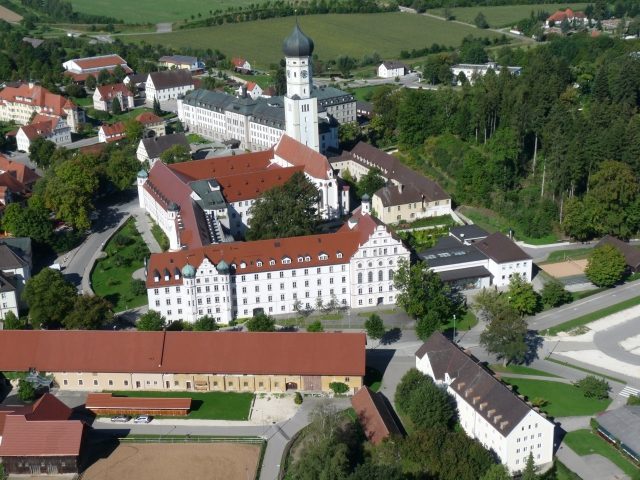
Ursberg Abbey is a former Premonstratensian monastery and now a monastery of the Franciscan St. Joseph Congregation in Ursberg (district of Günzburg, Bavaria) in the Diocese of Augsburg.
The monastery, dedicated to St. Peter and St. John the Evangelist, was founded in 1125 by the nobleman Wernher von Schwabegg-Balzhausen. It was the first settlement of the Premonstratensian Order in Southern Germany. The monastery became an Imperial Abbey in 1143. The formerly Romanesque church was built around 1230. It was baroqueized by the Wettenhausen collegiate master builder Joseph Dossenberger the Younger. During this time, the ceiling frescoes by Jakob Fröschle and Konrad Huber were also created. Ursberg Abbey founded Roggenburg Abbey, which still exists today, as early as 1126. In addition to numerous building programs, rational reforms also took place in the manorial and judicial rule, which, however, only led to the enactment of its own Policey Ordinance in 1777. It regulated the internal order of the Swabian Imperial Abbey, from Sunday and holiday regulations to rules for visiting taverns and the prohibition of gambling for the abbey's subjects.
Worthy of mention is the Romanesque crucifix with the assisting figures of the Holy Mother of God and John the Evangelist. The high altar is by J. Pflaum.
In 1803, it was dissolved during the secularization. The church became a parish church. The rectory and the Krumbach district court were housed in the monastery. In 1884, the priest Dominikus Ringeisen acquired the buildings and established a congregation of sisters there for the care of physically and mentally disabled people, now known as …
Source: Wikipedia · Licence: CC BY-SA 4.0
This description draws on the facts documented in the linked Wikipedia article; Wikipedia content is licensed under CC BY-SA 4.0. Wording and editing: Mobile History.
Location: 48.2661, 10.4464