Educational institution
MonasteryVolkersberg
Volkersberg Abbey
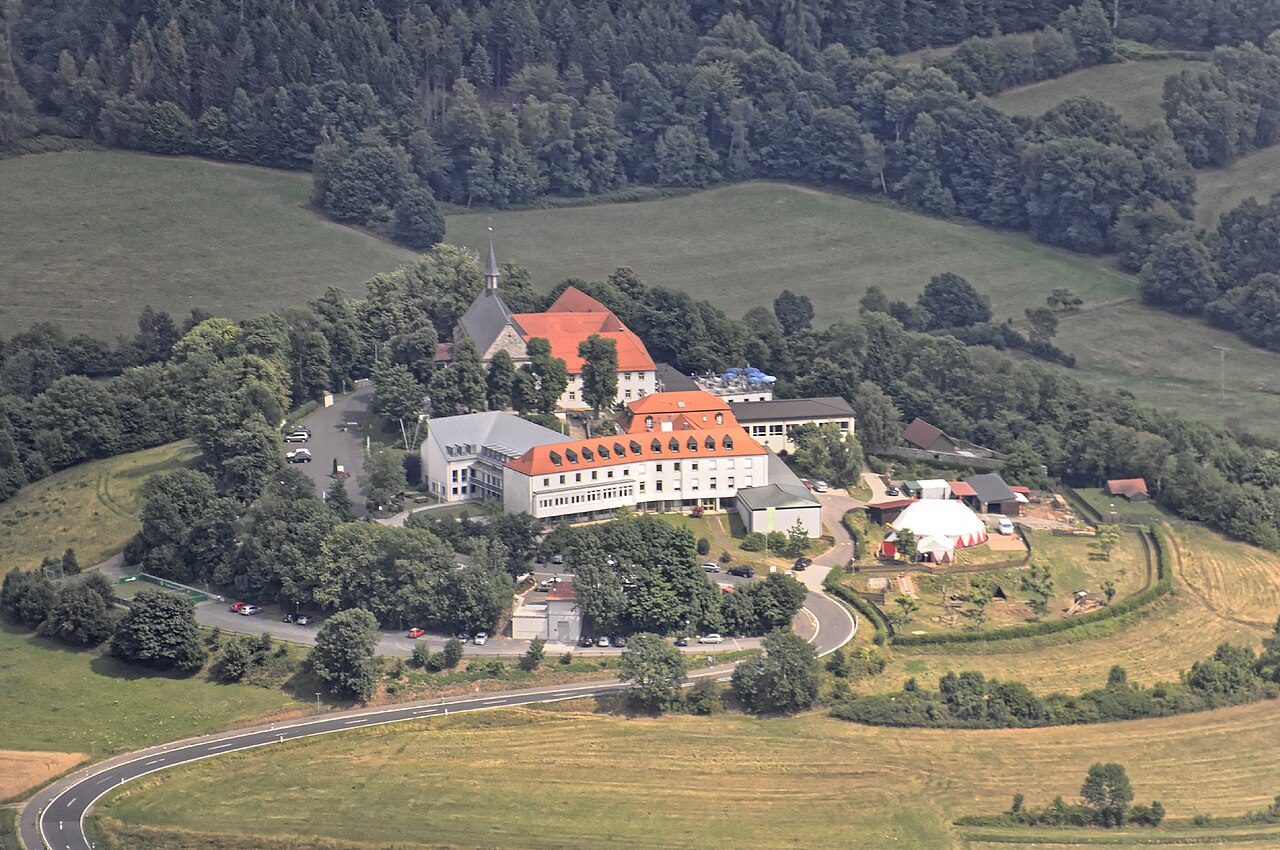
The former Franciscan monastery, Kloster Volkersberg, now serves as an educational institution on Volkersberg in the Bavarian Rhön. Its history is linked to pilgrimage and monastic use.
History+
The first mentions of Volkersberg date back to 1160, appearing in the inventory of goods of the Frauenberg Abbey near Fulda. A chapel there was first mentioned in 1378, and a brotherhood of the cross existed from 1450. Until the end of the 15th century, hermits cared for pilgrims. After a decline in pilgrimages during the Reformation and the Thirty Years' War, Volkersberg experienced a revival as a pilgrimage site in the mid-17th century, not least due to around 25 miracle reports between 1658 and 1672. The monastery, dedicated to the Finding of the True Cross, was founded in 1658 by Prince-Abbot Joachim von Grafenegg, who gifted the Franciscans a particle of the True Cross in 1659. The foundation stone for the monastery building was laid in 1661, church construction began in 1664, and its consecration took place in 1678. An inn for pilgrims was built in 1690, and by the early 18th century, up to 60 Franciscans lived here. The church was extended in 1707, and the monastery in 1710. A new Baroque inn was built in 1752, and a Stations of the Cross consecrated in 1755. The secularization of 1803 spared the monastery due to its poverty. In 1816, Volkersberg became part of Bavaria, and since 1821, the monastery has belonged to the Diocese of Würzburg.
Source: Wikipedia · Licence: CC BY-SA 4.0 · Image: © Ra Boe / Wikipedia / CC BY-SA 3.0 de via Wikimedia Commons
This description draws on the facts documented in the linked Wikipedia article; Wikipedia content is licensed under CC BY-SA 4.0. Wording and editing: Mobile History.
Location: 50.3295, 9.7675