Abbey
MonasteryWechselburg
Wechselburg Abbey
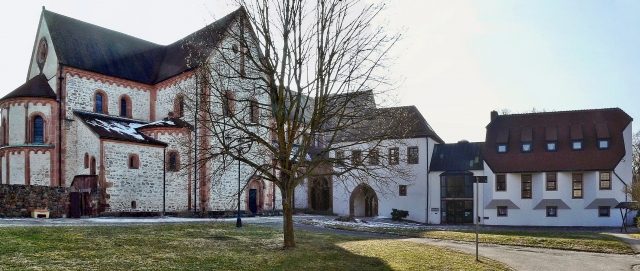
Wechselburg Monastery, once known as Zschillen Monastery, is a Benedictine monastery in Saxony. Its late Romanesque basilica is one of the best-preserved Romanesque grand buildings east of the Saale, and the rood screen with its sculptures is among the examples of German art from the 13th century.
History+
Dedo von Rochlitz-Groitzsch founded the monastery as a proprietary monastery. Around 1168, the late Romanesque basilica was partially consecrated by Gerung. Shortly after 1174, monastic life began according to the rules of Saint Augustine, with monks from the Augustinian Canons Regular Monastery of Petersberg. The construction of the three-aisled pillar basilica was completed around 1200, followed by the convent buildings. Margrave Heinrich the Illustrious handed over the monastery to the Teutonic Order in 1278. In 1543, the monastery and all its possessions fell to Duke Moritz of Saxony, who secularized it and exchanged it with the Lords of Schönburg for the towns of Hohnstein, Wehlen, and Lohmen, giving the place and the complex the name Wechselburg. The Teutonic Order unsuccessfully attempted to regain the monastery through legal means until 1570. After the Thirty Years' War, the Lords of Schönburg built a Baroque castle on the foundations of the ruined Romanesque monastery complex, which remained in their possession until 1945. The monastery church then served as an Evangelical castle chapel.
Source: Wikipedia · Licence: CC BY-SA 4.0 · Image: Thomas Eichler
This description draws on the facts documented in the linked Wikipedia article; Wikipedia content is licensed under CC BY-SA 4.0. Wording and editing: Mobile History.
Location: 51.0047, 12.7710