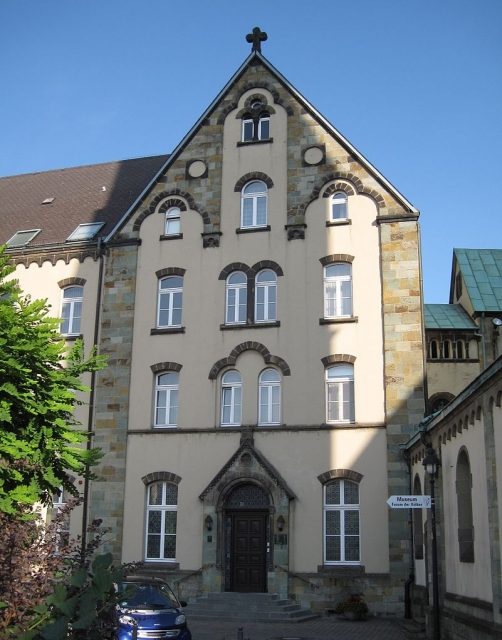
MonasteryWerl

Werl Abbey

Werl Abbey

Monastery operation

The Werl Monastery was a Capuchin monastery from 1645 to 1834 and has been a monastery of the Franciscan Order in Werl, Soest district, since 1848.

The original Capuchin monastery was founded in 1645 by Elector Ferdinand to strengthen Catholic life. In 1661, his successor Maximilian Heinrich handed over to the order the miraculous image of the Comforter of the Afflicted from the Soest Wiesenkirche, which attracted pilgrims and brought much money into the city. A number of medical miracles are also attested.

The monastery buildings were located east of the market. In 1786/89, the monastery church was rebuilt according to plans by Arnold Boner. The Capuchins earned their living through alms. In 1802, the convent consisted of 28 people. Among them were also some Frenchmen who had fled the French Revolution.

When Hesse took over the Duchy of Westphalia, the monastery initially remained. In 1804, it took in monks from the dissolved Capuchin monastery of Rüthen, and in 1813 from the abolished Capuchin monastery of Marsberg. The Werl monastery was then dissolved in 1834 under Prussian rule. The last monks left the monastery in 1836.

In 1848, Franciscans re-established the monastery. They were expelled in 1875 due to the monastery legislation during the so-called Kulturkampf and returned in 1887. The miraculous image and the pilgrimage basilica are still cared for by them today.

During the National Socialist era, pilgrimages were increasingly restricted and ultimately forbidden. The then pilgrimage director, Father Lambert Fester, nevertheless tried to maintain the "pilgrimage operation". He succeeded repeatedly despite restrictions. Since large pilgrimages were forbidden, participants of the foot pilgrimage from Werne came to Werl by detours and were stopped by the Gestapo shortly before the city and sent home.

In the crypt of the Franciscan monastery in the Werl Parkfriedhof lies the ashes of the Franciscan Father Kilian Kirchhoff, who was beheaded on April 24, 1944, in Brandenburg-Görden as a victim of the Nazi regime. He had been denounced by a woman from Kassel, arrested, and charged in Dortmund. Roland Freisler sentenced Kirchhoff to death on March 7, 1944, before the People's Court.

Simultaneum of the Monastery Church+

Around 1828, about 100 Protestants lived in Werl, which had about 3,350 inhabitants. These Protestant fellow citizens, mostly members of the Prussian civil service, had previously held their services in a chapel on the Gänsevöhde. From 1831, the monastery church - today the old pilgrimage church - was designated for simultaneous use. There were repeated difficulties between the two communities regarding church use. On March 6, 1851, the simultaneum was contractually abolished. The Protestant faithful celebrated their services in the council chamber of the then Werl town hall until the completion of their own church in 1854.

Take Mobile History with you

You are reading this text for free. Premium adds what matters on the road: descriptions read aloud, sites found through your camera, whole regions taken offline.

  • Every description, including the ~17,700 Premium sites
  • Audio guide: have descriptions read to you on location
  • AR finder: see sites through your camera, with distance and bearing
  • Unlimited saved sites

14 days free, then from €2.99 a month. Cancel anytime.

Source: Wikipedia · Licence: CC BY-SA 4.0

This description draws on the facts documented in the linked Wikipedia article; Wikipedia content is licensed under CC BY-SA 4.0. Wording and editing: Mobile History.

Location: 51.5537, 7.9156