MonasteryWittichen

Wittichen Abbey

Wittichen Abbey

To be privately owned

Wittichen Monastery is a former Poor Clares monastery in Wittichen, located in a narrow side valley of the Kleine Kinzig near Schenkenzell in the upper Kinzig Valley in the Black Forest.

The monastery was founded by the blessed Luitgard of Wittichen in 1324. According to tradition, God is said to have told Luitgard, who came from the Schenkenzell district of Kaltbrunn-Vortal, at the site of the monastery: "Here you shall build me a house!" So she set out to find fellow sisters and founded her monastery with 33 sisters in the solitude of Wittichen.

The monastery found support from the Dukes of Teck and the Counts of Geroldseck, as well as from Queen Agnes of Hungary. Through their mediation, the hermitage was recognized as a monastery by Pope John XXII. On Geroldseck property below Wittichenstein Castle and under the patronage of the Counts, a community of women developed after difficult beginnings (fire at the monastery in 1327, consecration of the monastery church in 1330) with extensive monastic possessions in Wittichen and Kaltbrunn, as well as on the Upper Rhine and Neckar (stewardships for property administration, among others, in Gengenbach, Horb, Lahr, Rottweil, Strasbourg, Villingen).

Temporarily dissolved in 1540 as a result of the Reformation, the convent of women consolidated again – albeit with restricted possibilities – and suffered heavy losses during and after the Thirty Years' War (1618–1648) (1640, 1663). The monastery was secularized in 1803.

The ideal-religious center of the nun community, which adopted the Rule of St. Clare in 1376, was the tomb of the blessed Luitgard. Pilgrimages were undertaken to her grave, especially after the opening of the grave in 1629 – the brain of the deceased was found completely intact. Wittichen Monastery had some significance since its foundation within the dominion and as a house monastery of the Counts of Geroldseck.

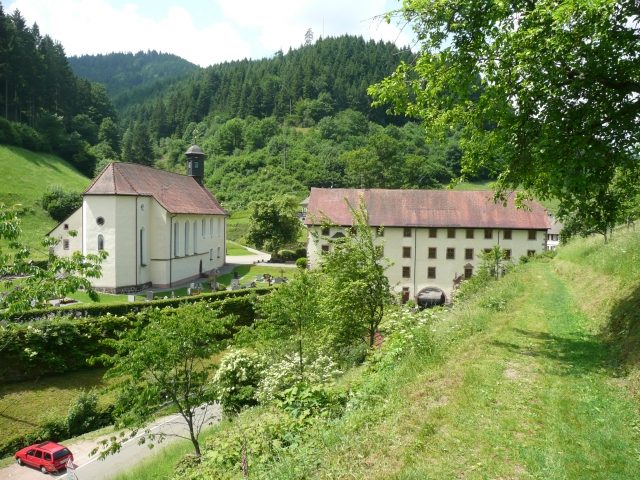
During the secularization, the monastery came into the possession of the Princely House of Fürstenberg. Part of the buildings was demolished in the 1850s due to excessive costs. The church, the nave, and the monastery stable are preserved, as is the cemetery.

Points of Interest+

The monastery church is a baroque jewel and is still a destination for many pilgrims today. Here you will find a tombstone with the coat of arms of the Urslingen family. A small museum is set up in the old monastery stable, exhibiting treasures such as the monstrance, vestments, and similar items from the monastery, as well as minerals from Wittichen.

The nave is used by the village of Kaltbrunn as a community center, but is impressive even from the outside due to its imposing size. The building effectively seals off the small valley. Through two sandstone-framed gates in the building, the valley stream and the through road, which leads to the former mining settlement of Wittichen, run side by side. The entire complex appears extremely idyllic despite its incompleteness.

Take Mobile History with you

You are reading this text for free. Premium adds what matters on the road: descriptions read aloud, sites found through your camera, whole regions taken offline.

  • Every description, including the ~17,700 Premium sites
  • Audio guide: have descriptions read to you on location
  • AR finder: see sites through your camera, with distance and bearing
  • Unlimited saved sites

14 days free, then from €2.99 a month. Cancel anytime.

Source: Wikipedia · Licence: CC BY-SA 4.0

This description draws on the facts documented in the linked Wikipedia article; Wikipedia content is licensed under CC BY-SA 4.0. Wording and editing: Mobile History.

Location: 48.3348, 8.3469