Hotel
Wöltingerode Abbey

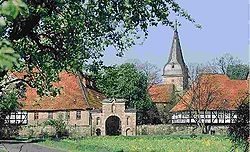
Wöltingerode Abbey is located in Wöltingerode in the district of Goslar. The monastery was founded in 1174 as a Benedictine monastery and existed until 1188. Subsequently, it became a monastery for Cistercian nuns. During this time, the foundation stone was laid for the monastery, whose dimensions can still be found today. Today, the monastery is used as a monastery hotel with gastronomy and for a distillery. The monastery is administered by the Klosterkammer Hannover. Wöltingerode was incorporated into the municipality of Vienenburg in 1929.
The Benedictine monastery was founded in 1174 by the Counts Ludolf II, Hogerus, and Borchardus of Wohldenberg. They generously endowed the monastery with 1500 acres of land, forest, pond, tithes, and mills. On October 19, 1174, Bishop Adelog of Hildesheim confirmed the founding of the monastery according to the Rule of Saint Benedict and granted it immunity and free election of the abbot. The Counts of Wohldenberg received the Vogtship and the right of patronage. This allowed them to choose their final resting place in the monastery.
Soon after the founding of the monastery, the monks' monastery was converted into a nunnery. According to the confirmation charter of Emperor Frederick Barbarossa in 1188, the monastery was occupied by nuns of the Cistercian Order. On October 3, 1216, Pope Honorius III took the monastery of St. Mary in Wöltingerode under his protection, confirming the property and rights of the monastery.
The church of Wöltingerode was first mentioned in a document in 1208. At the beginning of the 13th century, the church and monastery buildings had to be extended and rebuilt. In 1244, the monastery was consecrated by Bishop Konrad of Hildesheim. He confirmed the provisions previously made by Bishop Adelog. During this time, Wöltingerode Abbey enjoyed great prestige – it became the mother monastery for several other monasteries, such as Althaldensleben Abbey, Wienhausen Abbey, and Derneburg Abbey. In this first flourishing period of the monastery in the 13th century, book illumination was practiced here. Several manuscripts from Wöltingerode Abbey are preserved in the Herzog August Library in Wolfenbüttel.
In the 13th century, the monastery was further expanded. In 1279, the infirmary was mentioned, in 1293 the new dormitory, and in 1305 the "altar in the northern part of the monastery". At the end of the 13th and 14th centuries, the Wohldenberg counts, who had founded the monastery and later richly endowed it with gifts, became impoverished (the family died out in the male line in 1383). Consequently, bad times also came for the monastery. Already in 1290, properties had to be sold. In 1337, Bishop Heinrich of Hildesheim intervened and called for general support.
In the 15th century, the monastery experienced its second flourishing. After the Hildesheim Diocesan Feud, Wöltingerode Abbey came under the sovereignty of Duke Henry the Younger of Brunswick-Wolfenbüttel. When the Duke was driven from his land by the troops of the Schmalkaldic League, the nuns were to adopt the Lutheran doctrine or leave the monastery. After the Duke's return, the Catholic cult prevailed again until 1568. Then in 1568, his son and successor, Duke Julius, reintroduced the Lutheran doctrine. The abbess and nuns remained averse to the new doctrine. Only when the Duke had the Lutheran Anna von Haus elected as abbess could Wöltingerode become a Lutheran women's convent.
After the Edict of Restitution, Cistercian nuns from Bavaria were reintroduced to Wöltingerode in 1630 under Provost Heinrich Götze. After the Jesuits had settled in the Imperial Palace in Goslar, they tried, based on an imperial rescript, to take possession of Wöltingerode. Prince-Bishop Ferdinand gave his consent. The nuns could only be removed from the monastery by force. They were taken to Goslar to Frankenberg Abbey and from there, provided with travel money, sent to their homeland.
When the Swedes marched into Goslar in 1632, the Jesuits had to leave Wöltingerode. Until 1643, the monastery was Lutheran.
With the "Great Diocese of Hildesheim", Wöltingerode Abbey returned to the Diocese of Hildesheim in 1643. A reoccupation with nuns does not seem to have taken place immediately. On May 25, 1676, a great fire struck the monastery.
The half-timbered upper floor of the cloister is almost completely surrounded by a Latin inscription in golden majuscules, consisting of comforting and admonishing biblical words and blessings; inserted between them on the west wing is the note: :REAEDIFICATUM SUB A.C.H.A. ET A.F.P. DIE 12 AUGUSTI ANNO DOMINI 1679 : "Rebuilt under A.C.H.A. and A.F.P., August 12, 1679"; on the south wing the note: :AEDIFICATUM SUB LUCIA ROSA ABBATISSA ET FRE ANTONIO ECK PRAEPOSITO WOLTING: PROF VET: MONT: AO 1694 : "Built under Abbess Lucia Rosa and Friedrich Anton Eck, Provost of Wöltingerode, Professed of Altenberg, in the year 1694".
In 1802, Wöltingerode Abbey came to Prussia with the Diocese of Hildesheim, in 1807 to the Kingdom of Westphalia, which by decree on May 13, 1809, dissolved the nunneries of Wöltingerode, Dorstadt, and Heiningen. The monastery was bought by Israel Jacobson, appointed Secret Financial Councillor by Jérôme Bonaparte, for 200,000 francs. Where the treasures of the monastery remained is unknown. When, after Jérôme's fall, the Diocese of Hildesheim came to Hanover, Jacobson had to cede Wöltingerode to the Hanoverian government; according to Hanoverian law, no Israelite was allowed to own land.
The Wöltingerode monastery estate was united with the General Hanoverian Monastery Fund in 1818.
From 1830, the Wöltingerode office existed in the monastery. Together with three other administrative parts, this formed today's district of Goslar. From 1918 to 1993, the monastery housed the Rural Women's School of the Reifensteiner Association. In 1976, the monastery was renovated, and in 1979, the gallery of the church space was converted into a concert hall.
Currently, the complex is occupied by a monastery hotel including gastronomy and conference facilities, a distillery, a liqueur manufactory, and an agricultural operation.
Monastery Church
The former monastery church has only acquired its present appearance through multiple alterations and additions in various construction periods and consists of two parts. The eastern part now serves as a church. It is an old Romanesque cruciform basilica in a bound system from the end of the 12th century. The second choir quadrant dates from the 18th century. The western part consists of a Romanesque crypt-like lower church, presumably the original tomb of the Count of Wohldenberg, and the Gothic upper church with the nuns' gallery. Formerly, this part was used by the estate as a granary; today it is a concert and event hall for approx. 250 people. The adjoining west tower is Baroque.
The Baroque interior decoration created after the re-Catholicization around 1700 – high altar with a painting of Mary and figures of saints, pulpit with evangelists, confessional, ceiling painting (angels with instruments of Christ's passion in the choir), shell-shaped holy water basin, galleries – is completely preserved. The former cloister, which lies with one side to the south against the church, encloses a large rectangular inner courtyard with the adjacent rooms. The buildings are solid on the ground floor, with round-arched windows, and made of half-timbering on the upper floor. File:Wöltingerode Klosterkirche.jpg|Monastery church from the northeast File:Wöltingerode Innenhof.jpg|Inner courtyard, former cloister File:Wöltingerode Klosterkirche Innen.jpg|Interior facing east File:Wöltingerode Klosterkirche Inneres Emporen.jpg|Interior facing west
Monastery Distillery
Since 1682, grain from its own cultivation has been distilled in Wöltingerode and processed into fine grain spirits and liqueurs. According to old monastic tradition, a raw spirit is first produced from clear well water, barley malt, and wheat from the monastery's own lands in copper stills. Afterwards, the second distillation takes place in the monastery distillery. The result is a 96-percent fine spirit, which contains only the grain aromas. With spring water from the monastery well, this base is "spindled" to 38 percent alcohol. After that, the grain spirit is stored for at least one year in oak barrels in the old crypt. From the high-proof base, various liqueurs are also produced by adding plant, fruit, and herb aromas, partly according to old recipes. In winter, production is supported by a steam engine over a hundred years old.
Take Mobile History with you
You are reading this text for free. Premium adds what matters on the road: descriptions read aloud, sites found through your camera, whole regions taken offline.
- Every description, including the ~17,700 Premium sites
- Audio guide: have descriptions read to you on location
- AR finder: see sites through your camera, with distance and bearing
- Unlimited saved sites
14 days free, then from €2.99 a month. Cancel anytime.
Location: 51.9597, 10.5394