Museum
MonasteryRostock
Abbey of the Holy Cross
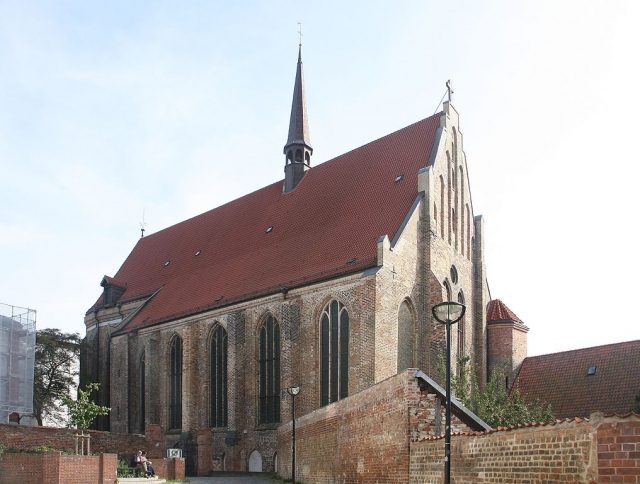
The Holy Cross Monastery in Rostock, Mecklenburg-Vorpommern, is a historic Cistercian nunnery and the only fully preserved monastic complex of its kind in the city. Today, it houses the University Church and a Cultural History Museum.
History+
The Holy Cross Monastery was founded between 1269 and 1272 by Cistercian nuns. It was named after its primary relic, a splinter from the cross of Jesus Christ. A forged document from 1270 attributed its foundation to the Danish Queen Margarethe, who also made extensive donations to the monastery. Over time, the monastery acquired considerable landholdings in Rostock and throughout Mecklenburg through gifts, endowments, and inheritances. The nuns predominantly came from affluent Rostock families, and the monastery experienced strong growth, leading to admission restrictions in the 14th century. The monastery church was completed around 1360. Following the Reformation, which reached the monastery in 1562, the institution was transformed into a convent for noblewomen in 1584, though the lifestyle of the residents largely adhered to the Catholic monastic order. After the Thirty Years' War, the number of residents decreased to nine. The monastery was finally dissolved on August 17, 1920, but the remaining ladies were granted lifelong residency rights.
Source: Wikipedia · Licence: CC BY-SA 4.0 · Image: https://commons.wikimedia.org/wiki/File:Kloster_zum_Heiligen_Kreuz,_Universit%C3%A4tskirche,_WLM_2011.jpg
This description draws on the facts documented in the linked Wikipedia article; Wikipedia content is licensed under CC BY-SA 4.0. Wording and editing: Mobile History.
Location: 54.0876, 12.1326