University building
MonasteryAachen
Klosterrather Hof
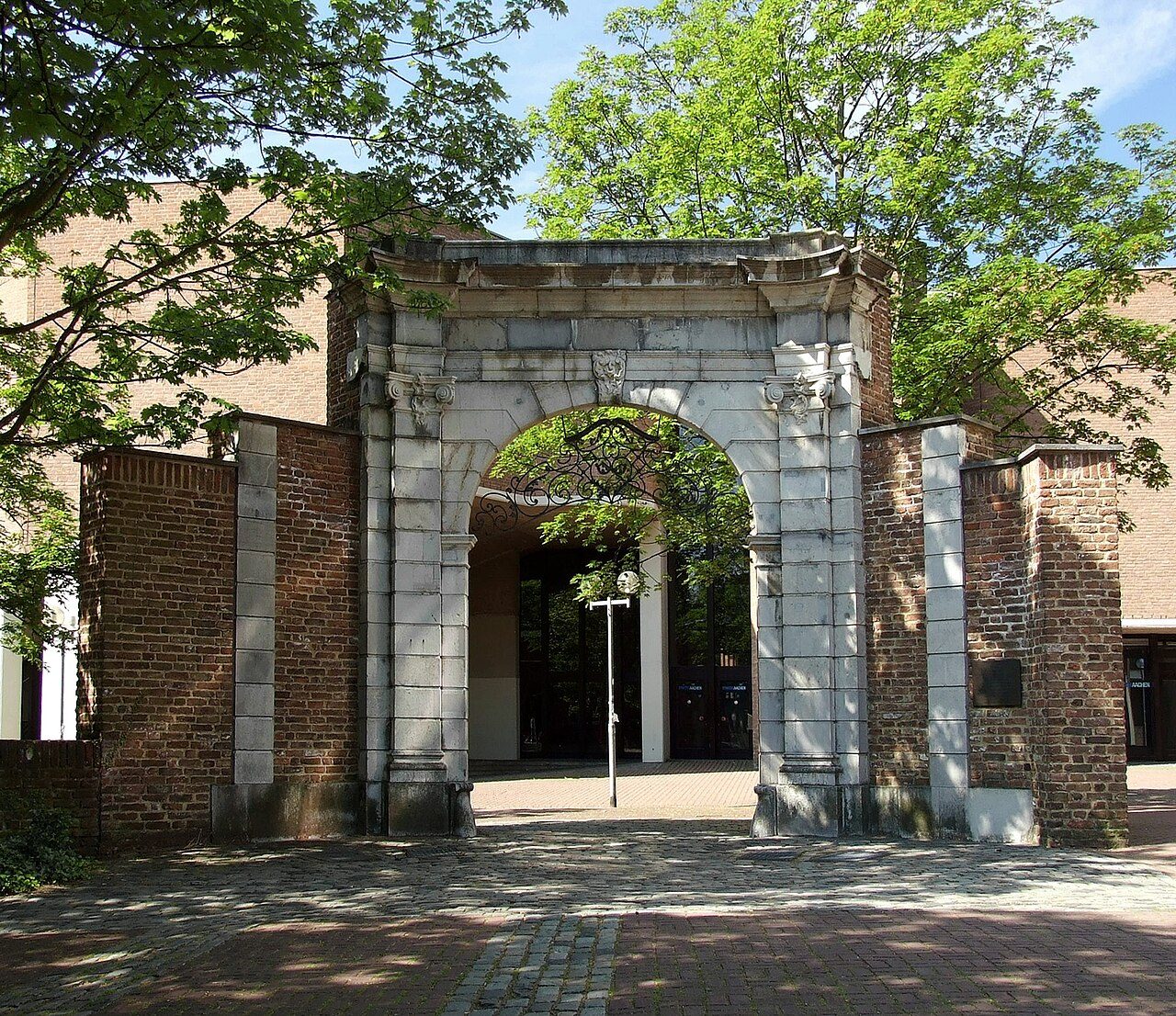
The Klosterrather Hof in the Aachen city region, North Rhine-Westphalia, was once a significant monastic court that evolved over centuries into a versatile complex of residential and factory buildings. Today, it is protected as a historical monument in North Rhine-Westphalia, bearing witness to a rich past that spans monastic use, industrial production, and urban development.
History+
In 1536, the Klosterrather Hof was established as the town house of Klosterrath Abbey from the Duchy of Limburg in Aachen. Following the devastating city fire of Aachen in 1660, the property underwent significant expansion through the acquisition of additional land, particularly along Eilfschornsteinstraße. Between 1786 and 1802, extensive new constructions were carried out under the direction of the Aachen Baroque master builder Joseph Moretti, including the gatehouse that still stands today. The secularization of the left-bank territories in 1802 led to the Hof falling to the French Republic. Napoleon Bonaparte himself sold the property in 1804 to the needle manufacturer Laurenz Jecker, who established a modern needle factory there. With around 150 employees, over a million pins were produced annually and distributed throughout Europe. After Jecker's withdrawal in 1809, the Migeon brothers took over the business. From 1811, the brothers Johann Josef and Johann Heinrich Schervier, who already operated a copper mill nearby, joined as equal partners. Johann Heinrich Schervier became the sole owner in 1823, and his daughter, the later founder of a religious order, Franziska Schervier, grew up in the residential building. After his death in 1845, Ludwig Heinrich Schervier inherited the property. The factory buildings were later taken over by Laurenz Jecker's son Julius Caesar Jecker and transferred to Heusch & Butenberg in 1877. Following Ludwig Heinrich Schervier's death in 1896, his widow Franziska inherited the properties, which she sold in 1910 to the machine manufacturer A. Schiffers. During World War II, the Klosterrather Hof was destroyed and subsequently largely demolished. The land became the property of the State of North Rhine-Westphalia and was used by RWTH Aachen, which constructed a lecture hall complex, the Kármán Auditorium, there in the 1970s. Only the Baroque gate from 1786 remained and was integrated into the open space design.
Location+
The Klosterrather Hof is located on Eilfschornsteinstraße in Aachen, a city within the Aachen city region in the federal state of North Rhine-Westphalia, Germany.
On site+
Today, only the historic gatehouse from 1786 of the original Klosterrather Hof remains, integrated into the open space design of the Kármán Auditorium of RWTH Aachen. The rest of the site is occupied by modern university buildings.
Nearby+
- Aachen Cathedral (sacred building, approx. 414 m away)
- Aachen-Ponttor City Fortification (city fortification, approx. 512 m away)
- Aachen-Marienturm City Fortification (city fortification, approx. 607 m away)
- Salvatorberg Monastery (sacred building, approx. 894 m away)
Take Mobile History with you
You are reading this text for free. Premium adds what matters on the road: descriptions read aloud, sites found through your camera, whole regions taken offline.
- Every description, including the ~17,700 Premium sites
- Audio guide: have descriptions read to you on location
- AR finder: see sites through your camera, with distance and bearing
- Unlimited saved sites
14 days free, then from €2.99 a month. Cancel anytime.
Location: 50.7771, 6.0799