MonasteryGnadenberg

Gnadenberg Abbey (Ruin)
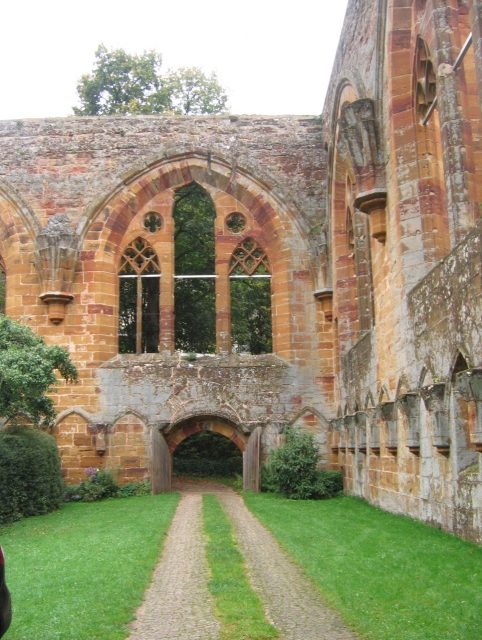
Gnadenberg Abbey (Ruin)

The Ruin can be visited

Gnadenberg Abbey is a former monastery of the Bridgettine Order (Order of the Most Holy Saviour) in the district of the same name in the municipality of Berg bei Neumarkt in the Upper Palatinate in Bavaria, in the Diocese of Eichstätt.

Gnadenberg was the first Bridgettine monastery in Southern Germany. It was founded in 1426 by Count Palatine Johann I of Neumarkt and his wife Katharina, daughter of Duke Wratislaw VII of Pomerania, at the location originally known as Eichelberg. Katharina knew the order from Wadstena Abbey in Sweden, where she had spent her youth. The Count Palatine's foundation charter is dated February 3, 1426. In 1430, the first monks arrived from Mariboo Abbey in Denmark. Bridgettine monasteries were designed as double monasteries by the order's founder; after the women's monastery was completed in 1435, the first nuns, with their first abbess Anna Svenson, also came to Gnadenberg from Mariboo Abbey in 1435.

A provisional church was consecrated on July 15, 1438, by the Eichstätt Bishop Albrecht II von Hohenrechberg; construction of the monastery church only began in 1451. At the consecration of the monastery on July 11, 1451, by Bishop Johann III von Eych, thanks to rapid recruitment of new members, the Danish nuns had already returned to their homeland in 1438. Elisabeth Kniepantlin had been elected as the second abbess; in the second half of the 15th century, Gnadenberg developed into a leading monastery of the Bridgettine Order.

The monastery church, in accordance with the Bridgettine Order's regulations, consisting of three naves of equal size and height, each with five vaulted bays of approximately square ground plan, and an altar choir (in Gnadenberg's case with 13 altars) in the west, was roofed in 1477-79, but was not yet vaulted when it was consecrated at Pentecost 1483 by Auxiliary Bishop Kilian of Eichstätt. Beyond the order's building program, a gallery walkway was added to the interior walls. The church was vaulted between 1511-18, creating net vaults; at the same time, work was done on the sisters' house. The master builders were entirely from Nuremberg, including Master Jakob Grimm (building plans and construction management), Master Eucharius Gaßner (carpentry), and Hans Frommiller (vaulting); Albrecht Dürer was commissioned to provide an expert opinion on the somewhat problematic, according to chroniclers, massive and artistic roof structure of the monastery church. The church had no tower, only a roof turret.

The monastery, whose buildings lay on both sides of the church (the completely vanished brothers' wing in the southeast, the sisters' wing in the northwest), received rich support from burgher families of the nearby imperial city of Nuremberg, whose daughters often entered the monastery. The patrician family of Führer was particularly prominent; in the 16th century, a Barbara Führer was abbess.

When the Reformation was introduced in Nuremberg around 1524, which also held patronage over the monastery, the monastery declined, and when the Reformation also took hold in the Upper Palatinate in 1556 through the new sovereign Ottheinrich, it was gradually dissolved. The last abbess was Ursula Breunin. The monastery was secularized in 1563; monastic life ceased in 1570. From 1577, the monastery estates were sold or granted as fiefs. In the Thirty Years' War, on April 23, 1635, Swedish troops burned down the church and parts of the monastery; since then, Gnadenberg has been a ruin.

In 1671, the monastery was assigned to the new Order of the Salesian Sisters, who came to Gnadenberg from their first German establishment, St. Anna in Munich, but did not rebuild the church. With the secularization in Bavaria at the beginning of the 19th century, this successor monastery was also dissolved. The monastery estates and the ruin came into private ownership, the latter temporarily, until it was acquired by the Bavarian state in 1898. During the 19th century, parts of the ruin were demolished, and a house was built into the southeast corner of the church ruin.

Current State+

The ruin of the former monastery church impresses with the monumentality of its still standing high outer walls of light brown sandstone and the Gothic tracery of its large window openings. In the southeast wall, the only preserved tomb monument is the life-size relief epitaph of Knight Martin von Wildenstein, who died in 1466 and had donated an Ascension altar and money for stained glass; the high tomb of the foundress Katharina (+ 1426) in front of the brothers' choir has disappeared. Externally, the buttresses are set back once and simply roofed. The footprint of the former hall church is 70 by 37 meters. The church ruin is only partially accessible due to a private garden, under which the pillar bases are presumed to be. Also not accessible are the remains of the formerly vaulted cloister in the former monastery courtyard and the nunnery, which formed a quadrangle, of which the northeastern wing has been preserved. The enclosing walls of the entire monastery complex are partially still present.

Parish Church+

After the reintroduction of the Catholic religion in the Upper Palatinate, the sacristy of the former monastery church was initially used as a provisional church for the parish of St. Brigitta. In 1654-55, the monastery wing that remained standing in the northwest, which had contained the refectory, was converted into a church; this has four window axes and no separate choir. A roof turret is located above the gable. The church has Baroque furnishings from the second half of the 17th century; the high altar shows a relief depiction of the Fourteen Holy Helpers instead of an altarpiece.

Take Mobile History with you

You are reading this text for free. Premium adds what matters on the road: descriptions read aloud, sites found through your camera, whole regions taken offline.

  • Every description, including the ~17,700 Premium sites
  • Audio guide: have descriptions read to you on location
  • AR finder: see sites through your camera, with distance and bearing
  • Unlimited saved sites

14 days free, then from €2.99 a month. Cancel anytime.

Source: Wikipedia · Licence: CC BY-SA 4.0

This description draws on the facts documented in the linked Wikipedia article; Wikipedia content is licensed under CC BY-SA 4.0. Wording and editing: Mobile History.

Location: 49.3689, 11.4110