To be privately owned
Koeth-Wanscheidsches Castle

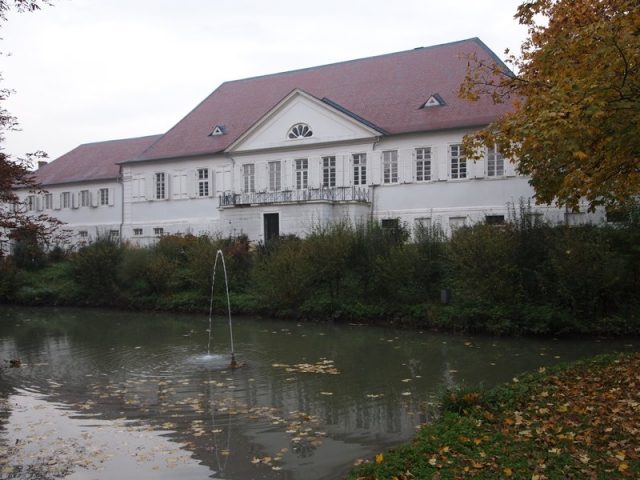
The Koeth-Wanscheid Castle in the Rhineland-Palatinate municipality of Dirmstein is a large, castle-like manor house, whose current components predominantly date from the late Baroque and Classicism periods. It is a protected monument.
The castle is located on the northwestern edge of Dirmstein's historic town center, which is still called Oberdorf today. The south front and inner courtyard face Herrengasse, while the east wing, as a gatehouse, borders Obertor street with its northern side. The further north facade faces the castle park, the southeastern end of which is formed by the castle.
Building+
The current building ensemble is grouped in a horseshoe shape around a large paved inner courtyard, which visually opens to the south, towards Herrengasse; it is enclosed by a low sandstone plinth with a picket fence on top and accessible via a centrally placed gate with sandstone pillars. On both sides of the gate, there were initially four, now three, old Norway maples, which were designated as a natural monument decades ago under the name "Four old maple trees".
On the west and east flanks of the courtyard stand the two so-called coach houses, cubically shaped utility buildings from the beginning of the 19th century, which are structured by stepped blind arches and continuous impost cornices.
The center of the horseshoe is formed by the actual castle, which consists of the central building and two lower side wings.
Building History+
In the middle of the 18th century, the Baden-Durlach court councilor Wolfgang Wilhelm von Rießmann was the first known owner of the castle. At that time, the moat of the village fortification still ran along the north side of the property, and the castle park did not yet exist. The town plan of 1746 recorded:
"H. v. Rismans house facing the streets made of wood and the new one facing the moat made of stone; along with two barns, both also made of wood"
The stone central building, referred to as the "new" house in this source, was constructed using wooden beams which, according to dendrochronological investigations, date from the years 1715–1718 and can thus be assigned to the same reconstruction phase as the Old Town Hall, the St. Michael Pharmacy, or the house Marktstraße 1. This proves that the predecessor property of the castle had also been destroyed when Dirmstein was almost completely burned down by French troops in 1689 during the War of the Palatine Succession.
In the second half of the 18th century, ownership of the castle passed from Rießmann to the von Haumüller family, who had been elevated to hereditary nobility in the 17th century. From about 1770, the castle was then owned by the Palatinate officer Georg August Heinrich von Kinkel. When the French Revolution spread to the Palatinate towards the end of the 18th century, he was to be dispossessed and the estate auctioned off. However, the castle had been transferred in time (1796) to his brother Heinrich August von Kinkel, who had become a Dutch vice-admiral and envoy and therefore enjoyed diplomatic immunity.
Joseph von Camuzi acquired the estate from him on December 2, 1802. His son Gideon – later, from 1868 to 1874, mayor – and his family expanded the area to the north beyond the previous village boundary by purchasing land behind the old village moat between 1824 and 1837. Gideon von Camuzi was friends with the Mannheim painter Louis Coblitz, who stayed with him at the castle in the summer of 1861 and created several paintings of Dirmstein.
Current Use+
At the beginning of the new millennium, the castle was completely restored externally and substantially internally by public funds. It has since been awaiting an investor. Above all, the requirement of the monument protection authority not to open the large roof areas with dormers, thus foregoing the use of the attic space, has deterred interested parties so far.
The coach houses and the inner courtyard have been leased for decades to a local beverage dealer for storage purposes.
Take Mobile History with you
You are reading this text for free. Premium adds what matters on the road: descriptions read aloud, sites found through your camera, whole regions taken offline.
- Every description, including the ~17,700 Premium sites
- Audio guide: have descriptions read to you on location
- AR finder: see sites through your camera, with distance and bearing
- Unlimited saved sites
14 days free, then from €2.99 a month. Cancel anytime.
Source: Wikipedia · Licence: CC BY-SA 4.0 · Image: http://www.wehrbauten.de/thread.php?threadid=1338
This description draws on the facts documented in the linked Wikipedia article; Wikipedia content is licensed under CC BY-SA 4.0. Wording and editing: Mobile History.
Location: 49.5644, 8.2444