Parish church
MonasteryWürzburg
Kollegiatstift Haug Abbey
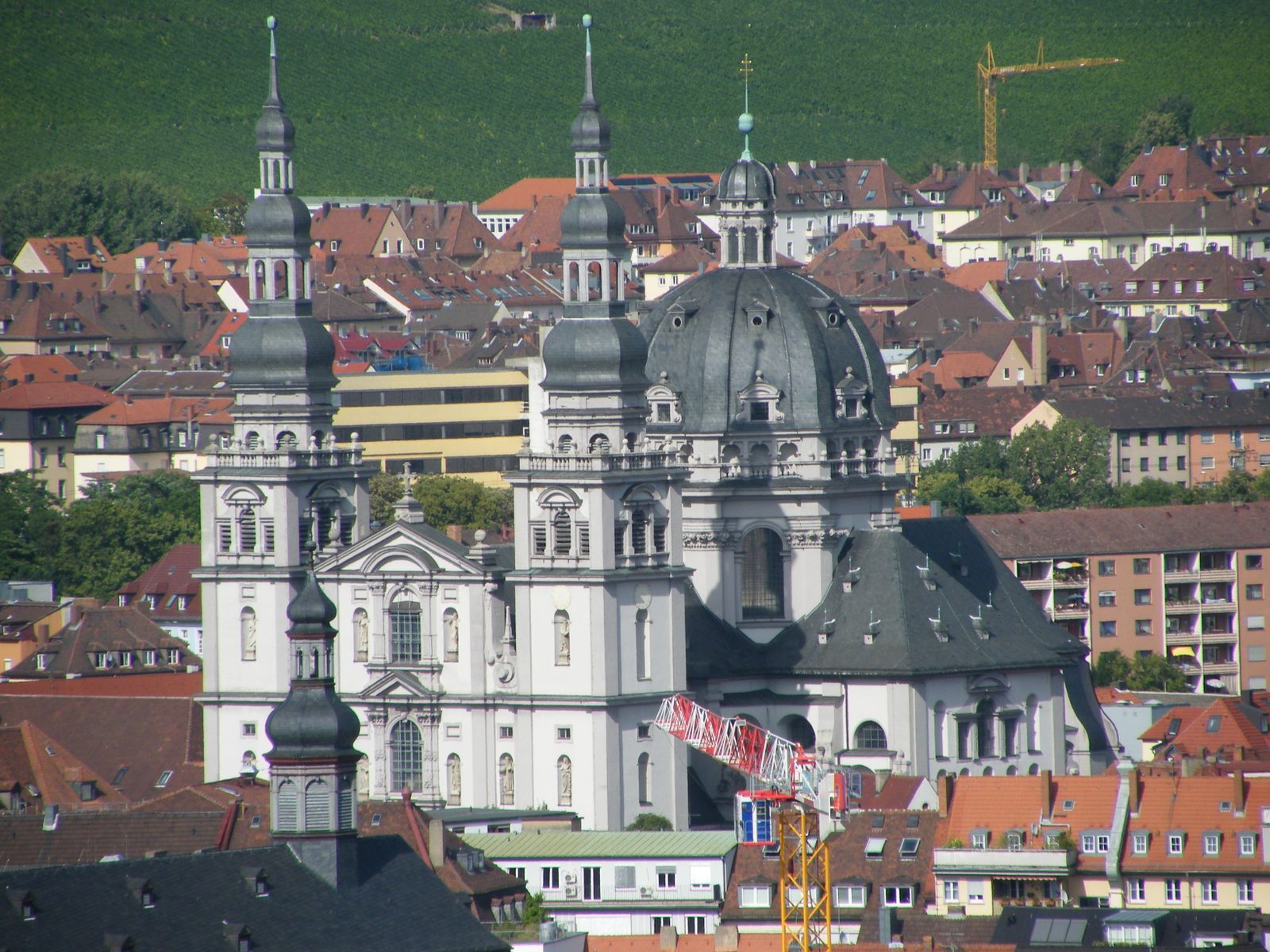
Stift Haug refers to the parish church of St. Johannes in Würzburg, located in the Haug district (also known as Hauger Viertel), and the associated parish as St. Johannes in Stift Haug. The former collegiate church belonged to the Collegiate Foundation of Haug until its secularization in 1803. The church, dedicated to John the Baptist and John the Evangelist, was completed in 1691 according to plans by Antonio Petrini. The two towers of Stift Haug, at a height of 75 meters, are the second-tallest church towers in Würzburg.
Predecessor Building+
The Collegiate Foundation of St. Johann zu Haug can be traced back to the community of the "Lords of the Mountain" mentioned in 1002, the name deriving from houc → Haug → hill. The foundation of Haug, originally founded around 1000 and consecrated by its builder, Bishop Heinrich I of Würzburg, was located north of the city wall, at the site of today's railway station, a few hundred meters north of its current location. In the 14th century, the physician and Wimpfen canon Berthold Blumentrost, originally from Schwäbisch Hall, taught as a scholastic in Würzburg, where in 1326 he had received an additional canonry as a canon at St. Johannes in Haug. To make way for the Baroque city fortifications, the then Prince-Bishop had the foundation demolished at its old site in 1657 and rebuilt at its current location.
New Collegiate Church+
From 1670 to 1691, Antonio Petrini, whose main work is the Hauger church building, created the synthesis between a Central European double-tower facade and a Roman dome structure, whose slender towers with the massive, slate-covered dome form an element that significantly shapes the cityscape. The large transept dome, inspired by St. Peter's Basilica, rises to a height of 60 meters. At the highest point inside the dome, the symbol of the Holy Spirit, the dove, is visible in a halo of rays. The dissolution of wall boundaries through arcades goes back to an idea by Donato Bramante, who had realized such a design around 1480 in the interior of the church of Santa Maria presso San Satiro in Milan. Petrini was the leading Baroque master builder in Franconia in the second half of the 17th century, and his Hauger collegiate church was the first monumental Baroque building in Würzburg after the Thirty Years' War.
Parish Church+
In 1803, Stift Haug was dissolved during the secularization. The collegiate church became a parish church.
Renovation after Bombing+
After the bombardment and subsequent city fire of March 16, 1945, the former splendid interior decoration, which had largely been created from about 1690 onwards, including wooden altars, choir stalls, sculptures and paintings, pulpit, and organ, burned down (among them most works by Michael Rieß, Johann Caspar Brandt (1652–1701), and Oswald Onghers). After reconstruction, the cool proportions and bright spaciousness of Petrini's massive architecture are impressive. In 2005, the complete renovation of the interior was completed.
Source: Wikipedia · Licence: CC BY-SA 4.0 · Image: Lukas M. ( Benutzer:Renredam ) · Wikimedia Commons · CC BY-SA 3.0
This description is a machine translation of an excerpt from the linked Wikipedia article. The source text was written by its authors, the translation is by Mobile History; like the original it is licensed under CC BY-SA 4.0.
Location: 49.7979, 9.9359