Church
MonasteryWürzburg
Kollegiatstift Neumünster Abbey
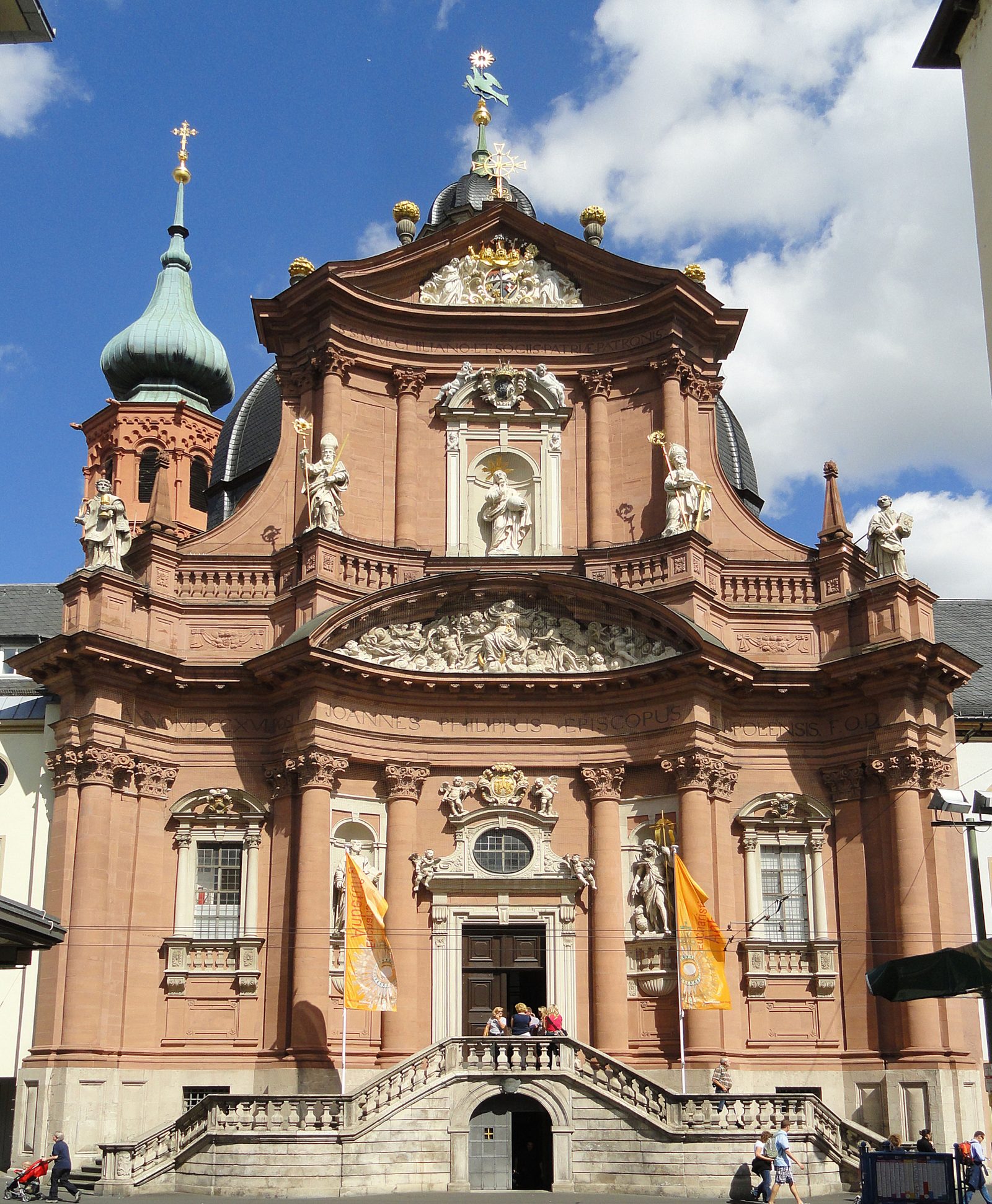
The Neumünster Collegiate church (German: Kollegiatstift Neumünster, French: Collégiale de Neumünster) is a former collegiate church in Würzburg, Germany. The church dates back to the 11th century.
The first church on the site was probably built during the tenure of Meningoz of Würzburg to commemorate the place where the so-called Franconian Apostles, Kilian, Colman, and Totnan, were martyred. Burchard, Meningoz's predecessor, and later Meningoz himself were buried in this church. The monumental inscription on Meningoz's sarcophagus is the oldest post-roman inscription in Franconia. In 1057, Adalbero of Würzburg founded the college of canons of Neumünster, dedicated to John the Evangelist. The church was completed three years later in the Romanesque style. The church was renovated and expanded from 1180 to 1250. From 1711 to 1716 Josef Greising built the west façade in the Baroque style. From 1725 the interior was redesigned in the baroque style by the brothers Johann Baptist Zimmermann and Dominikus Zimmermann. As a consequence of the German mediatisation, the church was temporarily used as a munitions depot until 1821. The Neumünster first became a parish church, separate from the adjacent Cathedral, in 1908. The parish is dedicated to John the Baptist and John the Evangelist. The church was heavily damaged in the bombing of Würzburg in 1945, leading to the destruction of much of the church's interior, including the Tilman Riemenschneider busts of the Franconian Apostles (afterwards replaced by copies).
Source: Wikipedia · Licence: CC BY-SA 4.0 · Image: Daderot · Wikimedia Commons · CC0
This description is an excerpt from the linked Wikipedia article and was written by its authors. Like the original it is licensed under CC BY-SA 4.0 and may be reused under the same terms.
Location: 49.7938, 9.9316