To be privately owned
Siersdorf Castle

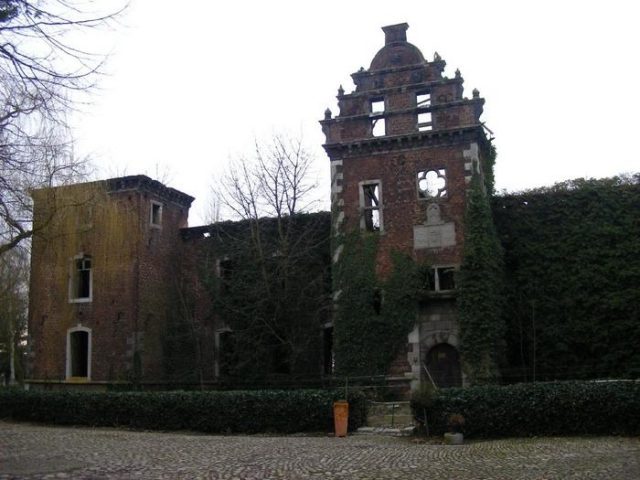
The Teutonic Commandery of Siersdorf is the ruin of a castle-like manor house in the Siersdorf district of Aldenhoven in the North Rhine-Westphalian district of Düren. It is located west of the Siersdorf parish church and belonged to the Bailiwick of Alden Biesen.
After severe damage in 1543 during the Third Guelders War of Succession, the Land Commander Heinrich von Reuschenberg had the building rebuilt in the Renaissance style starting in 1578. Extensively restored again in the 1920s by its then owners, the commandery was largely destroyed in November 1944 by heavy artillery hits.
After the manor house ruin was placed under monument protection as a building monument on April 25, 1986, the entire commandery grounds were also included in the list of monuments as an archaeological monument on October 4, 1989.
Description+
The commandery was formerly a five-part building ensemble, consisting of a manor house, outbuildings with a nearly U-shaped floor plan located southeast of it, a church, and two agricultural estates, the so-called Großer Hof (Large Estate) and Kleiner Hof (Small Estate).
The brick manor house is a rectangular, approximately 42 by 26 meter single-wing complex with four nearly square corner towers, accessible from the main building via diagonal corridors. The two-story Renaissance-style building has a bluestone plinth and is surrounded by a moat about eight meters wide and five meters deep with a counterscarp. Its show facade faces southeast and has a slightly projecting central risalit, which houses the staircase with a straight flight of stairs. It is crowned by a stepped gable with a round arch. This originally had a small sculpture as its upper finial, which was destroyed in World War II. The former four-story hip roof, which made up half of the total building height, with its former lantern and the differently shaped tower spires are also no longer preserved, as they too were destroyed by wartime action. Above the entrance in the risalit, next to the coat of arms of the Teutonic Order, that of the United Duchies of Jülich-Cleves-Berg, and that of the builder of the manor house, Heinrich von Reuschenberg, are also his Latin motto SOLI DEO GLORIA (German: To God alone be the glory) and the inscription SVB VMBRA ALARVM TVARVM PROTEGE NOS (German: Under the shadow of your wings protect us). The interior walls of the building are plastered with a layer of straw and clay, on which an additional thin layer of fine plaster is applied.
The neighboring Catholic parish church of St. John the Baptist was formerly also the burial place of the order knights residing in the commandery. Built in the first quarter of the 16th century by Commander Conrad von Reuschenberg, he had its crypt designed as a burial site for the Teutonic Order lords. Also from this period is its artistically crafted carved altar from Flanders. Hans Kunnes dates it to the period between 1520 and 1522. The church's choir stalls with the coat of arms of the Teutonic Order and the Reuschenberg family date from the time of Conrad's successor Franz von Reuschenberg, who headed the Siersdorf commandery from 1524 to 1527. In addition to eight wooden figures attributed to the workshop of the Master of Elsloo, the altarpiece from 1541 and the unique rood screen arch donated by Commander Johann von Goer are also of art-historical value.
The Beginnings
The foundation stone for the nearly 600-year history of the Siersdorf Commandery was laid in 1219 by a donation from Count Wilhelm III of Jülich, who, among other things, gave the Teutonic Order the church in Siersdorf "with all its appurtenances." It was his thanks for the care he had received from the order brothers during the Fifth Crusade in Jerusalem when he had fallen ill with malaria. Siersdorf was thus the oldest order settlement within the Bailiwick of Alden Biesen. The donation also included a former Frankish fief, to which the patronage of the neighboring church was attached. In its place, the order had the so-called Kleiner Hof built between 1264 and probably 1267 under Commander Volcwin(us). This first commandery building stood behind the now destroyed gate area of the current commandery and behind the tithe barn of the present Kleiner Hof. A new church building was erected at the same time.
Previously, the friendly connections of the order to the Jülich ducal house had led to numerous donations from the Jülich rulers and concessions, which significantly promoted the development of the order and the enlargement of its possessions in the Siersdorf region. For example, Count Wilhelm IV of Jülich had exchanged three Morgen behind the order's then estate for three Morgen located in the Wildstock, thus enabling the construction of the first commandery building.
Golden Age
After the neighboring church had been rebuilt between 1510 and 1520 under Commander Conrad von Reuschenberg, it was – like the village – burned down in 1543 by Emperor Charles V's mercenaries during the Third Guelders War of Succession. The commandery itself was plundered and partially destroyed.
After the departure of the Siersdorf Commander Johann von Goer in 1544, his office remained vacant for the following eight years. The Commander Adam von Holtorp (also von Holtorf), appointed in 1566, held the leadership only until April 1569, after which followed a 22-year vacancy of the position. During this time, Siersdorf was administered from Alden Biesen. Heinrich von Reuschenberg served as administrator of the commandery, who from 1572 was also Land Commander of Alden Biesen and from 1566 to 1567 and 1580 to 1584 Commander of the Teutonic Commandery of St. Aegidius in Aachen. In 1578, he initiated the long-needed reconstruction of the commandery's manor house. The costly work was supervised by master builders of the Teutonic Order, but the architect of the building remains unknown to this day.
Under Edmund von Reuschenberg, who was Commander in Siersdorf from 1591, the Großer Hof was rebuilt in 1607, as evidenced by Edmund's coat of arms together with that of the Teutonic Order and the corresponding year on the building. Further construction activities at the commandery did not follow until 1750. The interior of the manor house was modernized and the building's windows were baroque-ized by replacing the mullioned windows with segmental arch windows. The roof also received a lantern. In direct proximity to the building at that time were utility and ornamental gardens.
Gradual Decline
In 1794, Siersdorf, along with its commandery, like many other areas on the left bank of the Rhine, was occupied by French troops during the First Coalition War and became part of France with the Peace of Lunéville in 1801. Napoleon Bonaparte officially dissolved the Teutonic Order in 1809, and its property was nationalized. War veterans of the French army were quartered in the commandery. Valuable furnishings, such as numerous portrait paintings of Grand Masters and Commanders, were sold for one franc each, and the furniture was used for heating. Much of the interior disappeared during this time.
From 1814, Siersdorf belonged to Prussia, whose domain administration continued the sales of former commandery property to private interested parties. The manor house was auctioned on February 8, 1820, and, along with 394 Morgen of land, went to Gerhard Heusch of Laurensberg for 41,000 Thalers, thus entering private ownership. His family had the manor house extensively restored again in the 1920s.
Destruction in World War II
During World War II, the Siersdorf Commandery suffered severe damage. An American artillery hit damaged the roof, while a second hit significantly damaged the north tower. On November 18, 1944, American troops succeeded in taking the complex, which was subsequently used as a command post. In the turmoil of war, the interior furnishings of the manor house were lost.
The war damage was not repaired for the time being, leading to a gradual decay of the main building. In 1950, the owner family also had to cede large parts of the property belonging to the commandery to the Eschweiler Bergwerks-Verein (EBV). In addition to land, this also included the outbuildings of the complex. Despite some safety measures in the 1950s and 1960s, the ruin of the manor house continued to decay, as the scope of the work was just enough to prevent the remains of the building from completely collapsing.
Reconstruction Plans
The ruin of the manor house is currently in a "critical condition." In 2001, a support association was founded to promote and support plans for the reconstruction of the commandery. In the course of these efforts, five diploma theses were produced in 2006 at the Institute for Building History and Monument Preservation of the Faculty of Architecture at the Cologne University of Applied Sciences, which include conservation and utilization concepts for the Siersdorf Commandery. The support association is currently trying to find investors to implement one of these concepts. On May 11, 2012, it received a commitment from the federal government for funding of up to 150,000 Euros to ensure the basic structural safety of the ruin, which is severely endangered in its substance.
List of Siersdorf Commanders
- Volcwin(us) (1267-1268)
- Godfried van Stockem (1270-1274)
- Gyso von Hergenroth (1305-1308)
- Gerard von Runkel (1308-1322)
- Godfried von Lerreghe und Burke (1327)
- Godfried van Kerkom (1331)
- Otto von Zalem (1333)
- Johann von Scherve (1341)
- Reinhard von Welhoven (1344)
- Geldorf von Likburgh (1348)
- Baldewin von Ferkeshoven (1350)
- Jan von Montzen (Johann von Muntzen) (1373-1392)
- Godart von Bloedorp (1407)
- Diederik van Havert (1424-1441)
- Goswin von Cortenbach (1454-1462)
- Hugo von Sevenberch (1462-1491)
- Konrad von Reuschenberg (1491-1522)
- Franz von Reuschenberg (1524-1547)
- Johann von Goer (1547-1554)
- 1554-1566: Commander's position vacant
- Adam von Holtrop (1566-1569)
- 1569-1591: Commander's position vacant, Heinrich von Reuschenberg as administrator
- Edmond von Reuschenberg (1591-1623)
- Johann von Eynatten zu Opsinnich (1624-1649)
- Wilhelm von Neuhoff (1649-1676)
- Kaspar Schenck von Nideggen zu Hellenraedt (1677-1688)
- Bertram Wessel von Loe zu Wissen (1688-1691)
- Wilhelm Dietrich von Kolff zu Vettelhoven (1691-1717)
- Heinrich Schenck von Nideggen (1728-1732)
- Philipp Emmerich von Eltz (1734)
- Franz Gerhard von Cortenbach (1736-1742)
- Johann Kaspar von Hillesheim (1744-1761)
- Franz Theodor vom Rump (1762-1770)
- Raimund Kasimir von Lamberg (1771-1775)
- Lothar Franz von Horneck (1775-1776)
- Clemens August von Plettenberg (1776-1778)
- Lothar Franz von Horneck (1778-1805)
Take Mobile History with you
You are reading this text for free. Premium adds what matters on the road: descriptions read aloud, sites found through your camera, whole regions taken offline.
- Every description, including the ~17,700 Premium sites
- Audio guide: have descriptions read to you on location
- AR finder: see sites through your camera, with distance and bearing
- Unlimited saved sites
14 days free, then from €2.99 a month. Cancel anytime.
Source: Wikipedia · Licence: CC BY-SA 4.0 · Image: http://www.wehrbauten.de/thread.php?threadid=570
This description draws on the facts documented in the linked Wikipedia article; Wikipedia content is licensed under CC BY-SA 4.0. Wording and editing: Mobile History.
Location: 50.8999, 6.2221