CastleNürnberg-Erlenstegen

Kressen Castle
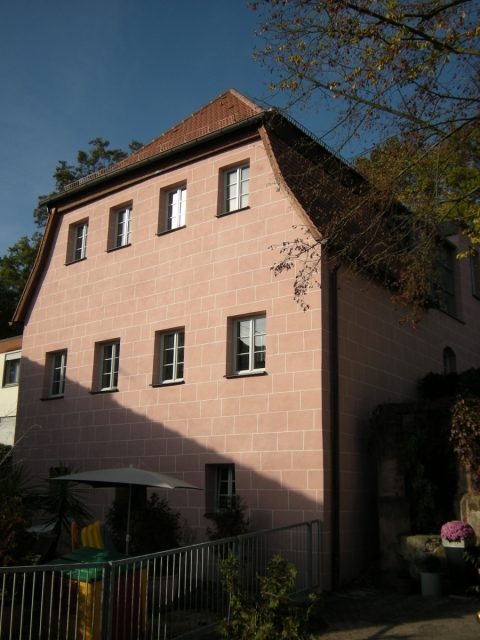
Kressen Castle

To be privately owned

As with other imperial fiefdoms in the Reichswald, a manor house was built here at an unknown time. The hereditary forest farm is said to have been in the hands of a Cuntz Schütz in 1439, another source names Markart Rabnolt for 1441. Wilhelm Derrer owned the hereditary forest farm in the early 16th century and granted the imperial city the right of access in case of war in 1517, which already suggests the existence of a manor. In 1534, the seat was sold to Sigmund Hagelsheimer, also known as Held. From him, it passed around the middle of the 16th century to the compass maker Hans Gebhardt, then in July 1571 from Gebhardt's heirs to Gabriel Eysvogel. The war damage from 1553 had been repaired by this time, but according to the owner, serious structural damage had since appeared because "nothing had been built or improved on the house for many years". The two-story manor house was to be renovated, with the Vogt's apartment, previously located on the lower floor, to be moved to the barn.

In 1592, the manor house was in the hands of an Egidius Arnold, who maintained a trout pond on the estate. To enjoy a "prospect" over the Pegnitz valley, a representative summer arbor had been built on an island in the pond. While Antoni Rieger was still named as the new owner in 1599, in 1610 Stephan Heber appeared as the new lord of the castle, who got into trouble and received a fine for an unauthorized installation of a laundry room. Nevertheless, the small house was still standing around 1800 and was used as accommodation for a bird catcher.

In 1638, Barbara, the wife of Jeremias Wortmann in Nuremberg, sold "her hitherto held hereditary right to and on the small manor in Erlenstegen" to Johann Sigmund Freiherr von Jö(b)stel(s)berg (1584–1652) from Styria, who was one of the many religious refugees settling in Nuremberg. In 1670, his son Wolfgang Friedrich (1619–1695) applied for the conversion of the Vogt's house, built in 1571, whose steep roof, still covered with monk-and-nun tiles, still reminded of its former barn function, but was now considerably damaged. Before 1700, the seat came to Friedrich Wilhelm Ebner von Eschenbach (1652–1711), who had the manor house extended by an annex in 1705. An external cellar was also integrated. In 1709, a summer house was extended. Around 1800, it was still known as "the small manor house located on the street" and was used as a rental house. In 1711, the stable building was extended by a residential floor and also rented out.

In 1716, Ebner's son-in-law Georg Jakob Pömer (1687–1732), who presumably acted as administrator or guardian, disposed of the seat. He wanted to build a brandy distillery on the estate. After the death of Jobst Wilhelm Ebner (1717–1763), the estate came to his niece Anna Helena née Holzschuher (1727–1786), the wife of Christoph Leonhard Kreß von Kressenstein. Subsequently, the manor was therefore referred to as "Kreßenhof", which was praised not least for its artistic garden, where orange trees were also cultivated.

In 1787, the seat was acquired by Georg Christoph Wilhelm Kreß von Kressenstein (1744–1825), Nuremberg castle official and city court assessor, for his still unmarried daughter Sarah Johanna (1771–1853). He witnessed the end of the manor house on Sunday, July 2, 1790, when a fire broke out in the early afternoon and allegedly reduced the building "to ashes down to the ground". In 1791, the castle official had the manor house restored with two stories and solid enclosures. In 1803, Sarah Johanna married the Royal Württemberg First Lieutenant (since 1808 Major) Christian Friedrich von Hüpeden.

In 1812, the manor consisted of the manor house, which then housed two rental apartments, three other tenement houses, and the Vogt's or gardener's house. In 1823, the castle estate was sold to the large baker Friedrich Neumann, who broke it up into several properties. The merchant sold the manor house as early as January 1825 to the master carpenter Johann Samuel Bergmann. In 1906, after several changes of ownership, it came into the hands of the stonemason Johann Kern. After his death, it passed into the ownership of a community of heirs in 1933.

The manor house, renewed in 1791 and covered with a half-hipped roof, has been preserved to this day. During a recent renovation, the plaster skin was painted in a red tone with a light false joint network. Unfortunately, only the draw well with a roof resting on two stone columns remains of the castle garden. As late as 1939, garden figures made of sandstone placed there were also praised, which apparently have been lost except for one example.

Take Mobile History with you

You are reading this text for free. Premium adds what matters on the road: descriptions read aloud, sites found through your camera, whole regions taken offline.

  • Every description, including the ~17,700 Premium sites
  • Audio guide: have descriptions read to you on location
  • AR finder: see sites through your camera, with distance and bearing
  • Unlimited saved sites

14 days free, then from €2.99 a month. Cancel anytime.

Source: Wikipedia · Licence: CC BY-SA 4.0 · Image: http://schloesserrundschau.de/bayern/schloesser01/nuernberg20.html

This description draws on the facts documented in the linked Wikipedia article; Wikipedia content is licensed under CC BY-SA 4.0. Wording and editing: Mobile History.

Location: 49.4728, 11.1363