ManorGeisenheim

Kronberger Hof Manor

Kronberger Hof Manor

School

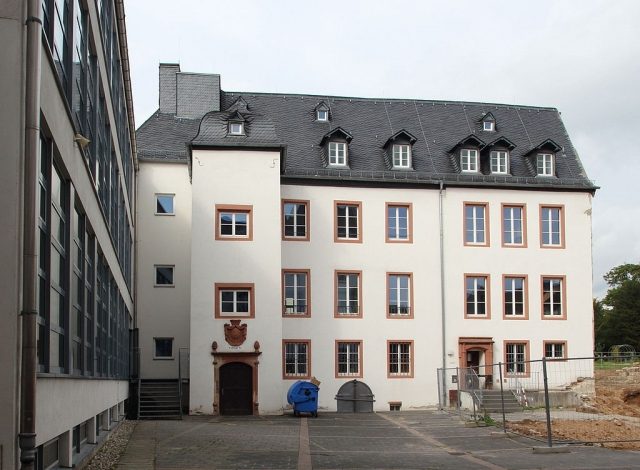
The Kronberger Hof is a former noble court in Geisenheim in the Rheingau, built in the second half of the 16th century. A remaining listed building, along with a preserved garden pavilion, has been part of the St. Ursula School since 1894.

As Hof von der Leyen, the court was built in 1581 for Hans Andreas von der Leyen, replacing 13 bourgeois houses. In 1616, the Archbishop and Elector of Mainz, Johann Schweikhard von Cronberg, acquired the court, which from then on was called Cronberger Hof. The property included various buildings, gardens, vineyards, fields, and meadows, which were cultivated by court staff and tenants.

After many changes of ownership, among which the Brömser family from Rüdesheim was probably temporarily included, the estate came into the possession of the Ostein family in 1732 with Johann Franz Heinrich Carl Graf von Ostein. Under Karl Maximilian von Ostein, parts of the garden area were used for the construction of the Palais Ostein. In 1801, Franz Georg Karl von Metternich, the father of the Austrian Chancellor Metternich, acquired the estate. During further changes of ownership, buildings and garden were separated from the rest of the property. In 1893, the Ursuline Order was finally able to acquire the building and garden from the Berlin wine merchant Andrew Thorndyke and opened a new convent with a girls' high school and boarding school on April 4, 1894. In 1899, the originally symmetrical building was extended to the east by three axes. For the construction of a new school building, three axes were demolished to the west in 1964.

The Kronberger Hof is a three-story stone building with a gabled roof and a projecting stair tower. Of the two Renaissance portals, the one marked with the year 1581 was probably originally at the back of the house. Above the portal marked with 1616 is a cartouche with the coat of arms of the Metternich family from a more recent period. The garden pavilion, built around 1720/30, features a remarkable stucco ceiling attributed to the school of the Ticinese stucco artist Carlo Maria Pozzi. Since 1995, the pavilion has served as the entrance building to a new sports hall.

Take Mobile History with you

You are reading this text for free. Premium adds what matters on the road: descriptions read aloud, sites found through your camera, whole regions taken offline.

  • Every description, including the ~17,700 Premium sites
  • Audio guide: have descriptions read to you on location
  • AR finder: see sites through your camera, with distance and bearing
  • Unlimited saved sites

14 days free, then from €2.99 a month. Cancel anytime.

Location: 49.9824, 7.9621