The Castle can be visited
CastleSeitenroda
Leuchtenburg Castle
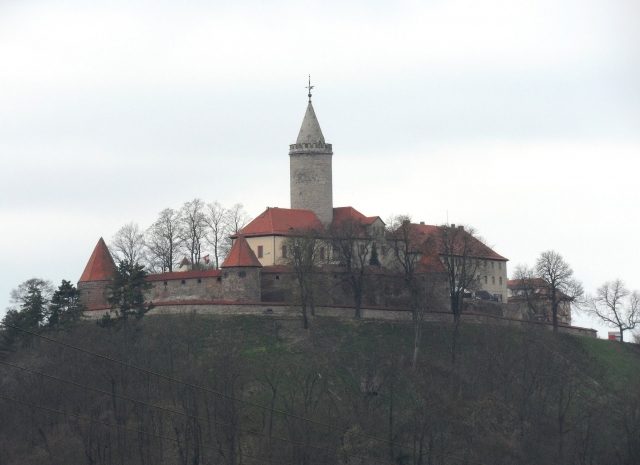
Leuchtenburg Castle is on a conical hill in Seitenroda in the Saale-Holzland district of Thuringia. It is often referred to as the “Queen of the Saale Valley,” a name derived from the bright, unwooded mountain on which it was built.
History+
The first documented mention of the castle dates back to April 15, 1221, when Hartmann IV. of Lobdeburg-Leuchtenburg settled a legal dispute in Dornburg. For the Lords of Lobdeburg, Leuchtenburg became a stronghold, alongside Lobdeburg, for their expansion southeastward and towards the upper Saale. In the second half of the 13th century, the castle underwent expansion. Due to heavy debts, the Lobdeburgers had to mortgage the castle to the Counts of Schwarzburg in 1313 and eventually sold it to them in 1333. After the Schwarzburgers were weakened by the Thuringian Counts' Feud, the Wettins managed to conquer the castle in 1392 and, in the Treaty of Leipzig in 1396, forced the Schwarzburgers to sell it to them definitively. Under Wettin rule, Leuchtenburg became the seat of an administrative office for the surrounding Wettin villages. Following the defeat of Elector Johann Friedrich the Magnanimous in the Schmalkaldic War in 1547, the castle served as a refuge for his wife and children. In 1553, the then-dry castle well was deepened to 80 meters, making it the second deepest well in Thuringia. During the Thirty Years' War (1618–1648), the castle offered protection. In 1702, the administrative office was moved to Kahla, and parts of the castle were subsequently used as a correctional facility, poorhouse, and asylum.
Source: Wikipedia · Licence: CC BY-SA 4.0 · Image: Uwe Klimpke
This description draws on the facts documented in the linked Wikipedia article; Wikipedia content is licensed under CC BY-SA 4.0. Wording and editing: Mobile History.
Location: 50.8043, 11.6124