The church can be visited
ChurchWolframs-Eschenbach
Liebfrauenmünster Church
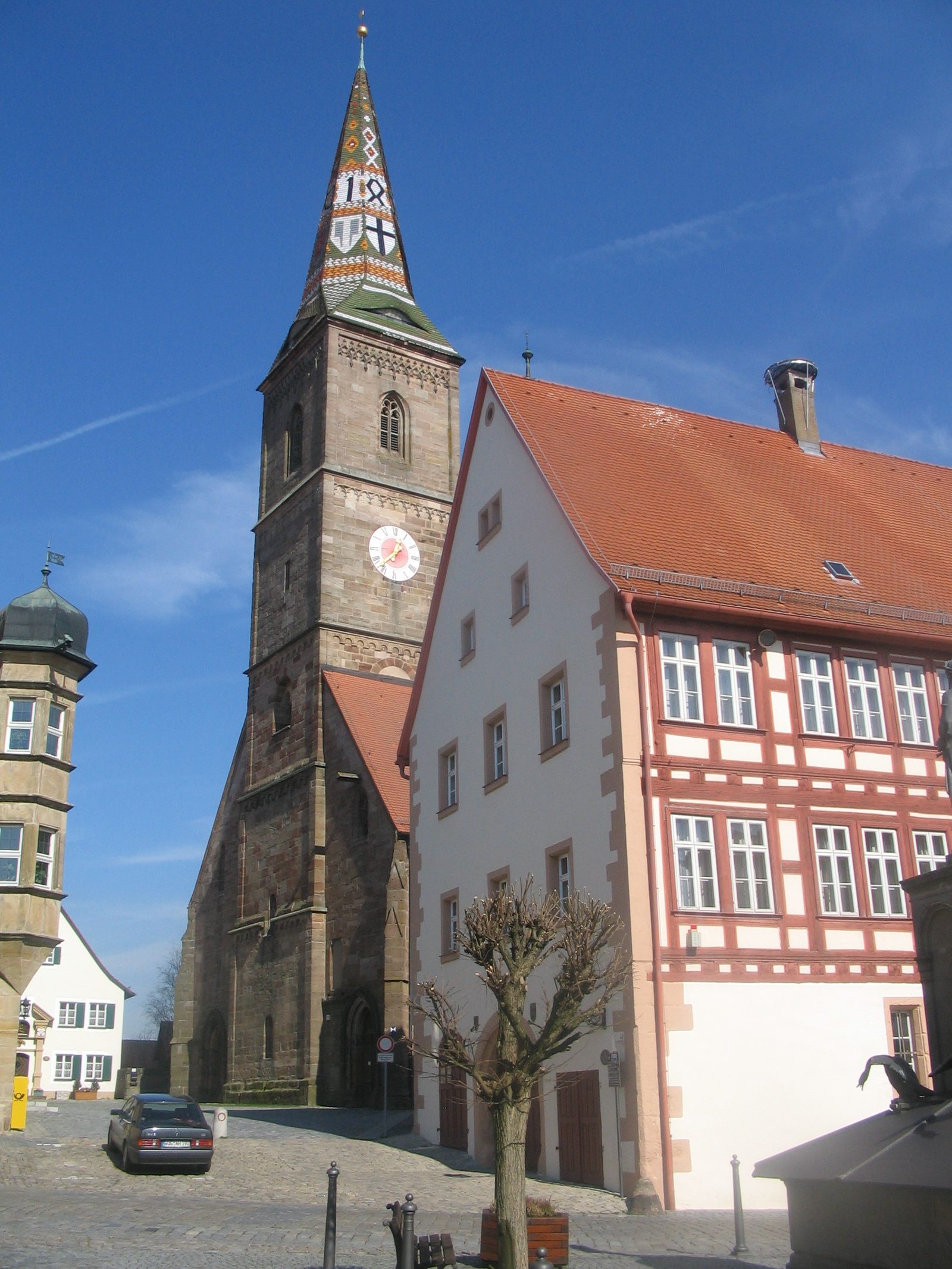
The Liebfrauenmünster is the Roman Catholic parish church in Wolframs-Eschenbach. It is located in the Central Franconian district of Ansbach and belongs to the Diocese of Eichstätt. The church is dedicated to the Assumption of Mary and is part of the Episcopal Deanery of Herrieden.
Traces of settlement and a predecessor wooden church are dated back to the 8th century. After a stone church from the Ottonian period, which was destroyed by Hungarian invasions, a successor building was erected, which already had the dimensions of the present church. The current Liebfrauenmünster dates back to the 13th century: The lowest Romanesque tower floor still comes from the church consecrated by Bishop Gundekar (1019–1075). Under the rule of the Teutonic Order, further floors were built in 1220/30, the choir around 1250, and the nave followed around 1300. In 1430/40, the tower received two Gothic floors and in 1465/66 the pointed spire with glazed tiles. The nave and choir were raised in 1453/54. In 1481, the sacristy was added on the north side. The church underwent a renovation and redesign in the Baroque style from 1713–1719 by the Teutonic Order master builder Franz Keller, the painter Franz Ignaz Roth, and his brother, the stucco artist and later Order master builder Franz Joseph Roth. In 1749, the current Marienkapelle (Mary's Chapel) was built on the site of an annex with an Order library. A profound change was brought about by the redesign in the Neo-Gothic style in 1876/78, during which all Baroque components were rigorously removed. All altars, benches, the pulpit, and the communion rail were renewed in this style, the walls were painted with images from the life of Jesus, and the windows received Neo-Gothic stained glass. The Neo-Gothic stylistic elements were removed again in 1946 during another renovation. From 1985 to 1990, during a thorough exterior renovation, major damage to the roof structure was repaired, the east gable was reinforced with a back wall, and the weathered string courses and eaves cornices were renewed. The last major redesign of the church took place in 2000/2001, during which the gallery was demolished, the pulpit was permanently removed, and the altar area was redesigned. The organ now found its place in the northern side aisle, combined with a space for the choir. This measure eliminated the central aisle and replaced it with a closed block of pews.
Furnishings+
Altars and Figures+
In the southern side aisle, the Altar of the Finding of the Cross (around 1490) depicts Empress Helena with her court and Bishop Macarius of Jerusalem with an advisor and two workmen finding the Holy Cross. On the side wings, the Roman martyrs John and Paul are depicted, on the back of the altar wings the Saints Gangolf and Martin, the latter dressed as wealthy Nuremberg patricians. In the predella, the 14 Holy Helpers can be seen. A late Gothic Pietà from 1480 stands on the high altar, flanked by figures of Saint Elisabeth and Saint George from 1745.
In the northern side aisle stands a Rosary Altar, also called the "Heavenly Court," from the school of Veit Stoß. This is a depiction of the heaven of saints framed by a rosary. Around an oversized cross, groups of saints from the Old Testament, the Apostles, the Martyrs, the ecclesiastical hierarchy (i.e., popes and bishops), theology, virgins, and holy mothers are arranged. A memorial plaque from 1922 for the poet Wolfram von Eschenbach, whose grave is in the church but can no longer be clearly located, is on the south wall of the church. Among the treasures of the church is a wooden figure group, the Nativity of Christ, around 1500, which is only placed in front of the altar on Christmas holidays.
In the side chapel hangs a painting of the Seven Sorrows of Mary, a copy of the miraculous image from Oberelchingen near Ulm. The altarpiece depicts the Assumption of Mary into Heaven. It was the former high altarpiece and refers to the patronage of the Liebfrauenmünster. The figure of Saint Sebastian with a historic votive candle (1700/1730) originally comes from the cemetery church of St. Sebastian, which is located west outside the city.
Organ+
The organ in the northern side aisle was built in 1984 as Opus 89 by the workshop Georg Jann in Laberweinting. It has 21 stops on two manuals and pedal.
Bells+
The large bell (strike tone e′), cast by Georg Herold in 1629, bears the inscription: + IESV + CHRISTE + FILI + DEI + VIVI + MISERERE + NOBIS + GEORG: HEROLT IN NVRMBERG 1629. The oldest bell from the 14th century (strike tone g′) bears the inscription JOHANNES + MATTHAEUS + LUKAS + MARKUS + MARIA between corded ridges. It was recast after the Second World War and its tone was changed. In 1975, the peal of bells was supplemented by three new bells with strike tones a′ – h′ – d″ from the Heidelberg bell foundry.
Take Mobile History with you
You are reading this text for free. Premium adds what matters on the road: descriptions read aloud, sites found through your camera, whole regions taken offline.
- Every description, including the ~17,700 Premium sites
- Audio guide: have descriptions read to you on location
- AR finder: see sites through your camera, with distance and bearing
- Unlimited saved sites
14 days free, then from €2.99 a month. Cancel anytime.
Source: Wikipedia · Licence: CC BY-SA 4.0 · Image: User:Jarlhelm · Wikimedia Commons · CC BY-SA 3.0
This description is a machine translation of an excerpt from the linked Wikipedia article. The source text was written by its authors, the translation is by Mobile History; like the original it is licensed under CC BY-SA 4.0.
Location: 49.2269, 10.7263