Cathedral
ChurchLimburg
Limburg Cathedral
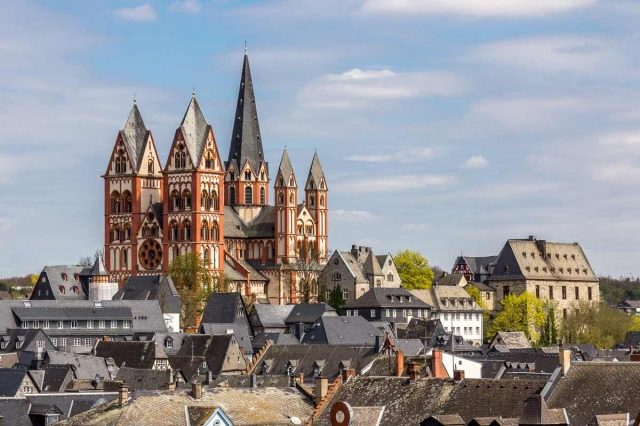
The Catholic Cathedral of Limburg, also known as Georgsdom or Limburger Dom in German after its dedication to Saint George, is located above the old town of Limburg in Hesse, Germany. It is the cathedral of the Roman Catholic Diocese of Limburg. Its high location on a rock above the Lahn provides its visibility from far away. The building is one of the most perfect buildings of the late Romanesque style.
The first church on the "Limburger Rock" was built in 910 by Konrad Kurzbold. Inside today's cathedral, the outline of the former church still can be found.
The date of placing the foundation stone is unknown. However, investigations of the wood used inside the Dom give information about the period in which it was built. According to estimates, construction began about 1200, maybe as early as 1190. The consecration was in 1235 by Theoderich von Wied, the archbishop of Trier.
The church of St. Georg was upraised in 1827 to be the Cathedral of the new diocese of Limburg. The first bishop of Limburg was Jakob Brand (1827 to 1833). The diocese has currently about 700,000 Catholics and is one of the younger dioceses. On Friday, February 2, 2007, Pope Benedict XVI accepted the age-related resignation of former bishop Franz Kamphaus. Franz-Peter Tebartz-van Elst was named new bishop on November 28, 2007, and took office on January 20, 2008. He was suspended on 23 October 2013, the administrator of the diocese has been general vicar Wolfgang Rösch.
Architecture+
The polychrome external plaster of the Dom, consisting of white, red, ochre, black and some green, has been restored from 1968 to 1972 following original remains, which had been removed during restoration works in 1872 to 1873. This explains, why the Dom has been portrayed in rock-colour after that time.
Source: Wikipedia · Licence: CC BY-SA 4.0 · Image: http://de.wikipedia.org/wiki/Datei:BD_20130423-Limburger_Dom-00001.jpg
This description draws on the facts documented in the linked Wikipedia article; Wikipedia content is licensed under CC BY-SA 4.0. Wording and editing: Mobile History.
Location: 50.3888, 8.0671