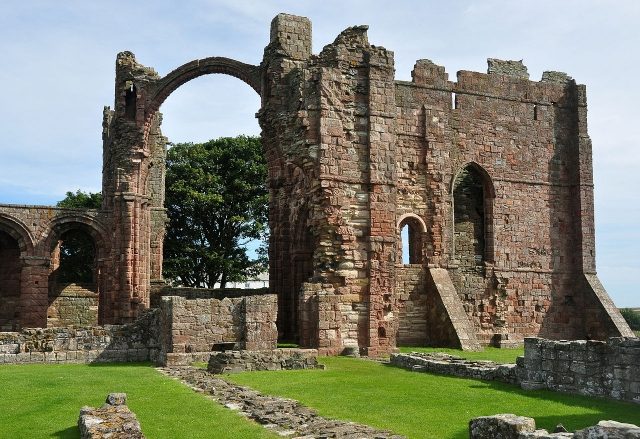
The Abbey can be visited
Lindisfarne Priory
The monastery of Lindisfarne was founded by Irish monk Saint Aidan, who had been sent from Iona off the west coast of Scotland to Northumbria at the request of King Oswald. The priory was founded before the end of 634 and Aidan remained there until his death in 651. The priory remained the only seat of a bishopric in Northumbria for nearly thirty years. Finian (bishop 651–661) built a timber church "suitable for a bishop's seat". St. Bede however was critical of the fact that the church was not built of stone but only of hewn oak thatched with reeds. A later bishop, Eadbert removed the thatch and covered both walls and roof in lead. An abbot, who could be the bishop, was elected by the brethren and led the community. St. Bede comments on this:
And let no one be surprised that, though we have said above that in this island of Lindisfarne, small as it is, there is found the seat of a bishop, now we say also that it is the home of an abbot and monks; for it actually is so. For one and the same dwelling-place of the servants of God holds both; and indeed all are monks. Aidan, who was the first bishop of this place, was a monk and always lived according to monastic rule together with all his followers. Hence all the bishops of that place up to the present time exercise their episcopal functions in such a way that the abbot, who they themselves have chosen by the advice of the brethren, rules the monastery; and all the priests, deacons, singers and readers and other ecclesiastical grades, together with the bishop himself, keep the monastic rule in all things.
Lindisfarne became the base for Christian evangelising in the North of England and also sent a successful mission to Mercia. Monks from the Irish community of Iona settled on the island. Northumberland's patron saint, Saint Cuthbert, was a monk and later abbot of the monastery, and his miracles and life are recorded by the Venerable Bede. Cuthbert later became Bishop of Lindisfarne. An anonymous life of Cuthbert written at Lindisfarne is the oldest extant piece of English historical writing. From its reference to "Aldfrith, who now reigns peacefully" it must date to between 685 and 704. Cuthbert was buried here, his remains later translated to Durham Cathedral (along with the relics of Saint Eadfrith of Lindisfarne). Eadberht of Lindisfarne, the next bishop (and saint) was buried in the place from which Cuthbert's body was exhumed earlier the same year when the priory was abandoned in the late 9th century.
Cuthbert's body was carried with the monks, eventually settling in Chester-le-Street before a final move to Durham. The saint's shrine was the major pilgrimage centre for much of the region until its despoliation by Henry VIII's commissioners in 1539 or 1540. The grave was preserved however and when opened in 1827 yielded a number of remarkable artefacts dating back to Lindisfarne. The inner (of three) coffins was of incised wood, the only decorated wood to survive from the period. It shows Jesus surrounded by the Four Evangelists. Within the coffin was a pectoral cross 6.4 centimetres (2.5 in) across made of gold and mounted with garnets and intricate tracery. There was a comb made of elephant ivory, a rare and expensive item in Northern England. Also inside was an embossed silver covered travelling altar. All were contemporary with the original burial on the island. When the body was placed in the shrine in 1104 other items were removed: a paten, scissors and a chalice of gold and onyx. Most remarkable of all was a gospel (known as the St Cuthbert Gospel or Stonyhurst Gospel from its association with the college). The manuscript is in an early, probably original, binding beautifully decorated with deeply embossed leather.
Following Finian's death, Colman became Bishop of Lindisfarne. Up to this point the Northumbrian (and latterly Mercian) churches had looked to Lindisfarne as the mother church. There were significant liturgical and theological differences with the fledgling Roman party based at Canterbury. According to Stenton: "There is no trace of any intercourse between these bishops [the Mercians] and the see of Canterbury". The Synod of Whitby in 663 changed this. Allegiance switched southwards to Canterbury and thence to Rome. Colman departed his see for Iona and Lindisfarne ceased to be of such major importance.
In 735 the northern ecclesiastical province of England was established with the archbishopric at York. There were only three bishops under York: Hexham, Lindisfarne and Whithorn whereas Canterbury had the twelve envisaged by St. Augustine. The Diocese of York encompassed roughly the counties of Yorkshire and Lancashire. Hexham covered County Durham and the southern part of Northumberland up to the River Coquet and eastwards into the Pennines. Whithorn covered most of Dumfries and Galloway region west of Dumfries itself. The remainder, Cumbria, northern Northumbria, Lothian and much of the Kingdom of Strathclyde formed the diocese of Lindisfarne.
Take Mobile History with you
You are reading this text for free. Premium adds what matters on the road: descriptions read aloud, sites found through your camera, whole regions taken offline.
- Every description, including the ~17,700 Premium sites
- Audio guide: have descriptions read to you on location
- AR finder: see sites through your camera, with distance and bearing
- Unlimited saved sites
14 days free, then from €2.99 a month. Cancel anytime.
Source: Wikipedia · Licence: CC BY-SA 4.0 · Image: http://commons.wikimedia.org/wiki/File:Lindisfarne_Priory_7.JPG?uselang=de
This description draws on the facts documented in the linked Wikipedia article; Wikipedia content is licensed under CC BY-SA 4.0. Wording and editing: Mobile History.
Location: 55.6690, -1.8009