CastleNürnberg-Mögeldorf

Linksches Castle
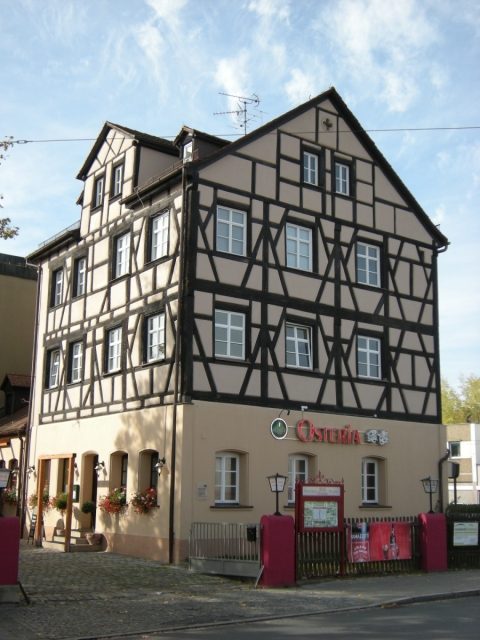
Linksches Castle

Restaurant

The small manor house was built as a summer residence in a garden already famous for its orange cultivation around 1700, and was depicted at that time in the "Nürnbergische Hesperiden" as "the upper small castle and garden in Mögeldorf". A very similar engraving by Johann Alexander Boener from 1707, however, is labeled as "the Linckische Garden-House in Mögeldorf". The estate was under the manorial lordship of the Löffelholz family and was probably granted as a hereditary lease.

From 1710 to 1729, Dr. Martin Linck (presumably from the Nuremberg legal family) is attested as the owner, then until 1739 his widow Margaretha Barbara. From 1740, Paul Canutius Leincker, a Nuremberg pharmacist, is named as the owner.

In 1779, Paul Canutius Leincker was succeeded as owner by Court Councillor Dr. Sebald Schütz (born 1746), who was married to a Leincker. He owned the property with the manor house, a gardener's house, a small rental house, and the Voithaus, as well as various farm buildings, around 1800.

The Schütz family sold the manor in 1825, which was still a hereditary lease of the Löffelholz family at the time, to the Mögeldorf building contractor Johann Michael Gößel. The buyer broke up the estate, sold many plots of land, and kept only the manor house and the castle garden for himself. However, the garden was later significantly reduced in size by the construction of the Ostbahn. Gößel had sold the remaining property in 1851 to Christoph Ruff from Rasch, who passed it on to the tailor Stephan Sippel in the same year. In 1856, new farm buildings were added to the manor house, before the sale to the paper manufacturer Christian Hahn followed in 1862.

With the subsequent sale to master mason Leonhard Huber and his wife Christina, there was a change of use: In 1864, the family converted the manor house into an inn (during this time, the half-hipped roof was probably replaced by the current low gable roof) and demolished the farm buildings to erect a dance hall building. Huber, however, died soon after, and his widow had to file for bankruptcy in 1868, which was followed in 1869 by the transfer to the innkeeper couple Johann Georg and Margaretha Wittmann. Leo Beyer reports on the great boom the inn experienced after it was taken over by the fruit merchant Johann Heinrich Herrmann in 1882.

In 1899/1900, the property changed hands several times again and came into the possession of the Fürth large brewery Humbser. While the hall building and the bowling alley were destroyed or at least significantly damaged in the Second World War, the manor house has been preserved to this day. During a facade renovation around 1956, the plaster skin was removed and the constructive half-timbering of the upper floors was exposed. Friedrich August Nagel assessed the existing building as the result of several early modern construction phases: already in the 1950s, he wished for investigations, as the construction and age of the former manor house "still posed riddles" to him. The building continues to exist as the "Volksgarten" inn to this day.

Take Mobile History with you

You are reading this text for free. Premium adds what matters on the road: descriptions read aloud, sites found through your camera, whole regions taken offline.

  • Every description, including the ~17,700 Premium sites
  • Audio guide: have descriptions read to you on location
  • AR finder: see sites through your camera, with distance and bearing
  • Unlimited saved sites

14 days free, then from €2.99 a month. Cancel anytime.

Source: Wikipedia · Licence: CC BY-SA 4.0 · Image: http://schloesserrundschau.de/bayern/schloesser01/nuernberg09.html

This description draws on the facts documented in the linked Wikipedia article; Wikipedia content is licensed under CC BY-SA 4.0. Wording and editing: Mobile History.

Location: 49.4595, 11.1313